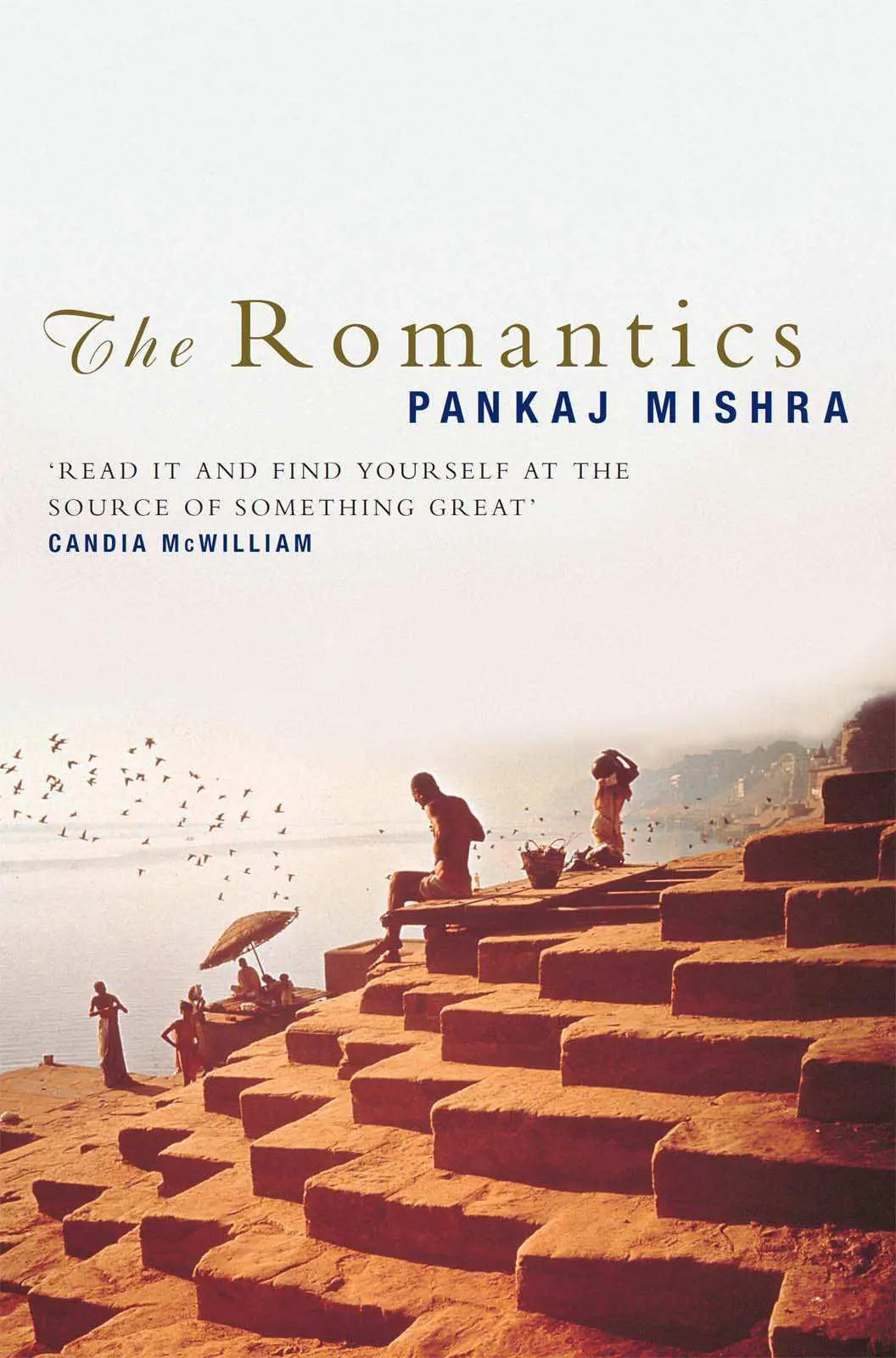
Pankaj Mishra - The Romantics
Здесь есть возможность читать онлайн «Pankaj Mishra - The Romantics» весь текст электронной книги совершенно бесплатно (целиком полную версию без сокращений). В некоторых случаях можно слушать аудио, скачать через торрент в формате fb2 и присутствует краткое содержание. Год выпуска: 2001, Издательство: Anchor Books, Жанр: Современная проза, на английском языке. Описание произведения, (предисловие) а так же отзывы посетителей доступны на портале библиотеки ЛибКат.
- Название:The Romantics
- Автор:
- Издательство:Anchor Books
- Жанр:
- Год:2001
- ISBN:нет данных
- Рейтинг книги:4 / 5. Голосов: 1
-
Избранное:Добавить в избранное
- Отзывы:
-
Ваша оценка:
The Romantics: краткое содержание, описание и аннотация
Предлагаем к чтению аннотацию, описание, краткое содержание или предисловие (зависит от того, что написал сам автор книги «The Romantics»). Если вы не нашли необходимую информацию о книге — напишите в комментариях, мы постараемся отыскать её.
The Romantics — читать онлайн бесплатно полную книгу (весь текст) целиком
Ниже представлен текст книги, разбитый по страницам. Система сохранения места последней прочитанной страницы, позволяет с удобством читать онлайн бесплатно книгу «The Romantics», без необходимости каждый раз заново искать на чём Вы остановились. Поставьте закладку, и сможете в любой момент перейти на страницу, на которой закончили чтение.
Интервал:
Закладка:
In the midst of this, Catherine was busy chatting with a couple of French tourists she had spotted in the lobby, backpackers wearing identical crimson anoraks. She seemed so distant and unfamiliar in her black overcoat and a stylish blue beret I had not seen her in previously.
I suddenly wished she was with me, and overcoming the pathos of my own vulnerability, I went and stood next to her.
She turned away from the tourists to look at me and smiled — a brief quizzical smile — and then turned back to them again.
My uneasiness deepened as we went in for lunch. The soft-hued interiors, the quiet conversations and subdued laughter at surrounding tables, the clink and clatter of spoons and forks, all intimidated me into a restive silence, and once again I sought strength from Catherine’s unfazed demeanour.
Among the strange faces at our table was that of one of the newly arrived Americans, a tall balding middle-aged man, a visiting scholar of Indian history. His wife was a stout and somewhat fidgety woman who kept going off in the midst of lunch to apply fresh coats of powder and lipstick, and came back each time seized by a fresh anxiety.
‘Andrew, Andrew,’ she would start, ‘I just wanted to say that the bathroom hasn’t been sterilized this morning.’ Or it would be: ‘Andrew, Andrew, I just wanted to say that Prakash hasn’t returned from the bazaar yet.’ Interrupted in the midst of a long story he had been telling the French tourists with great detail all through lunch — about the Maharaja of Jodhpur, whom he referred to as His Majesty — her husband would grunt and then ignore her altogether.
At one point, he turned to Catherine and asked her what she was doing in India and how much longer she planned to stay. Catherine told him. She also told him about Anand, describing him as ‘my Indian boyfriend’. He asked her more questions, and Catherine now went into a long litany of her anxieties regarding her return to France.
There were no good jobs to be had for people like her, who had waited too long after finishing their first university degrees. The universities were reducing their staff. There was little scope in publishing firms. It was why a lot of young people were going off to London or America to look for work. She blamed Mitterrand; she blamed socialism for the failing economy.
As she went on, sounding, I felt, quite overwrought, the French tourists kept shaking their heads in agreement. Once or twice, Catherine’s eyes met mine — the profound worry in them was unmistakable. The tourists said a few words in confirmation. Once, Andrew’s wife came down from her room to suggest a person in Paris who might help Catherine find a job. The conversation moved to Gorbachev and perestroika. The French tourists turned out to have strong views on this subject: they argued furiously with Andrew when he said that Yeltsin was the only hope for the Soviet Union.
*
Catherine said when we reached the house that she was tired and wanted a nap. She threw herself on the living-room sofa, and lay there all afternoon, curled up sullenly on her side, on the chocolate-brown silk cover, her hair falling in a thick mass almost to the carpet, exposing the delicate down on the nape of her neck.
I sat out on the sunny lawn. The deep midday stillness was disturbed only by strangled shouts from a basketball court and echoes of a recorded muezzin on a loudspeaker in the town below. I read The Leopard , and ambled through Sicilian landscapes in melancholy reverie.
Catherine emerged from her sleep several hours later to propose a walk. Bleary-eyed, she stood at the door to the living room, smoothing her hair and saying, ‘We have to go out anyway. We must call Miss West in Delhi and find out her plans.’
We did so. Miss West sounded cheerfully resigned on the phone, and inquired about her friend the maharaja, but also told us that she had been detained for a few more days and would not be able to reach Mussoorie until after we were gone.
Later, after the phone call to Delhi, we sat in a glass-roofed restaurant full of Punjabi vacationers from Delhi — the men in three-piece navy-blue suits, the women in glossy salwar-kameezes, the squabbling children in fluorescent Disney colours — and wondered how best to spend our time in Mussoorie. I was keen to go somewhere else and get away from the over-appointed house and the hotel, the maharaja and the American visitors, and so when Catherine suggested making an excursion to Kalpi, a riverside village she had heard of from one of her friends, I immediately agreed. We made inquiries at the local tourist information centre and were told there was a bus for Kalpi early next morning. We decided to take it.
Walking back from the mall, past the busy restaurants and the electronic beeps and peeps of video-game parlours to the forested hill, Catherine abruptly began to speak of Anand.
He was impractical, she said, and had no idea of what was in store for him in Paris. He thought it would be very easy to perform, to make albums, to be recognized, not realizing that people in Europe hang around on the fringes of the music world for years before they are noticed.
And so she went on in her soft strained voice until she suddenly stopped and said, ‘What do you think you would have done in my situation?’
It was the very first time she had asked me such a direct question, and it put me in a quandary. Until now, I had been merely a listener. Like Miss West, I had been a witness to her dissatisfactions; I had never actually wondered what I would do in her situation, simply because I couldn’t imagine it ever developing in my own life. Then, it wasn’t my place to offer advice. I didn’t know Anand well, and of Catherine I had only a broad fuzzy image in my mind. With her knowledge of literature, her instinct for style and elegance, she was the cultured European woman who for some half-understood reasons had chosen to live in Benares, and had, for even less well-understood reasons, fallen in love with an Indian man from a very different background and outlook.
Yet I felt I was called upon to say something, and I felt that this time, unlike on other such occasions in the past, I couldn’t get away so easily. I thought hard of something appropriate, Catherine quietly expectant beside me. But I could only remember my father’s homilies about the importance of detachment, homilies drawn from classical Hindu scriptures, and they were what I was just beginning to repeat before her, a little embarrassedly, when she impatiently interrupted me.
‘Are you saying I should be more detached from Anand?’ she asked.
She didn’t wait for my reluctant nod. ‘Yes,’ she said, with a new tone of zestful certainty in her voice. ‘That’s exactly what I have been thinking about recently. I have invested too much in Anand and I need more detachment. Yes, detachment is right, absolutely right.’
She fell silent as we trudged back to Landour on the leaf-strewn and flinty paths through the forest, our backs turned to the glorious chaos of colours on the western horizon, where the sun was slowly disappearing behind starkly outlined hills.
The light had turned an aquamarine blue when we reached the top of the Landour hill and strolled through the language school, where a couple of American students stood shining a torch over a spectacularly abscessed dog, on the way that went past the disused British cemetery. Snow lay thick on the paths in this densely forested part of the hill, where tall pines and oaks brood over the sad human waste of empire, the graves of very young women and children. Behind the trees glimmered the villages of the valley behind Mussoorie, the low, tin-roofed, wanly lit huts, which on moonless nights were like sallow gems scattered all across the dark folds of the hills. A sombre silence hung in the air, the silence of ageing trees and the dead, and the snow in the dark seemed to glow with a soft inner light.
Читать дальшеИнтервал:
Закладка:
Похожие книги на «The Romantics»
Представляем Вашему вниманию похожие книги на «The Romantics» списком для выбора. Мы отобрали схожую по названию и смыслу литературу в надежде предоставить читателям больше вариантов отыскать новые, интересные, ещё непрочитанные произведения.










Обсуждение, отзывы о книге «The Romantics» и просто собственные мнения читателей. Оставьте ваши комментарии, напишите, что Вы думаете о произведении, его смысле или главных героях. Укажите что конкретно понравилось, а что нет, и почему Вы так считаете.