Pankaj Mishra - The Romantics
Здесь есть возможность читать онлайн «Pankaj Mishra - The Romantics» весь текст электронной книги совершенно бесплатно (целиком полную версию без сокращений). В некоторых случаях можно слушать аудио, скачать через торрент в формате fb2 и присутствует краткое содержание. Год выпуска: 2001, Издательство: Anchor Books, Жанр: Современная проза, на английском языке. Описание произведения, (предисловие) а так же отзывы посетителей доступны на портале библиотеки ЛибКат.
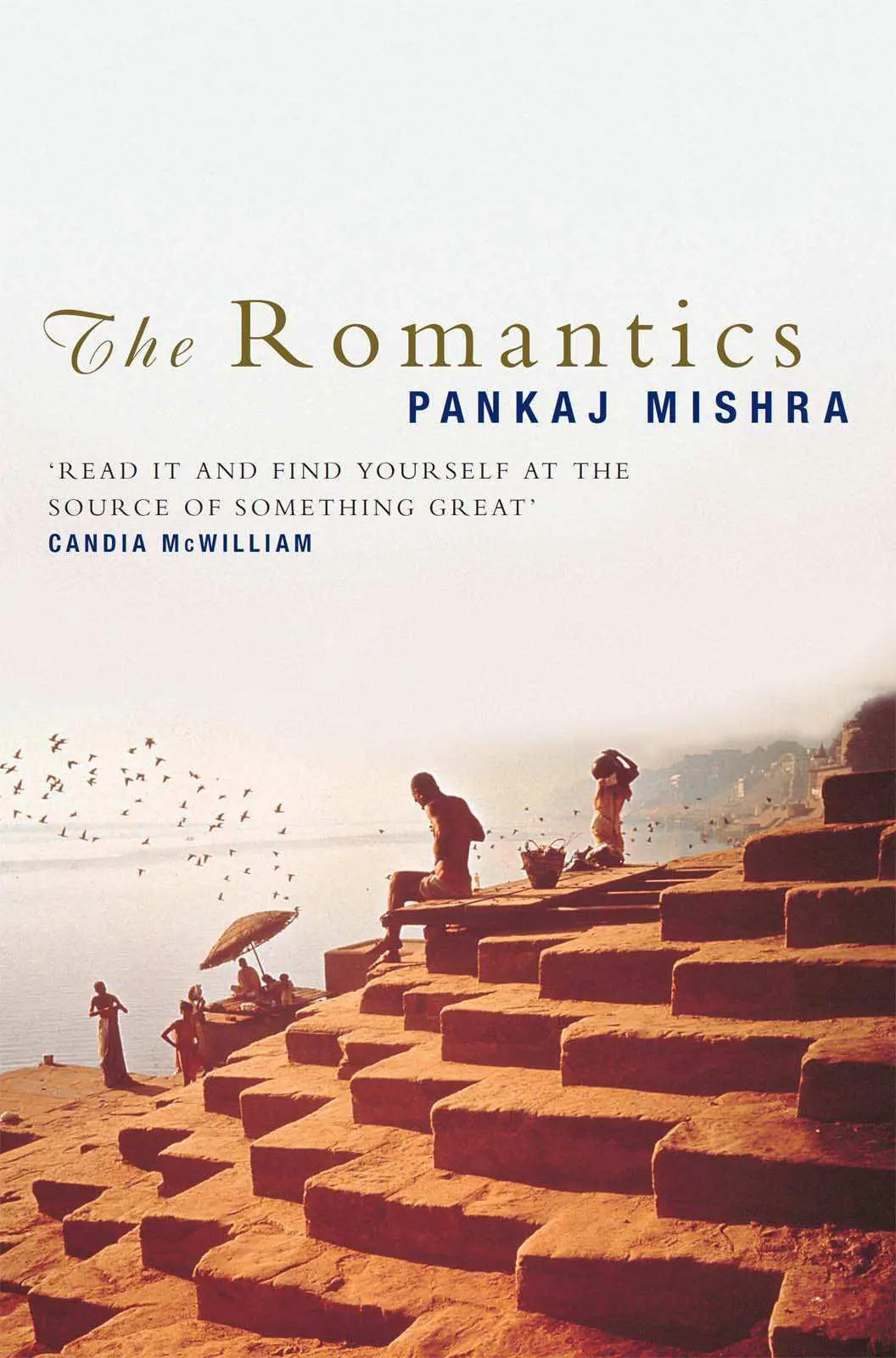
- Название:The Romantics
- Автор:
- Издательство:Anchor Books
- Жанр:
- Год:2001
- ISBN:нет данных
- Рейтинг книги:4 / 5. Голосов: 1
-
Избранное:Добавить в избранное
- Отзывы:
-
Ваша оценка:
The Romantics: краткое содержание, описание и аннотация
Предлагаем к чтению аннотацию, описание, краткое содержание или предисловие (зависит от того, что написал сам автор книги «The Romantics»). Если вы не нашли необходимую информацию о книге — напишите в комментариях, мы постараемся отыскать её.
The Romantics — читать онлайн бесплатно полную книгу (весь текст) целиком
Ниже представлен текст книги, разбитый по страницам. Система сохранения места последней прочитанной страницы, позволяет с удобством читать онлайн бесплатно книгу «The Romantics», без необходимости каждый раз заново искать на чём Вы остановились. Поставьте закладку, и сможете в любой момент перейти на страницу, на которой закончили чтение.
Интервал:
Закладка:
Gradually, with many incomprehensible mutterings, the chokidar brought in candles and logs of firewood, fresh sheets and quilts smelling of mothballs. Catherine knelt before the stone fireplace for a long time, striking matches one after another, before giving up. The wood was too damp. ‘We’ll have to do without the fire,’ she said, smiling, and gave a mock shiver.
The long drive had filled her with high spirits; she was amused by the chokidar — his slow mincing gait, his slurred speech — and attempted to mimic him when he was out of sight.
I was tired, and when Catherine went to the bathroom for a bucket-bath I lay down on the narrow double bed and soon dozed off.
I woke up to find the room in pitch-darkness — Catherine had blown out the candle — and Catherine next to me, her face buried deep into the pillow, the back of her neck with its delicate down gently rising and falling.
I lay there stiffly for a while, not daring to shift position lest I wake her up. The exhilaration of the ride hadn’t done away with the peculiar tension I had known in Mussoorie the day before, and I now felt even more keenly, lying next to Catherine, the somewhat comic strangeness of my situation: a Brahmin student from Allahabad all alone with a French woman in a room at the edge of the world.
This wasn’t how I had imagined ourselves when we first set out from Benares. In days past, when such vague and exuberant hopes accompanied me repeatedly to Catherine’s house, I hadn’t gone on to visualize such perfect proximity to her. Something had held me back: a puritanical fear, perhaps.
But it was a situation that seemed to have its own odd logic and momentum. I felt I had already surrendered to it, was no longer in control. My nervousness had been replaced by a quiet excitement.
*
I must have drifted back to sleep at some point. I opened my eyes to find Catherine moving around the room, searching for something, her shadow dark and looming in the light from the candle.
‘Would you like to go out?’ she said. ‘It’s wonderful outside.’
It was wonderful outside, the day dying in a sea of indigo ink; the snowy summits in front wreathed in cotton-wool clouds that caught the last light of the day and held a pinkish tinge; the tall hills behind us silently silhouetted against the darkening sky, where a star or two had begun to glimmer.
We walked up to the temple we had seen on the way up to the rest house. It was very small, shaded by an old oak tree, with elaborate and elegant wood carvings on the eaves. There was no one around, but the gate to the sanctum was open and the sequinned idol inside was of Krishna, purplish instead of the normal dark blue. A smell of freshly burned incense hung in the thin air. Moths whirled around the lantern that stood on the brick-paved porch. On the left of the temple was a storeroom of sorts, on stilts; behind it was a wooden lion’s-head gargoyle from which water, fed by a stream, gurgled out into a narrow drain.
Someone finally emerged out of the darkness. It was the priest; a young sadhu, an unexpectedly handsome man. His well-muscled torso was uncovered — astonishingly so, for the cold was intense. He wore a white dhoti over bare feet. There were marks of sandalwood paste on his broad forehead. His long black hair hung down over his shoulders. He saw us; his eyes lingered slightly longer on Catherine, but not a flicker of surprise crossed his fine sharp-featured face. We had come late for the evening puja, he said; it had just finished.
He spoke Hindi with a strong Sanskritic emphasis. There was grave courtesy in his manner. He invited us to sit on the porch and share his evening meal. Catherine hesitated, but he assured us there was enough food for all. In a few brisk precise movements, he brought out brass thalis from the storeroom and ladled out dhal and rice from large steel containers and filled chipped enamel cups with water from the gargoyle. We ate with our fingers. He apologized for not being able to offer us spoons or forks; he said the water came from a nearby spring and was safe to drink. He said little more of his own accord; he asked us no questions — no questions about where we came from, and what we were doing in Kalpi.
I asked him how long he had been at the temple.
‘For five years,’ he said, his head bowed over the thali, fingers nimbly mixing dhal with rice.
And where had he grown up?
‘Lucknow,’ he said, his mouth full. He then paused in his chewing and looked up at me with his clear confident eyes and added: ‘But that was another life, less meaningful, less substantial.’
He bowed his head; he went on eating. So beautifully he spoke, with such resonant Sanskrit phrases: they weren’t something he could have picked up in Lucknow; they spoke of a different kind of training. Intrigued, I asked him more questions. Slowly, the details came out, sketchy but significant; and it was with some difficulty that I translated them into English for Catherine’s sake.
He came from a middle-class shopkeeping family and had been conventionally educated at a local school and university. His parents had arranged a marriage for him when he reached twenty-one. He hadn’t wanted to get married, but his parents had been attracted by the large dowry that came with the bride. His wife died soon after marriage — he barely knew her, but it was a devastating event for him; it set him thinking about his life and made him question everything he had held to be true. With that growing estrangement from the world he had grown up in, he had begun frequenting temples and ashrams; he had started to read religious texts. Then one day he had left home and travelled with some sadhus to Gangotri, the source of the Ganges. He had wandered around for some months, staying at various ashrams, and then had come to Kalpi. Here, he had lived with the man who was previously the priest at the temple. The man was old and ailing. He had looked after him, and when he died, he had decided to stay on in the village.
Catherine, who hadn’t spoken at all until now, and had been struggling to eat with her fingers, asked me to translate a question for her. She asked: ‘Do you keep in touch with your parents and brothers?’
‘No,’ he said, his handsome face impassive in the light from the lantern. ‘When I left, I left those relationships behind me. I didn’t bring them here. They belong to the past.’
*
It was dark when we returned from the temple, moving slowly, with the aid of Catherine’s torch, down the steep, muddy slope, past sweet whiffs of Rajnigandha. The sky overhead was luminous with stars; the black hillsides, their outlines blended with the sky, were punctuated by the tiny, wan lights of kerosene lanterns; a dog somewhere nearby kept barking; the rope bridge was dark and still against the white glowing water.
Catherine said she wanted to sit by the river for a while. We took the narrow dirt path that led to the water, past scattered boulders and twists of pony excrement, and found a suitable place on one of the huge rocks just above the water. The river was calmer here. I sat next to Catherine, legs dangling over the rock, feeling a fine cold spray on my face.
We sat there for a while, without exchanging a word. I thought of what the sadhu had said about his rejection of the past. It had briefly reawakened a feeling that had come to me earlier in the day, the old, almost religious sense of the Himalayas as a refuge from the futility of life elsewhere. I thought of his earlier life, his grief on his young wife’s death, his wanderings in the mountains.
I could sense Catherine’s thoughts weren’t far away from the sadhu. After sitting silently for some time, I asked her, ‘What did you make of him?’
It seemed as if she had been thinking of him; she instantly replied, without turning her face, ‘He is a weird man.’
Читать дальшеИнтервал:
Закладка:
Похожие книги на «The Romantics»
Представляем Вашему вниманию похожие книги на «The Romantics» списком для выбора. Мы отобрали схожую по названию и смыслу литературу в надежде предоставить читателям больше вариантов отыскать новые, интересные, ещё непрочитанные произведения.










Обсуждение, отзывы о книге «The Romantics» и просто собственные мнения читателей. Оставьте ваши комментарии, напишите, что Вы думаете о произведении, его смысле или главных героях. Укажите что конкретно понравилось, а что нет, и почему Вы так считаете.