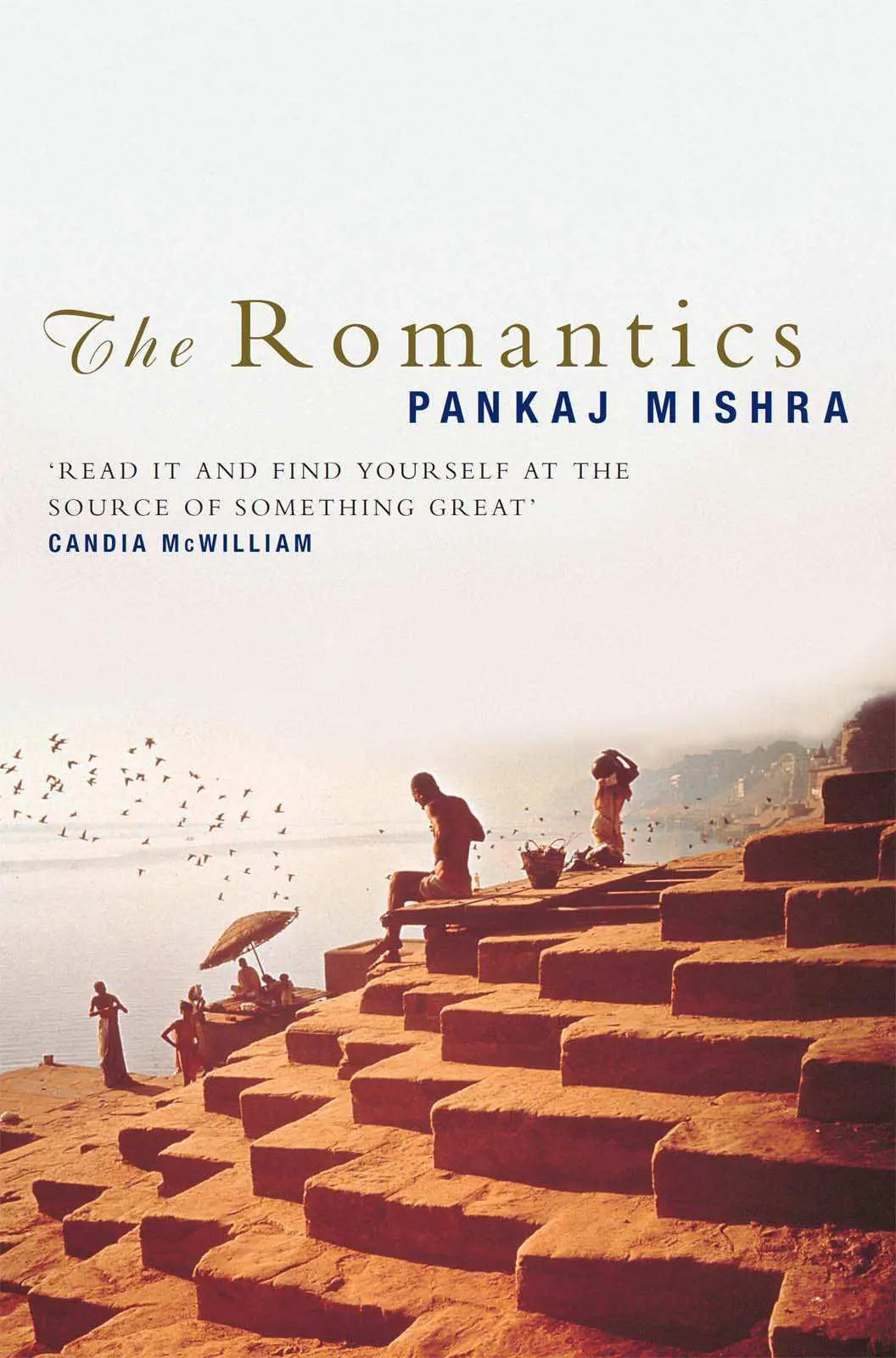
Pankaj Mishra - The Romantics
Здесь есть возможность читать онлайн «Pankaj Mishra - The Romantics» весь текст электронной книги совершенно бесплатно (целиком полную версию без сокращений). В некоторых случаях можно слушать аудио, скачать через торрент в формате fb2 и присутствует краткое содержание. Год выпуска: 2001, Издательство: Anchor Books, Жанр: Современная проза, на английском языке. Описание произведения, (предисловие) а так же отзывы посетителей доступны на портале библиотеки ЛибКат.
- Название:The Romantics
- Автор:
- Издательство:Anchor Books
- Жанр:
- Год:2001
- ISBN:нет данных
- Рейтинг книги:4 / 5. Голосов: 1
-
Избранное:Добавить в избранное
- Отзывы:
-
Ваша оценка:
The Romantics: краткое содержание, описание и аннотация
Предлагаем к чтению аннотацию, описание, краткое содержание или предисловие (зависит от того, что написал сам автор книги «The Romantics»). Если вы не нашли необходимую информацию о книге — напишите в комментариях, мы постараемся отыскать её.
The Romantics — читать онлайн бесплатно полную книгу (весь текст) целиком
Ниже представлен текст книги, разбитый по страницам. Система сохранения места последней прочитанной страницы, позволяет с удобством читать онлайн бесплатно книгу «The Romantics», без необходимости каждый раз заново искать на чём Вы остановились. Поставьте закладку, и сможете в любой момент перейти на страницу, на которой закончили чтение.
Интервал:
Закладка:
The train stayed on beyond its scheduled time for departure, well after the goodbyes had been said, and in the strange limbo that developed, communication first dwindled and then ceased altogether.
Anand looked increasingly glum, and when the train finally jerked into movement and began to slide down the platform, it was with a great effort that he held up his hand, as if drawing on his last reserves of energy, but did not wave.
The train picked up speed; dust blew in through the windows. Benares — this part of it newly developed and ugly — soon petered out in ponds of stagnant water and rows of corrugated-iron sheds and yards filled with rusty junked cars and trucks. The five burka-draped women with us in the compartment began to whisper among themselves. I heard the word ‘angrez’ — the all-inclusive term for foreigners. They were speculating about Catherine, who was sitting by the iron-barred window, gazing out at the darkening flat fields and ditches.
Night swiftly descended. A weak yellow light came on in the compartment. We clattered past a series of dark, deserted stations. Little points of light punctuated the blackness outside. Catherine didn’t shift from her position by the window. The Muslim women played cards, pale white arms and long, pink-painted fingernails darting in and out of their burkas.
It was still dark when we reached Dehradun and transferred to the small crowded bus that was to take us to Mussoorie. I sat next to a bleary-eyed Catherine, our bodies separated by a couple of inches, and touching when the bus driver took a sharp turn on the deserted sodium-lamp-lit road. A new, awkward intimacy ensued, reinforced by the curious backward glances of the army cadets in the row in front of us.
I must have dozed off soon afterwards, for when I woke up the bus was speeding along a brightly lit stretch of roadside petrol pumps and Catherine was asleep on my shoulder, the garish lights outside flickering across her face, her reposeful eyes and slightly open mouth. Careful not to disrupt her sleep, I sat stiffly on my seat, flinching each time the tyres hit a pothole, and watched the orange glow of dawn fringe the towering snow-capped green hills of Mussoorie. Most of Doon valley still lay under deep-blue shadows. But on Rajpur Road, the dew-drenched lawns of retired civil servants and army generals were beginning to glitter, and rolled-up newspapers on wide gravelled driveways patiently awaited their first readers.
Catherine blinked into wakefulness just as the bus began its groaning spiralling ascent to Mussoorie. We hadn’t spoken at all on the train. In any case, the loud clatter of the train’s wheels would have made it difficult to talk. We had retired to our bunks early. She now apologized for having gone to sleep on my shoulder. ‘I hope I didn’t stop you from sleeping,’ she said. I said she hadn’t. She smiled, and then in a sudden access of energy began gently to massage my slightly numb upper left arm. ‘Did you sleep well then?’ she pressed and asked. I lied again.
*
The air in Mussoorie, when we left the diesel-smelling warmth of the bus, felt chilly. Snow lay in grimy mounds on the side of the road. Coolies from Kashmir squatted around little charcoal braziers; thin columns of smoke rose into the crisp air from the tin-and-timber shacks huddled down in the valley. Outside shuttered shops stood men wearing thick mufflers and pyjamas, and brushing their teeth at municipal taps.
The house arranged by Miss West was on the large hill in Landour Cantonment. It was a substantial cottage with a white roof and green trim around the door and windows: in its size, scale and setting, it wasn’t like anything I could have imagined. Set in a large clearing of level, grassy lawn, and secluded by a thick screen of oak and pine trees, the cottage was the biggest on the hillside. From within, the large glass wall of the living room provided a panoramic view of Dehradun quietly smouldering in the wide and deep Shivalik valley. The valley itself was brilliantly visible, with enough dry riverbeds and green clumps of forests and hollow depressions to resemble a gigantic topographical map. Closer, down the hill, irregularly patched with snow, lay the doll’s-house-shaped Wynberg Allen School, and even lower, the cluttered slopes of downtown Mussoorie, the jumble of new hotels and restaurants. On the far left of the valley I could see the Ganges, hurtling past Hardwar on its furious descent from the Himalayas, but reduced, from such a distance, to a curled silver ribbon on a map.
And after all this, there was the house itself, the maharaja’s possession, with its rich oak panelling and gleaming kitchen and springy sofas and soft carpets and expensive stereo systems and televisions and large porcelain bathtubs.
Catherine seemed delighted by the house and the surroundings. ‘Miss West has some rich friends,’ she said as she dragged an armchair out to the lawn and settled herself in it.
I said nothing, but I felt vaguely oppressed by the opulence of the house and was unable to put any words to what I felt. Odd, meaningless thoughts floated in my mind as we sat there in perfect seclusion and quiet for some time. Dry leaves softly rustled as someone came down the path that ran behind the house. Once or twice, the sound of a bus or truck horn came piercing through the clean air. Overhead, in the blue, birdless sky, the white clouds were like wisps of shaving foam.
The sense of oppression grew when we went for lunch. Before that, the caretaker of the house had come round while Catherine was taking a shower. I heard footsteps behind me and turned to see a short old man in faded khaki shirt and pants limping across the lawn. I stiffened in my chair, suddenly vulnerable, suddenly feeling myself more and more of a usurper in this setting. The man frowned at me as he came nearer; his small scaly face held a question mark. When I told him that we were guests of Miss West, he smiled; a wide, obsequious smile that added more folds to his reptilian face.
We were to eat at a nearby hotel. Miss West hadn’t wanted to bother with cooking during her time in Mussoorie. The hotel was owned by the same maharaja who owned the house we were in. It was his own mansion — built in Swiss chalet style, with gables and fretwork — that he had converted into a hotel after the government of India stopped paying privy purses to the former maharajas. That’s what Miss West had told me, the maharaja and the mansion seeming very much a part of the glamour of India for her.
I expected her to have informed the maharaja of our arrival. But he knew only of Catherine — he bowed and flashed a wide smile at her and asked her if everything was all right at the house. His response to my presence took me completely by surprise.
‘So you are a tour guide with Miss Catherine? From Delhi?’ he asked, in gruff Hindi, of the kind I later heard him use with the menial staff. His eyes were large below bushy eyebrows. His thick moustache was unwaxed and drooping and flecked with grey.
Tour guide? I recovered to say, ‘No, why do you think that?’
But he only nodded; he wasn’t listening, and his staff took their cue from him. The manager, a tall, ramrod-stiff military type, insisted that I put down my name in capital letters in the hotel register. ‘What is this handwriting, please? I am not being able to read anything. Please write clearly. We need the name for police record.’
Turbaned bellboys wore smiles of mockery as I complied. They were still smiling when a cavalcade of dusty Dodge Caravans and Land Rovers with blue diplomatic licence plates came crunching up the gravel driveway. They shuddered over the cattle grid and then slid to a halt under the gabled portico. Children in rumpled clothes poured out, followed by weary-looking adults. Twangy American accents filled the small forecourt. The maharaja, pouting over the newspaper, snapped to attention; so did his staff. The manager abandoned his peremptory military manner behind the desk. He roared at the bellboys, and rushed to the cars to supervise the unloading of the luggage.
Читать дальшеИнтервал:
Закладка:
Похожие книги на «The Romantics»
Представляем Вашему вниманию похожие книги на «The Romantics» списком для выбора. Мы отобрали схожую по названию и смыслу литературу в надежде предоставить читателям больше вариантов отыскать новые, интересные, ещё непрочитанные произведения.








Обсуждение, отзывы о книге «The Romantics» и просто собственные мнения читателей. Оставьте ваши комментарии, напишите, что Вы думаете о произведении, его смысле или главных героях. Укажите что конкретно понравилось, а что нет, и почему Вы так считаете.