Pankaj Mishra - The Romantics
Здесь есть возможность читать онлайн «Pankaj Mishra - The Romantics» весь текст электронной книги совершенно бесплатно (целиком полную версию без сокращений). В некоторых случаях можно слушать аудио, скачать через торрент в формате fb2 и присутствует краткое содержание. Год выпуска: 2001, Издательство: Anchor Books, Жанр: Современная проза, на английском языке. Описание произведения, (предисловие) а так же отзывы посетителей доступны на портале библиотеки ЛибКат.
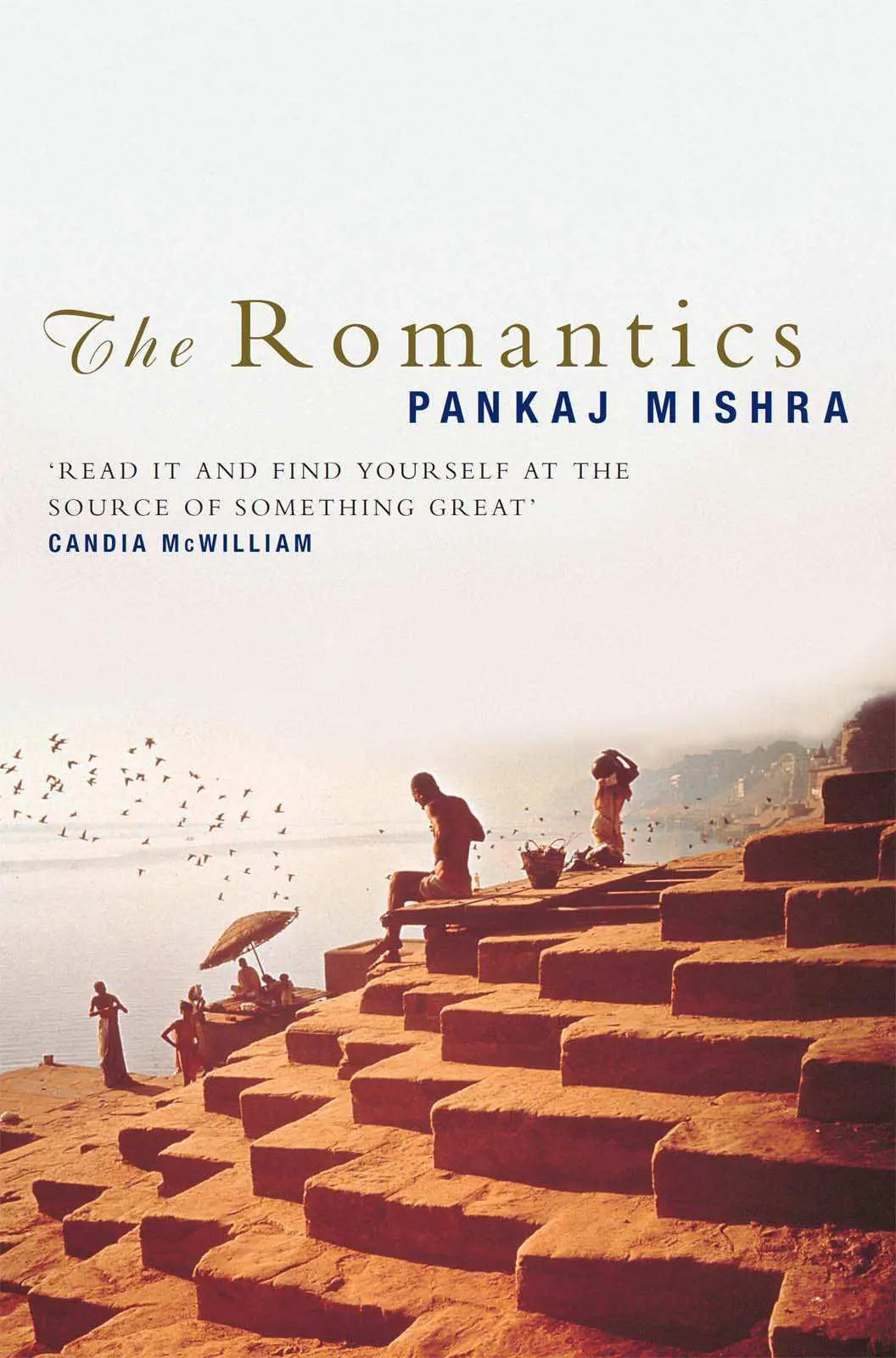
- Название:The Romantics
- Автор:
- Издательство:Anchor Books
- Жанр:
- Год:2001
- ISBN:нет данных
- Рейтинг книги:4 / 5. Голосов: 1
-
Избранное:Добавить в избранное
- Отзывы:
-
Ваша оценка:
The Romantics: краткое содержание, описание и аннотация
Предлагаем к чтению аннотацию, описание, краткое содержание или предисловие (зависит от того, что написал сам автор книги «The Romantics»). Если вы не нашли необходимую информацию о книге — напишите в комментариях, мы постараемся отыскать её.
The Romantics — читать онлайн бесплатно полную книгу (весь текст) целиком
Ниже представлен текст книги, разбитый по страницам. Система сохранения места последней прочитанной страницы, позволяет с удобством читать онлайн бесплатно книгу «The Romantics», без необходимости каждый раз заново искать на чём Вы остановились. Поставьте закладку, и сможете в любой момент перейти на страницу, на которой закончили чтение.
Интервал:
Закладка:
He got up and paced the room, the laces trailing on the floor. He stopped before the table and stared at the pile of books on it. His voice softened when he spoke again. ‘Have you read Iqba¯l?’ he asked.
I said no, a bit surprised. He had previously asked me about Faiz. His interest in Iqba¯l, the poet advocate of Islamic Pakistan, was even odder.
He extracted a slim book from the pile on the table and leafed through its Bible-paper-thin pages.
I was exhausted from all the running, and the memory of the policeman’s awful bloody wound was still fresh; at the back of my mind was the fear that the policemen would decide to raid all the hostels in the campus. I was eager to get out of the campus as fast as I could. And so I barely listened to what Rajesh recited. But stray words from the poem stayed in my memory, along with their gloomy sentimentality, and I recently found an English translation of the poem.
Love fled, Mind stung him like a snake; he could not
Force it to vision’s will;
He sought the orbits of the stars, yet could not
Travel his own thoughts’ world;
Entangled in the labyrinth of his learning,
Lost count of good and ill;
Enchained the sunbeams, yet his hand no dawn
On life’s dark night unfurled.
8
IT WAS AROUND THIS TIME that Catherine’s friends from France began to appear at her house. They would come in groups of two and three, leave after a few days and then come back again after a week or so. The chaste spaces of Catherine’s rooms, still without furniture, came to be littered with grubby backpacks, empty Perrier bottles, bundles of laundry, old copies of Le Figaro and L’Express and Newsweek in Air France folders.
She had known these friends as fellow students during her undergraduate years at the Sorbonne. Nearly all of them had been active in left-wing student movements, with a special interest in Third World causes. It was Catherine who told me this. I think she was eager to establish the credentials of her friends. So that when I saw them first, they were inseparable in my eyes from those massive French demonstrations led by Danielle Mitterrand that made it occasionally to the front pages of Indian newspapers.
After just a few years out of college, they had taken good jobs in various fields. When Catherine said this to me soon after the first of them arrived at her house, I had to ask her what she meant, and I noticed a tinge of envy in her voice and manner as she listed their flourishing careers in advertising, journalism, design and so forth. I now see that she must have felt left behind in Benares; that meeting old friends with new and varied accomplishments in their recent past would have aroused an old student competitiveness within her.
In their company, Catherine became a vivacious yet somewhat remote person. She and her friends spoke among themselves in English, out of consideration for Anand and me. But she would frequently lapse into rapid-fire French in the middle of a conversation. The effect was disconcerting, and not the least because I already felt disconnected from the conversation, from the names of unseen cities and cafés and films tripping off their tongues.
Faced with such mature experience of the world, such casual yet intimate knowingness, I felt the fragility of my own personality, my lack of opinions and taste.
Catherine did make several attempts to bring me closer to her friends. With Anand, her friends’ attitude could only be that of an interested and kindly patron. He had nothing to say to them. They were bored by Indian classical music and sat through the couple of private performances Catherine persuaded Anand to give only because it would have been rude to leave. She felt that I was the Indian friend she had in Benares with whom they could profitably converse. She enthusiastically introduced them to me, describing me as an ‘intellectual’ — a word so quintessentially of Paris that it embarrassed me. But in using it, Catherine was probably hoping only to set off some sort of frank exchange.
However, things didn’t turn out that way. I knew so little about her friends, and I had no means of finding out more. Catherine had made me think of them as people concerned about the Third World. The simpler truth was that they had moved on from their student days to professional careers; their visits to India, on Catherine’s repeated invitation, were in the nature of safe adventures, forays from secure positions into the unknown world for which they had once possessed an abstract political passion.
But I didn’t know this then. Whatever else I knew of their social and intellectual background came to me from books, from the nineteenth- and early twentieth-century utopian philosophers I had been directed to by Edmund Wilson, the American critic, whose books I was then reading at the library. The dated and mostly irrelevant knowledge I possessed only confused me further; it made me look for meaning and nuance where none existed.
Almost the same kind of book-created confusion existed on their side. I recall one episode with particular clarity. Seconds after we were introduced, one of Catherine’s friends — Jacques, a tall shambling man with a permanently aggrieved expression on his face — had set about interrogating me about Gandhi. It took me some time to figure out what he meant by his questions, and by then it was too late to go back to basic history.
In the vision that had come to him from books and films, every Indian was axiomatically a Gandhian, and the country on the whole an Edenic setting of self-sufficient villages and their cotton-spinning non-violent inhabitants. His great desire was to explore the ‘real’ India — the Gandhian India, as opposed to the ‘fake’ India he said lazy tourists saw.
I had lived in India all my life, but I couldn’t divide it up between the tourists and the Gandhians. Jacques’s way of looking at India intrigued me. I felt, as I often did with Catherine, that he was bringing a larger vision to something that had grown overfamiliar. I wished to enter that vision, to see things the way he would see them, and I felt oddly protective about him when I heard — from Anand — that he had had a hard time on his travels. He had left Benares with the intention of finding this Gandhian India, and was ready to sacrifice all comfort and luxury to this end. He had returned a fortnight later, sick and feeble with food poisoning and dysentery. The horrors of semi-urban and urban India, Anand said, had repelled him so profoundly, that within the very first week he had shed his ascetic resolve and sought refuge in those very same sanctuaries of five-star hotels he had earlier derided.
My encounters with Catherine’s other friends were equally unsuccessful. Once past the barrier of language (they spoke English with considerable difficulty and with a heavy, almost incomprehensible accent), our conversations floundered in prejudice and artifice. Most of them couldn’t think of India as anything other than an exotic hotbed of illiteracy, poverty and religion: they would come back from their travels around Benares, speaking excitedly of sadhus who had been standing on one leg for ten years, of beggar children without limbs and of the huge rats scurrying about in the alleys.
In trying to correct their notions of India, I became false to myself and others. I turned into a performer, one eye and ear always open for Catherine. I became eager to flaunt my book-learning, and I dropped names right and left: Nietzsche, Mann, Proust, James, Kierkegaard, Pascal. I was keen to demonstrate that I had read them all and, what’s more, remembered everything I had read.
I couldn’t tell how far I succeeded in impressing them. Perhaps very little. For their attitude remained one of gentle condescension, some of which I sensed, and thus became even more aggressively knowledgeable about everything. I remember, in this regard, a brief argument with one of Catherine’s closest friends, Claire, a thin, bony woman with close-cropped hair. She claimed to be in love with England and Englishness; and she had found them best represented, she told me, in Evelyn Waugh’s Brideshead Revisited . I had read the novel, and found only the first part somewhat accessible. The later descent into Catholic theology had left me perplexed; people and motivations had grown suddenly obscure, even preposterous. Then, recently browsing through the dusty stacks at the BHU library, I had come across Edmund Wilson’s famous attack on the novel, and much of it had struck me as true and just. I repeated before Claire some of Wilson’s arguments, only to elicit from her this retort: ‘Who is Edmund Wilson?’ I said he was an American critic, to which she said, ‘You know, you must never trust an American on these matters. What do they know about European literature? Nothing. Why are you Indians reading these Americans?’
Читать дальшеИнтервал:
Закладка:
Похожие книги на «The Romantics»
Представляем Вашему вниманию похожие книги на «The Romantics» списком для выбора. Мы отобрали схожую по названию и смыслу литературу в надежде предоставить читателям больше вариантов отыскать новые, интересные, ещё непрочитанные произведения.







Обсуждение, отзывы о книге «The Romantics» и просто собственные мнения читателей. Оставьте ваши комментарии, напишите, что Вы думаете о произведении, его смысле или главных героях. Укажите что конкретно понравилось, а что нет, и почему Вы так считаете.