Pankaj Mishra - The Romantics
Здесь есть возможность читать онлайн «Pankaj Mishra - The Romantics» весь текст электронной книги совершенно бесплатно (целиком полную версию без сокращений). В некоторых случаях можно слушать аудио, скачать через торрент в формате fb2 и присутствует краткое содержание. Год выпуска: 2001, Издательство: Anchor Books, Жанр: Современная проза, на английском языке. Описание произведения, (предисловие) а так же отзывы посетителей доступны на портале библиотеки ЛибКат.
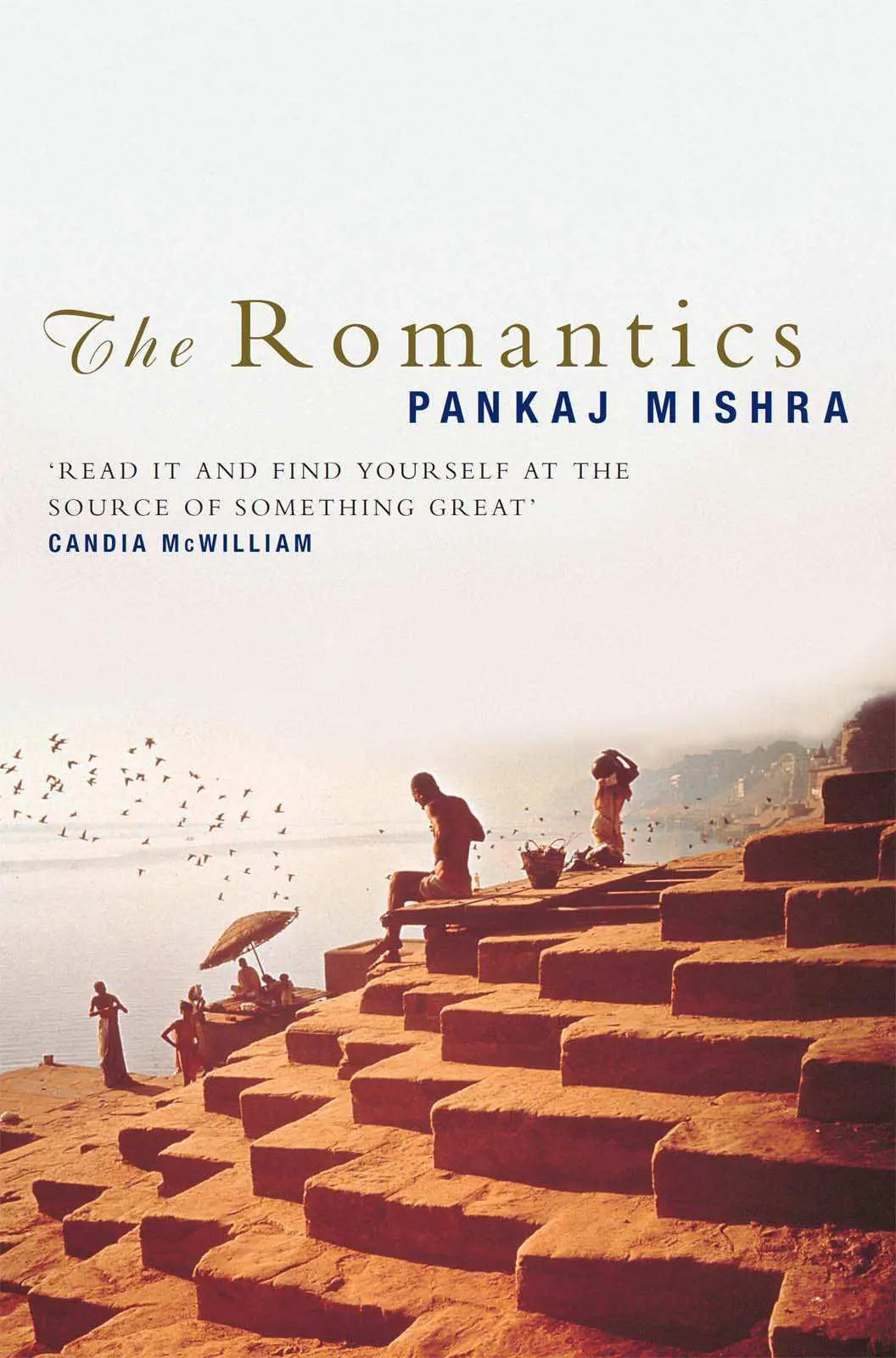
- Название:The Romantics
- Автор:
- Издательство:Anchor Books
- Жанр:
- Год:2001
- ISBN:нет данных
- Рейтинг книги:4 / 5. Голосов: 1
-
Избранное:Добавить в избранное
- Отзывы:
-
Ваша оценка:
The Romantics: краткое содержание, описание и аннотация
Предлагаем к чтению аннотацию, описание, краткое содержание или предисловие (зависит от того, что написал сам автор книги «The Romantics»). Если вы не нашли необходимую информацию о книге — напишите в комментариях, мы постараемся отыскать её.
The Romantics — читать онлайн бесплатно полную книгу (весь текст) целиком
Ниже представлен текст книги, разбитый по страницам. Система сохранения места последней прочитанной страницы, позволяет с удобством читать онлайн бесплатно книгу «The Romantics», без необходимости каждый раз заново искать на чём Вы остановились. Поставьте закладку, и сможете в любой момент перейти на страницу, на которой закончили чтение.
Интервал:
Закладка:
For centuries after Akbar, my ancestors had remained wealthy landowners in the flat lands enclosed by the foothills of the western Himalayas. During all that time, the turbulent history of medieval India touched them little. My own knowledge of that past went only as far back as my great-great-grandfather, in the last century, but I can’t imagine his own ancestors deviated much from the well-worn Hindu grooves in which he and his son and grandson spent their own lives: studentship in Benares, adulthood and marriage, late-middle-age detachment and then the final renunciation followed by a retreat to the Himalayas.
With India’s independence in 1947, this regulated life was unravelled with bewildering speed. My grandfather and his sons found themselves thrown into the new ruthless go-getting world of independent India with none of their old certainties intact. Successive land reform legislation undermined the family’s assets to the point where ancestral jewellery had to be pawned off to pay for the education of my father and his brothers. There was a time when neither studentship nor marriage seemed a possibility.
My father grew up knowing both a kind of feudal grandeur and shameful penury. From a life of secluded leisure, he was catapulted into the ranks of desperate millions seeking jobs under the new regime. I did not know until after my mother’s death how deeply marked he was by that period of difficult transition.
In time, the years of struggle were left behind. He joined the Public Works Department (PWD); he worked his way to a kind of middle-class security and equilibrium. But he never spoke about his early years. Once, in an uncharacteristic burst of nostalgia, he mentioned the caparisoned elephants he rode to his grandmother’s village. On another occasion, he spoke of the time Pandit Nehru had come to the family house to borrow a horse from the stables. These memories alone came to represent for me the life he had known as a child.
For me, born in 1969 and growing up with cricket, the books of Enid Blyton and Tintin comics, there could be no such memories. That past of my father — and also my mother, whose family had suffered a similar upheaval — was very far away from the series of PWD bungalows and mediocre Christian-run schools in which I had spent my childhood. The serenity of the old Brahmin world in which his family had lived for centuries was even more remote from me. I had an intimation of it on Sunday mornings, when my father, freshly bathed and bare-torsoed, would sit on a tiger skin rug before a fragrant fire of sandalwood and recite Vedic hymns in an approximation of a much grander ritual his ancestors had performed for millennia. I felt great reverence and awe for these ancient practices. But at the same time I could feel my own life had drifted apart from them; it had attached itself to another constellation of desires and reverences.
I had the sharpest sense of this at the time of my mother’s death. My mother had chosen to live in an ashram in Benares when she knew that she didn’t have much longer to live. Her decision was in line with an immemorial Hindu belief that to die in Benares was to be released from the cycle of rebirths; it couldn’t be argued with.
Before I could arrive in Benares, she died and had to be cremated quickly. I was secretly relieved to be spared of my duties in this regard. I couldn’t have coped with the physical facts of a Hindu cremation — the cold flesh, the open-mouthed grimace, the bridal gaudiness inflicted on the helpless female corpse, the breaking of the skull with a bamboo pole. It would have intruded too much into the memories I had of my mother, this neglected figure of my childhood, her happy flushed face and eager embrace as I arrived home for the school holidays, the sad fragrance and reticulated feel of her forehead as I kissed her goodbye a few weeks later, both of us restraining our tears under the disapproving gaze of my father.
I was alone in my grief now; whatever emotion my father felt, he was unlikely to share it with me. I went by myself to the room in the ashram where my mother had spent her last years, slowly subsiding into a mist of religious piety and illness. It was where I had once seen her tiny figure huddled on the bed, quietly crying to herself. That was also the time when she first told me — out of what depths of desolation, I now wonder — that she did not wish to live any longer; and I, though taken aback, had taken after her husband, who thought her incapable of independent thought, had not really believed she knew what she was saying. In that room, devoid of furniture and resonantly silent, there was now an altar of sorts. Bouquets of fresh flowers and incense sticks — a special tribute to my mother from the ashram’s inmates — stood on a table before a newly framed picture of her. For as long as I could remember, she had refused to have her picture taken; my father had chosen for this commemorative moment a very old photograph of hers, one that I had never seen. It showed her in her graduation robes and cap, cradling her rolled-up degree, her face — as was the preferred pose in the 1950s — in half-profile, with the beginnings of an uncertain smile, the smile of the marriageable girl student who has already had an intimation of the savourless life in store for her.
Standing in that room, I thought of my mother’s various kindnesses to me, the jars of home-made snacks and sweets she would bring to my school, the rupee notes she would push into my pocket when my father wasn’t looking. I remembered the letters she would write in her large-eyed script, overflowing with maternal anxiety. It was only after these memories exhausted themselves that my attention turned to other things, and I began to notice her various personal effects that had been transferred to this room, everyday items that death had raised to the status of memorabilia: the cloth-bound volumes of the Ramayana and Mahabharata and the collected works of Saratchandra and Tagore, her diary with its accounts and laundry lists, old issues of the religious magazine Kalyan , rosary beads in a frayed velvet pouch, small idols of Krishna and Rama.
These things had accompanied her all her life; they had made up her world; but it was not until I came across the heavily annotated Hindu calendar she kept hung in her room all her life that I realized how inviolably whole that world had been to her. It had been a realm of existence over and above her sorrows and disappointments on the material plane, a world with its own rhythms and seasons, virtues and habits. Magh, Aasharh, Phagun, Sankrant, Amavasya, Nau Ratri: the sonorous poetry of these Sanskrit names, the musical chiming of these months, festivals and fasting days — they had brought a subliminal order to her time on earth; they had measured out, and made bearable, her life.
But how alien those names sounded to me! How hard it was in that room, facing that calendar, my mother’s possessions all around me, the soft chanting of the ashram’s inmates wafting in through the open windows, to deny the knowledge that the past that had given shape and coherence to my parents’ lives was no longer available to me.
I was very much on my own: this was what my father sought to convey to me in the days that followed my mother’s death. Until then, I had never exchanged more than a few words at a time with my father. He had been the same with my mother. Practical matters were briefly discussed before both withdrew into their respective private worlds. He had been a less distant figure when I was still a child; I remember him reading me stories from the Mahabharata , and explaining to my young, uncomprehending mind the complex dialogue between the sage, Yajnavalkya, and his wife, Maitreyi, in the Brihadaranyaka Upanishad about the illusoriness of love and attachment. But he was by nature a reticent man, and his reticence grew with time.
Читать дальшеИнтервал:
Закладка:
Похожие книги на «The Romantics»
Представляем Вашему вниманию похожие книги на «The Romantics» списком для выбора. Мы отобрали схожую по названию и смыслу литературу в надежде предоставить читателям больше вариантов отыскать новые, интересные, ещё непрочитанные произведения.







Обсуждение, отзывы о книге «The Romantics» и просто собственные мнения читателей. Оставьте ваши комментарии, напишите, что Вы думаете о произведении, его смысле или главных героях. Укажите что конкретно понравилось, а что нет, и почему Вы так считаете.