Pankaj Mishra - The Romantics
Здесь есть возможность читать онлайн «Pankaj Mishra - The Romantics» весь текст электронной книги совершенно бесплатно (целиком полную версию без сокращений). В некоторых случаях можно слушать аудио, скачать через торрент в формате fb2 и присутствует краткое содержание. Год выпуска: 2001, Издательство: Anchor Books, Жанр: Современная проза, на английском языке. Описание произведения, (предисловие) а так же отзывы посетителей доступны на портале библиотеки ЛибКат.
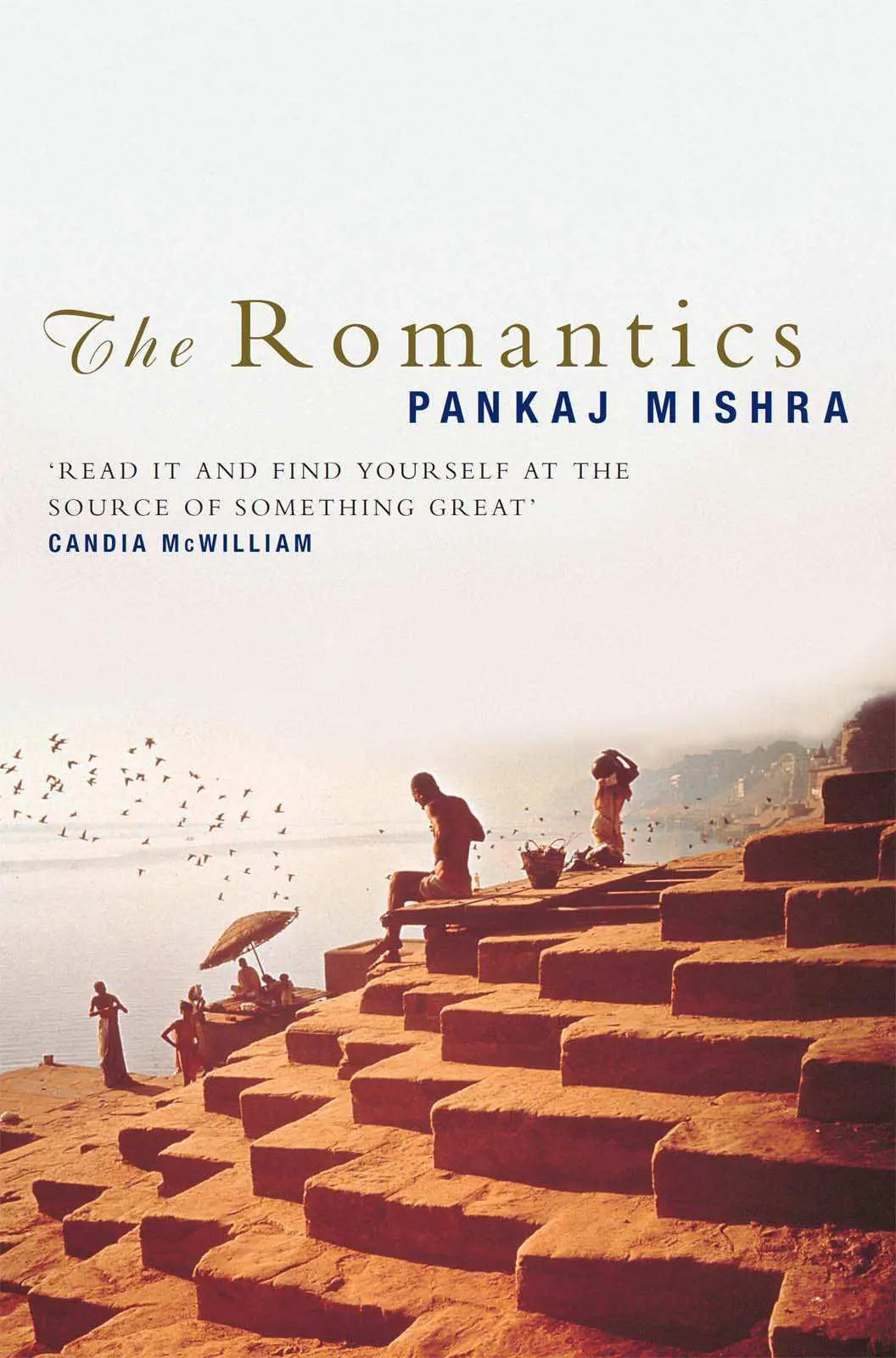
- Название:The Romantics
- Автор:
- Издательство:Anchor Books
- Жанр:
- Год:2001
- ISBN:нет данных
- Рейтинг книги:4 / 5. Голосов: 1
-
Избранное:Добавить в избранное
- Отзывы:
-
Ваша оценка:
The Romantics: краткое содержание, описание и аннотация
Предлагаем к чтению аннотацию, описание, краткое содержание или предисловие (зависит от того, что написал сам автор книги «The Romantics»). Если вы не нашли необходимую информацию о книге — напишите в комментариях, мы постараемся отыскать её.
The Romantics — читать онлайн бесплатно полную книгу (весь текст) целиком
Ниже представлен текст книги, разбитый по страницам. Система сохранения места последней прочитанной страницы, позволяет с удобством читать онлайн бесплатно книгу «The Romantics», без необходимости каждый раз заново искать на чём Вы остановились. Поставьте закладку, и сможете в любой момент перейти на страницу, на которой закончили чтение.
Интервал:
Закладка:
It was peculiarly disquieting to hear all this. I had no awareness of how the music industry worked, but felt that the success Anand projected in his immediate future couldn’t be so easily achieved. I thought he had very little sense of the world he was about to enter, and, watching the hopeful unclouded expression in his eyes, I couldn’t help feeling — as on that first visit to Catherine’s house — a sense of wrongness and incongruity.
But it was too late to withdraw. Without quite realizing it, I had become addicted to their company; it was the regular fix I needed in addition to my daily visits to the library. I went often to Catherine’s house, and stayed for long periods. The sadhu with matted hair in the alley outside her house and the halwai with the enormous paunch in his sooty sweetshop became familiar, reassuring figures. But these visits weren’t without their secret torments: I saw in Anand’s serenity the serenity of a sexually satisfied man, and I was often pursued, after leaving their house, by dark imaginings of that unknown part of his relationship with Catherine, its physical side. These imaginings were limited and made yet more intense by my own lack of experience. But they gave an edge to my impressions of Catherine, to her soft voice and to her face that seemed to change its appearance every time I saw her; and another layer of awkwardness was created between us.
In any case, I didn’t speak much. I would tell Catherine about my recent discoveries at the library — and that was all I had to offer by way of conversation. I mostly listened to their plans and anxieties about the present and the future, their disagreements, their playful bantering.
I can see now that for Catherine and Anand I had my role cut out. They were so self-contained and content when in each other’s company, but like all couples, they needed witnesses from the external world, and in this most tradition-minded of Indian cities, the presence of people like Miss West and myself was to them an important fact; it was a positive endorsement of their new fragile status as an unmarried couple. Catherine barely knew anyone in Benares apart from Miss West, Mark and a few French semipermanent residents I would see occasionally, middle-aged harassed-looking men wearing pony-tails and earrings. Anand, too, had few friends in Benares: timid, depressed-looking sitar or tabla players who would sometimes be at Catherine’s house, hunched over in one corner, not saying much, unsure of what to make of Catherine or, indeed, Anand. I now see how his relationship with Catherine, a rich European woman, must have put a strain on these older relationships in Benares; it would have set him apart from the people he knew among the musical fraternity, most of whom lived improvised lives in the poorer quarters of the city.
But there were my own needs. I had no friends: growing up alone, I had developed no skills for intimacy, or even ordinary camaraderie; friendships seemed to require from me a degree of self-abnegation I could not achieve. However, a large part of the loneliness I had increasingly come to feel had been offset by my obsessive reading, the regard I had for the life of the mind. With each book, I entered into what I felt to be an exalted bond with its writer, to whom I gave all the care and attentiveness I could not bring to human relationships.
But as I grew older the substitution of books for friendship had seemed to work less and less. In truth, I had been lonely for a very long time. In Benares, the unexpected company first of Miss West and then of Catherine had only made the fact more apparent to me — a fact that never struck me with greater poignancy than when I knocked on Catherine’s door, and the sound of the heavy iron bolt struck against the old bleached wood travelling up the empty stairs seemed to carry some of my loneliness. It explained the speed with which I grew to cherish the long evenings in Catherine’s house, in the room filled with smoky blue light, the fluorescent tube outside flickering away as usual, and the pigeons periodically responding to unseen provocations by exploding into the dusk.
So it was that I began to dislike leaving her house late in the evening and walking up three flights of stairs to find my tiny room in darkness and, when I switched on the weak bulb, all my things in it exactly as I had left them: the books slumped on the table with the markers jutting out, and crammed into the octagonal niches; the pyjamas spread-eagled on the bed where I had thrown them; the Hawaiian slippers flung beneath the chair where I had changed into shoes; the postcard picture of Proust on the window sill where I had put it up several weeks ago. It was as though I had expected them to have changed position during my absence; that they hadn’t was proof of the loneliness and boredom I increasingly felt when in that room.
6
IN THE YEARS SINCE THEN, I have often thought about the evening of Miss West’s party. I have wondered about the strange emotion I felt the morning after, standing alone on the roof, Miss West having drugged herself into sleep after an anguished night. It has taken me time to see that the loneliness I was to know later, when I returned to my room from Catherine’s house, was only another aspect of that earlier emotion.
So little did I know any of the people present at the party that in the brief time I had seen them they became even more mysterious to me. I was tormented by my ignorance. I wanted to know more; I wanted to know everything about them. The knowledge was one way of dealing with the troubled, if undefined, sense I had after the party, a sense of the largeness and diversity of the world, and a simultaneous awareness of how little of it was accessible to me, how someone like me — someone with no money or clear prospects — was placed at its remotest fringes.
The reality of my position was made more apparent by Debbie’s reply when I asked her what she was doing in Benares. ‘Passing through,’ she had said, and the words had stayed with me. They had suggested a kind of perpetual journeying through the world, a savouring of life in a way I had no means of knowing, the life itself seeming — as it did in the pictures in Miss West’s room — unimaginably adventurous.
And the more I knew of it, the more inadequate I felt. I knew nothing of Miss West, but had presumed to see sadness and disappointment in her past: this was the romantic idea that had been spawned by the idle solitude of those fog-bound first days in Benares. That morning after the party, gazing at the pictures in Miss West’s room — the pictures that spoke to me of the pleasures of untroubled prosperity — I was given a truer idea of Miss West, and it had brought with it only more pangs of loneliness and self-pity.
*
So many tangled roots our personalities have: the social and emotional circumstances of our early years, of our parents’ lives, and, if you go back even further, of our ancestors’. In some sense, the emotion I felt that morning after Miss West’s party, although never fully defined, had always been with me. It had cast its shadow upon my childhood, and it came to me then as a fear of being abandoned and unprotected. In later life, the fear lost its rawness; it became part of the larger preoccupations of a solitary adolescence. I had never analysed this fear; there had been no occasion to do so. It is only now as I write, and attempt to link disparate events and emotions, that I see the larger context to which it belongs, the long way it goes back, to a past that has grown dim in all except its broadest details.
My ancestors were Brahmins, originally from Kanauj, the capital of the great seventh-century Indian empire founded by Harshavardhan. There were no dates for their exodus from Kanauj. We vaguely knew, by way of family lore, that the sixteenth-century Mogul emperor Akbar had created a native aristocracy by awarding large grants of land to the Brahmins of the region, and that our own ancestors had been among those so favoured. No one, however, had any details. It wasn’t the kind of thing anyone cared to document, or even remember; the past was too much a part of the present to be categorized in a strict historical sense.
Читать дальшеИнтервал:
Закладка:
Похожие книги на «The Romantics»
Представляем Вашему вниманию похожие книги на «The Romantics» списком для выбора. Мы отобрали схожую по названию и смыслу литературу в надежде предоставить читателям больше вариантов отыскать новые, интересные, ещё непрочитанные произведения.









Обсуждение, отзывы о книге «The Romantics» и просто собственные мнения читателей. Оставьте ваши комментарии, напишите, что Вы думаете о произведении, его смысле или главных героях. Укажите что конкретно понравилось, а что нет, и почему Вы так считаете.