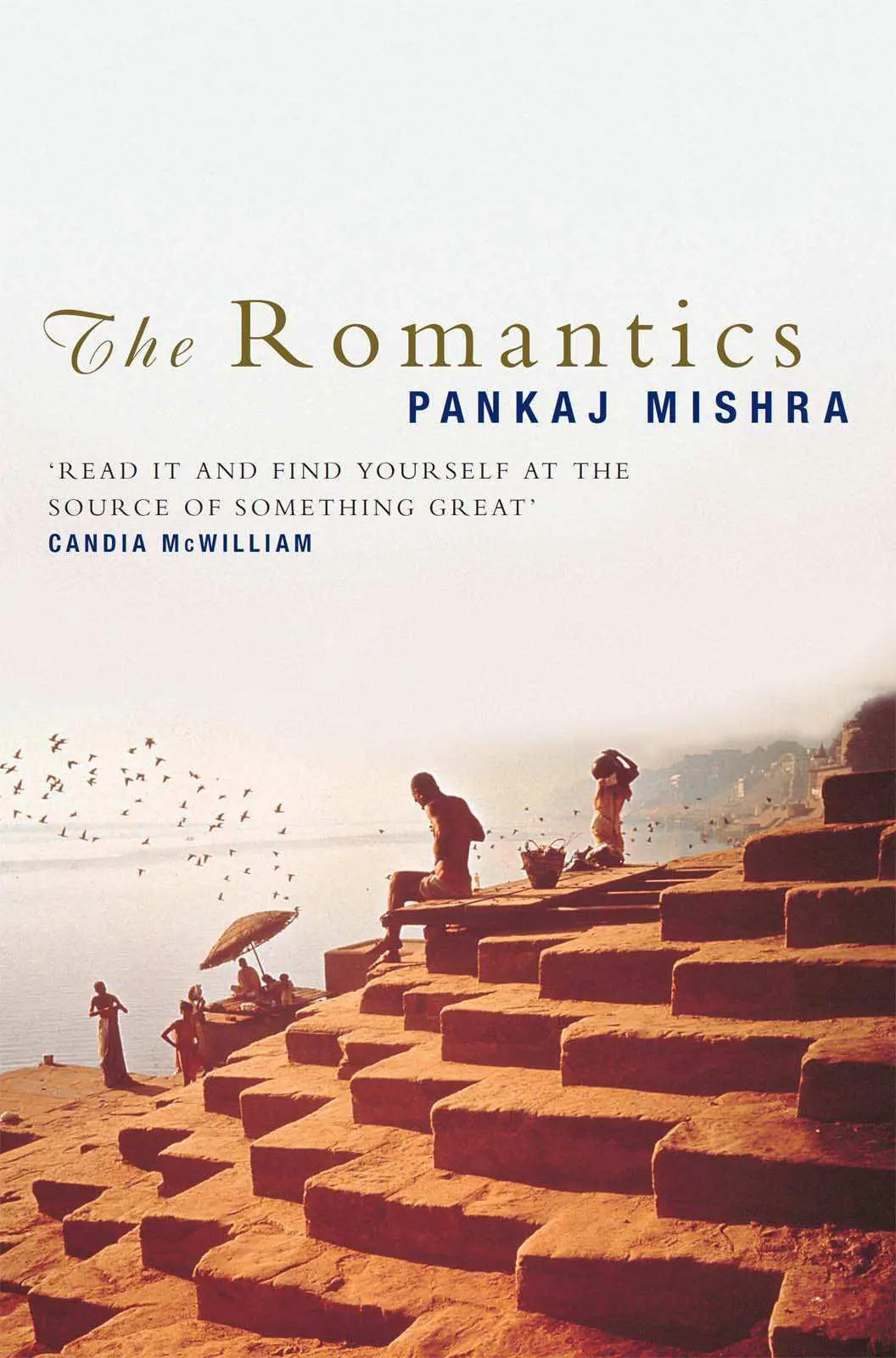
Pankaj Mishra - The Romantics
Здесь есть возможность читать онлайн «Pankaj Mishra - The Romantics» весь текст электронной книги совершенно бесплатно (целиком полную версию без сокращений). В некоторых случаях можно слушать аудио, скачать через торрент в формате fb2 и присутствует краткое содержание. Год выпуска: 2001, Издательство: Anchor Books, Жанр: Современная проза, на английском языке. Описание произведения, (предисловие) а так же отзывы посетителей доступны на портале библиотеки ЛибКат.
- Название:The Romantics
- Автор:
- Издательство:Anchor Books
- Жанр:
- Год:2001
- ISBN:нет данных
- Рейтинг книги:4 / 5. Голосов: 1
-
Избранное:Добавить в избранное
- Отзывы:
-
Ваша оценка:
The Romantics: краткое содержание, описание и аннотация
Предлагаем к чтению аннотацию, описание, краткое содержание или предисловие (зависит от того, что написал сам автор книги «The Romantics»). Если вы не нашли необходимую информацию о книге — напишите в комментариях, мы постараемся отыскать её.
The Romantics — читать онлайн бесплатно полную книгу (весь текст) целиком
Ниже представлен текст книги, разбитый по страницам. Система сохранения места последней прочитанной страницы, позволяет с удобством читать онлайн бесплатно книгу «The Romantics», без необходимости каждый раз заново искать на чём Вы остановились. Поставьте закладку, и сможете в любой момент перейти на страницу, на которой закончили чтение.
Интервал:
Закладка:
‘Now,’ Miss West interrupted, ‘I didn’t know that . How absolutely awful .’
Catherine said that it had indeed happened — not once or twice but several times. ‘And,’ she added, with a sudden sharp edge of passion in her voice, ‘this was when he was already eighteen years old.’
Catherine mentioned similar cruelties, the passion in her voice unmistakable now. It was odd to hear her talk about Anand in his absence: he suddenly appeared a man of deeper personality and experience than his own quiet, slightly bland presence made him out to be.
Presently, Catherine got up to turn on the lights and came back with a few photos of Anand’s village. Shoddy printing and tiny white disfiguring spots made it impossible to isolate any detail on them. But the overall picture they added up to was clear: the jumble of low mud huts and naked brick houses with cowsheds in the front yard on narrow lanes rutted by bullock-cart wheels, beyond which lay the whitewashed shrines, the buffaloes floating on algae-covered ponds, the sea of yellow mustard fields and the emptiness of dusty country roads.
How hard it was to imagine Catherine in this setting! Or to visualize the journey to the village, to see Catherine among the overflowing crowds on Bihar trains, packed tight together on hard wooden bunks and the floor and spilling out on the roof; to see her with the even more ragged passengers on the ramshackle country bus of dented abraded steel, its tyres worn smooth by the broken roads, the windshield cracked and grimy. Such aggressive curiosity she would arouse! How exposed she would be to the blank insistent stares, the intrusive questions in pidgin English, the lewd speculation about her connection with Anand.
*
As it turned out, I didn’t see her for many days after she returned. The first time I asked Miss West about the visit, her sole remark was: ‘It didn’t work out.’ Judging by her tone, she didn’t want to invite more questions on this matter, but later, in an absent-minded moment as we stood on the roof one evening, she came back to it without any prompting from me.
‘Did I tell you about Catherine’s visit to Bihar?’ she said. ‘They were hard on her, scowling and suspicious: they didn’t say anything to her — they hardly speak a word of English — Anand got all the flak. Poor girl, she was in tears. But that’s something she’ll have to live with. You can’t expect people like Anand’s parents to change: they’ll always disapprove of her, and in some sense that disapproval is important to them. It’s part of their identity; they can’t let go of it.’
Catherine herself had moved on to other preoccupations when I next saw her. The biggest source of anxiety now was her own parents. She had discussed with them the possibility of arranging some concerts in Paris so that Anand could pay, with the advance money, for his air ticket to France. They had replied that he ought to earn the necessary amount in India before he even started for France.
This greatly exasperated Catherine. How on earth was he going to do that? she exclaimed. Didn’t they know the difference in scale between the two economies? That kind of money doesn’t come easily in India. Her mother had been here after all; she must have taken with her at least some idea of Indian conditions; she was expected to be more understanding than her husband.
We were at Mark’s house. Miss West had taken me there, on one of her rounds of late-afternoon visits after the mornings spent reading and listening to music, and we had found Catherine, along with Sarah, the German Buddhist. Miss West often asked me if I wanted to accompany her on her trips. The visit to Mark’s house, as with the previous visit to Catherine’s, was her attempt to create a social life for me. Lately, she had also undertaken to introduce me to Western classical music; she played me CDs of Schubert’s String Quintet in C Minor and the String Sextet No. 2 by Brahms, and directed my attention to specific bits. I didn’t always like the music or understand what she said, but I was glamoured by this contact with names that I had encountered only in print.
I had seen Mark’s house several times from the river ever since Miss West pointed it out to me. This was the first time I had been inside it. It had three rooms huddled around a courtyard that offered a wide, unrestricted view of the river. The rooms were filled with a medley of selfconsciously ethnic knick-knacks — Azamgarh dhurries, Himachali wall hangings, Gujarati lampshades, Tibetan tangkas and various kinds of pots and pans.
As we walked into the half-enclosed courtyard where they all sat, catching the last bit of warmth before the sun disappeared behind the houses to the west, Mark was reclining regally on a jute mat, facing the glinting river. Sarah and Catherine were leaning against the wall a few inches away, but it was Debbie who caught my eye. She was lying on a saggy string cot, stripped down to her bra and panties, her skin already a leathery brown, her legs drawn up and parted in a rather graceless manner.
Miss West had told me that a widow from Bengal lived in one of the rooms in Mark’s house; she had long stopped paying the rent, but the landlord had been unable to evict her. It was her white saris that hung on a clothes line in the courtyard. Mark, Miss West said, got along well with her.
But what about Debbie? I wanted to ask Miss West, who had remarked once before on her sunbathing: one of the signs, I remembered, of her ‘commonness’. No one seemed to see anything amiss in her present appearance; Debbie herself seemed profoundly unconcerned about it. But it was shocking to me, and I knew it was very far from anything a widow from Bengal, living out her last years in prayer and near-destitution, could have countenanced. All through the visit I kept worrying about the possibility of her making an unexpected appearance upon the scene.
We had arrived in the middle of several bustling conversations. Mark smiled at us and gestured towards the vacant space in front of him. Sarah paused for the briefest while in her conversation with Debbie, acknowledging our presence with a smile that momentarily animated all the wrinkles on her face. Debbie abruptly sat up, revealing the freckled tops of her breasts, and waved.
Catherine was in the midst of a serious-seeming conversation with Mark. On the last occasion we were together at her house, I had heard her say to Miss West, ‘I don’t like Americans very much, but Mark is different. He is deep, deep.’ I couldn’t see Miss West’s face; she had her own opinions of Mark, opinions she had expressed to me. But she said nothing to Catherine, and it pleased me to think that there were things she would confide only in me.
Catherine had gone on to describe a conversation with Mark. He had told her about his life, his various careers, how they brought him little satisfaction in the end. Catherine said, ‘He has suffered a lot of pain.’ It was Benares, she said, that had healed him.
Later, while Miss West chatted with Mark and Sarah, I listened to Catherine talk to Debbie, who was saying, ‘No, I didn’t want to come to India as much as I wanted to go to Latin America.’
‘Why Latin America?’ Catherine wanted to know.
Debbie screwed up her face and adjusted the bra straps aslant on her shoulders — the skin of her shaved armpit, when she lifted her arms, was rutted and bristly. ‘I don’t know,’ she said, ‘but I had this really deep urge to go there after reading Márquez. You know, Love in the Time of Cholera . It’s my all-time favourite novel. . It’s just so romantic. . I just love the way he writes. I mean, the people in his books, they are so emotional , so free with their feelings, their bodies, everything. I don’t know, I’m not much of a literary critic, but I can’t think of a writer who can hold a candle to Márquez when it comes to. . when it comes to. . I don’t know.’
Читать дальшеИнтервал:
Закладка:
Похожие книги на «The Romantics»
Представляем Вашему вниманию похожие книги на «The Romantics» списком для выбора. Мы отобрали схожую по названию и смыслу литературу в надежде предоставить читателям больше вариантов отыскать новые, интересные, ещё непрочитанные произведения.










Обсуждение, отзывы о книге «The Romantics» и просто собственные мнения читателей. Оставьте ваши комментарии, напишите, что Вы думаете о произведении, его смысле или главных героях. Укажите что конкретно понравилось, а что нет, и почему Вы так считаете.