S. Agnon - Shira
Здесь есть возможность читать онлайн «S. Agnon - Shira» весь текст электронной книги совершенно бесплатно (целиком полную версию без сокращений). В некоторых случаях можно слушать аудио, скачать через торрент в формате fb2 и присутствует краткое содержание. Год выпуска: 2014, Издательство: Toby Press, Жанр: Современная проза, на английском языке. Описание произведения, (предисловие) а так же отзывы посетителей доступны на портале библиотеки ЛибКат.
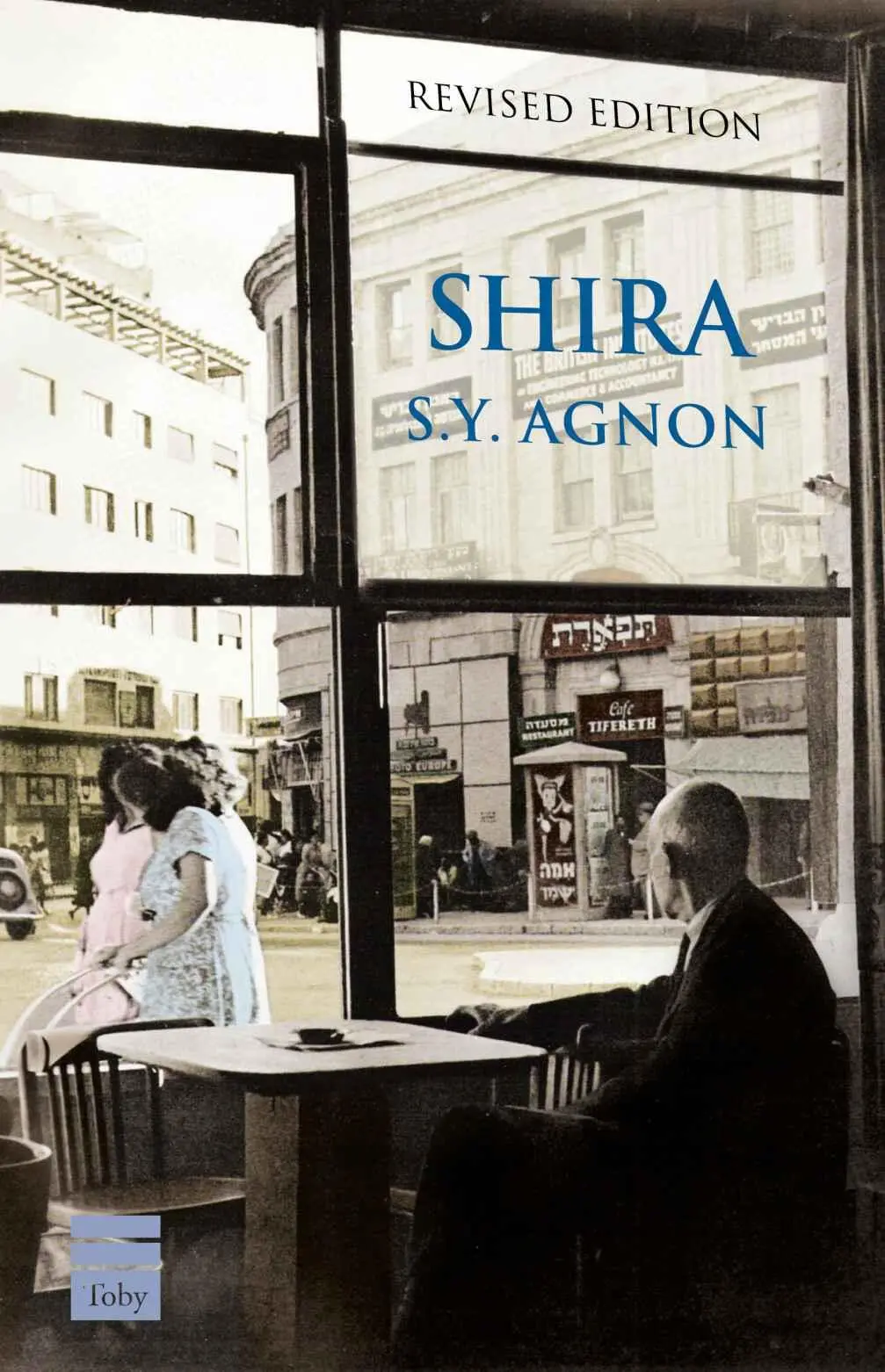
- Название:Shira
- Автор:
- Издательство:Toby Press
- Жанр:
- Год:2014
- ISBN:нет данных
- Рейтинг книги:5 / 5. Голосов: 1
-
Избранное:Добавить в избранное
- Отзывы:
-
Ваша оценка:
Shira: краткое содержание, описание и аннотация
Предлагаем к чтению аннотацию, описание, краткое содержание или предисловие (зависит от того, что написал сам автор книги «Shira»). Если вы не нашли необходимую информацию о книге — напишите в комментариях, мы постараемся отыскать её.
Shira — читать онлайн бесплатно полную книгу (весь текст) целиком
Ниже представлен текст книги, разбитый по страницам. Система сохранения места последней прочитанной страницы, позволяет с удобством читать онлайн бесплатно книгу «Shira», без необходимости каждый раз заново искать на чём Вы остановились. Поставьте закладку, и сможете в любой момент перейти на страницу, на которой закончили чтение.
Интервал:
Закладка:
He gradually calmed down. He wiped his brow and said, “Far be it from me to wish you misfortune, Shira. Live, but let me be, so I can live too. And, if you like, go off with your lovers and marry them. You could marry the one who gave you the cigarettes, or, if you prefer, the one with the whip, or that blind Turk. I won’t interfere. I will entertain you with a lovely tune, if you like.” He began singing, “Flesh such as yours…” Before he got to “Will not soon be forgotten,” his limbs became inert, and he was suffused with a pleasant sensation. The entire world became inert and vanished. Even Shira became inert and vanished. Only Herbst continued to exist.
When he got home and climbed into bed, he didn’t think about Shira or about anything in the world or about what had happened on the way. He rested his head on the pillow and stared at the ceiling and at his shadow on the wall. While he was watching the shadow, it closed its eyes, exactly as Herbst himself did. The house was quiet. At intervals, a sigh could be heard in Henrietta’s room, but it didn’t reach Manfred’s ears, because of the snore from the wall or from the shadow on the wall.
Now something occurred that was either a dream or I don’t know what it was. Manfred Herbst had a childhood friend, a Greek scholar who used to correct Wilamowitz’s translations of the Greek tragedies. One day, he abandoned his studies and left for America. The war came, and there was no trace of him until he came back and was exiled to a detention camp. He suddenly appeared in Mea Shearim. Or perhaps in Tel Aviv. No, it was Mea Shearim, because, when he and Manfred went walking, Mount Zion walked with them. During their entire walk, they never asked each other what they had been doing all those years, but they did discuss gender restriction in language, particularly those words that are masculine in one language and feminine in another. Herbst was going to mention Neu’s definition of the word piyyut (poetry) as an example. Before he could mention it, his friend bent down and said, “I think my shoes are torn.” Herbst took him to a shoemaker. When they were at the shoemaker, Herbst noticed that his shoes were also in need of repair. He extended his legs, slipped off his shoes, and handed them to the shoemaker. The shoemaker took them, rounded the toes, and stitched them with white raffia. The American reached into his pocket and paid the shoemaker what he asked, sixty grush. Herbst began arguing with the shoemaker. Not only had he ruined the shoes and changed their shape, but he was asking sixty grush, which was too high a price. Hearing the argument, the neighbors appeared. Everyone at the Bezalel exhibit came too, as well as all those who were praying in the Emet Veemunah Synagogue next to Bezalel. Herbst wanted to tell them what the shoemaker had done. He realized there wasn’t time, since he had to rush off to the wedding of Shira and Lisbet Neu. They were marrying each other, and he still hadn’t given them a wedding present. He left all the people to wonder about him and ran to a craftsman, from whom he bought a knife of pure silver. He ran and brought it to Lisbet and Shira — a wedding gift to gladden their hearts.
With this I have concluded Book One of the book about the nurse Shira and Dr. Manfred Herbst. I will begin another, in which I will recount what followed.
Book Two
Chapter one
It was two years since Herbst met the nurse Shira. Many things had happened in those years. Not only in the world, but in Herbst’s home as well. I will now recount some of what was new with Herbst.
Little Sarah was already walking, like all bipeds, and chattering away like a full-fledged person. Her speech was still a jumble of single words, but her mother knew how to combine them. Apart from this, she was very clever and showed her cleverness in every realm. Hen-rietta had a chicken coop. Once, when Henrietta was trying to get a chicken out of the coop, it escaped, and another one flew into her hand. Sarah chased it away and caught the fugitive. Another time, two days after her birthday, her mother was baking a cake for Shabbat. Sarah remembered that it was her doll’s birthday and she hadn’t baked her a cake yet. She went and told her mother, who gave her a pinch of dough, from which Sarah made a cake. These were some of Sarah’s tricks, and they provided some solace for Henrietta.
Henrietta managed to get a certificate for her brother. In the interim, he was offered a certificate for South America and went there instead. Henrietta got a certificate for another relative. In the interim, the Nazis harassed him out of existence, and he was dead. Henrietta tried to transfer the certificate to another relative and was told, “Why not?” Again, she ran around in a panic, for what had happened to her dead relative could happen to a live one. It was the anguish over these certificates that aged her prematurely. Since she considered herself old, the whole world seemed old to her, and she made no attempt to improve herself for her husband. Nor did she remark affectionately, as she used to, “Are there no young women in Jerusalem who would be glad to be with you?” Such talk was far from her lips and, needless to say, from her heart. Now all of Henrietta’s conversation with Manfred related to their daughters, to Tamara, for instance, who has finished her studies but has no job. All the openings are in depressed villages or in older settlements abandoned by the younger generation. A young teacher ought to be placed in a school in town, so she can learn from experienced teachers and from the principal, which is impossible in a far-flung village where the teachers and principal are second-rate. Meanwhile, she wastes her time on enterprises that please neither her father, her mother, nor even herself. A grown daughter can be an asset to her mother, but Tamara is incompetent in household matters and adds to her mother’s work. Henrietta Herbst, who taught Arab women domestic skills, didn’t teach them to her own daughter. Tamara spends half the day in bed, the other half in a telephone booth calling half of the directory. She spends evenings in a café, a cigarette in her mouth, a scornful look on her face, young men enveloping her in clouds of pipe smoke while she envelops them in clouds of cigarette smoke. When the band strikes up a tune, she dances, making no attempt to avoid the English officers, whose language she knows if not their intentions. Perhaps she does know their intentions and assumes her scorn will repel them too.
As for Zahara, we had the impression that her heart was drawn to Avraham-and-a-half or Heinz the Berliner. But she suddenly seems attracted to someone else, who doesn’t measure up to the former in height or to the latter in intelligence. Who is he? Heinz from Darmstadt. In fact, he is also one of the founders of Ahinoam, a good fellow, too, with some virtues the others lack. But why should a girl wear herself out and be torn between so many? This was not her mother’s way. Before Henrietta knew Manfred, she didn’t look at another man, and as soon as she got to know him, she clung to him. Before Manfred knew Henrietta, his eyes were buried in his books. Other than Henrietta, no young woman, however scholarly or beautiful, distracted him from his studies, although he lived in Berlin, whose very air loosens the constraints of the heart and the eye. This daughter of theirs lives in a small kvutza in the Land of Israel, settled by young men and women who left Germany to live a pure life on the land. But, in the end, she doesn’t measure up to her parents. Which is especially perplexing, for she is a girl with a head on her shoulders and eyes in her head. Why should she be groping as if she were blind?
Let me get back to Dr. Herbst. His great work on burial customs of the poor in Byzantium is in progress — a mass of references, notes, index cards, notebooks, quotations, outlines that remain incomplete, material that is still not in order. Herbst sits at his desk, removes a slip of paper, and replaces it with another. He writes, erases, records, copies, pastes in quotation after quotation, and substitutes a more appropriate word wherever possible. A scholar’s wisdom is not like dough in a woman’s hand, from which a piece can be torn to make a cake for a doll’s birthday. It is bothersome, like the chickens in their coop when you reach for one and another comes flying into your hand; not only do you have to pursue the one you want, but you have to struggle to get rid of the one in your hand. This may be a false analogy; still, it applies to the scholar’s struggle with his material. However, it must be noted that Herbst’s struggles are not in vain. Any author would be proud of the data Herbst has amassed. When he surveys his material, he often thinks: I’ll sit down and organize, combine, and copy, and I’ll have a book. But wisdom has such scope and is contained in so many volumes that no scholar can know today what tomorrow will bring. He persists, continuing to do today what he did yesterday and every other day, in some cases to support his data and in others to avoid discovering later that he left something out. There are scholars whose expertise is bewildering. Their bibliography alone occupies a third of the book, and when you examine it you realize that most of the books mentioned are irrelevant. Other scholars, after citing many sources, add see and see also. In fact, they have copied their material from such see alsos , which is to say that the sources referred to by see also are the ones from which they have copied their data, never having seen the original books from which the data are derived. Still, should someone say, “Others have preceded you,” they can point out, sanctimoniously, that full credit was given. Other scholars quote extensively from their own books; that is to say, they cite themselves as authorities. If this isn’t a matter of extreme innocence, then it’s a game, for they play at showing how smart they are, how many books they have already produced. There are scholars who quote the opinions of others, not to support their own, but to dispute them.
Читать дальшеИнтервал:
Закладка:
Похожие книги на «Shira»
Представляем Вашему вниманию похожие книги на «Shira» списком для выбора. Мы отобрали схожую по названию и смыслу литературу в надежде предоставить читателям больше вариантов отыскать новые, интересные, ещё непрочитанные произведения.










Обсуждение, отзывы о книге «Shira» и просто собственные мнения читателей. Оставьте ваши комментарии, напишите, что Вы думаете о произведении, его смысле или главных героях. Укажите что конкретно понравилось, а что нет, и почему Вы так считаете.