S. Agnon - Shira
Здесь есть возможность читать онлайн «S. Agnon - Shira» весь текст электронной книги совершенно бесплатно (целиком полную версию без сокращений). В некоторых случаях можно слушать аудио, скачать через торрент в формате fb2 и присутствует краткое содержание. Год выпуска: 2014, Издательство: Toby Press, Жанр: Современная проза, на английском языке. Описание произведения, (предисловие) а так же отзывы посетителей доступны на портале библиотеки ЛибКат.
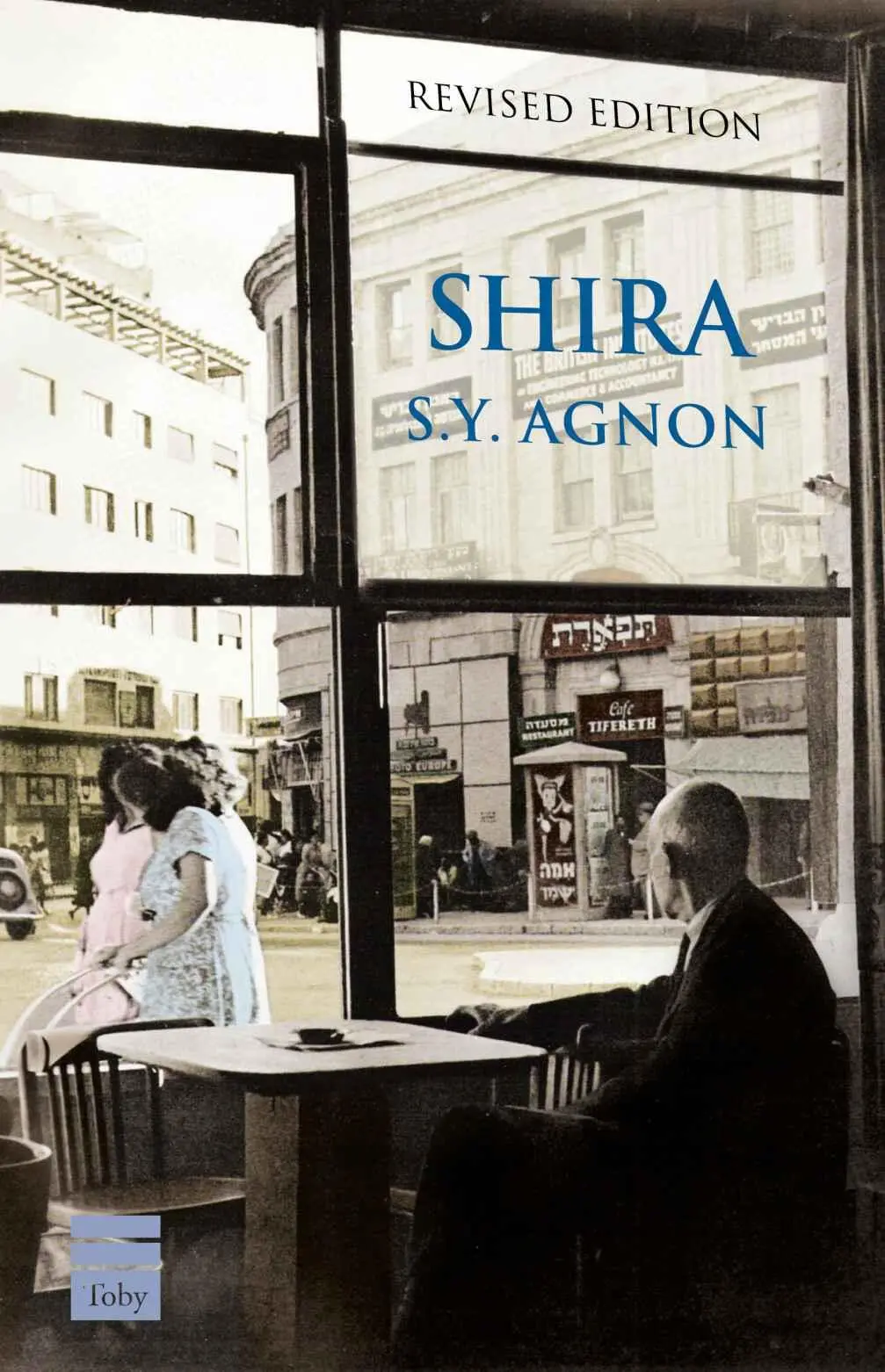
- Название:Shira
- Автор:
- Издательство:Toby Press
- Жанр:
- Год:2014
- ISBN:нет данных
- Рейтинг книги:5 / 5. Голосов: 1
-
Избранное:Добавить в избранное
- Отзывы:
-
Ваша оценка:
Shira: краткое содержание, описание и аннотация
Предлагаем к чтению аннотацию, описание, краткое содержание или предисловие (зависит от того, что написал сам автор книги «Shira»). Если вы не нашли необходимую информацию о книге — напишите в комментариях, мы постараемся отыскать её.
Shira — читать онлайн бесплатно полную книгу (весь текст) целиком
Ниже представлен текст книги, разбитый по страницам. Система сохранения места последней прочитанной страницы, позволяет с удобством читать онлайн бесплатно книгу «Shira», без необходимости каждый раз заново искать на чём Вы остановились. Поставьте закладку, и сможете в любой момент перейти на страницу, на которой закончили чтение.
Интервал:
Закладка:
Herbst lowered his head and lifted a finger toward the left side of his brow while holding on to his cup. After a while, he put down the cup and studied Böcklin’s skull. Did Böcklin paint from a model or from his imagination? Why do I ask? Herbst wondered.
Temima continued, “Most of the cultural institutions, headed by the university — which truly belongs here — are in Jerusalem. The National Library and the Bezalel Museum, for example. So naturally there are many cultured people, more than anywhere else in the country, and every new book, as well as every new idea, comes here before it comes to our kvutza. Still, I can say that, when I come from my kvutza to Jerusalem, I don’t feel inadequate. To borrow a term from Freud, I don’t have an inferiority complex. After all, we in our villages are also promoting the country’s interests. A few days ago, I happened on a book of philosophical essays and I found something on this subject that I can quote word for word. If the capital is the head of the country, then the villages are its limbs. To which I add: Just as a body can’t live without a head, a head can’t exist without limbs.” Shira said, “I see, Temima, that you’re looking for an excuse for living in the country rather than the city.” Temima said, “What makes you think I’m looking for excuses? Besides, what difference can one person make in times such as these? I don’t mean myself and those like me. What I have in mind is the world at large. You have to consider whatever is going on in the era it is your fate to be living in and account for every single action. We have no right to let actions go by without examining them and concerning ourselves with them.” Shira said, “And if you and I don’t concern ourselves with whatever is going on in the world, will anything be different?” Temima said, “Really, I don’t understand what you mean.” Shira said, “I think I’m making myself clear.” Temima said, “I’m surprised at you, Shira. After all, a person is a person. Isn’t it a primary duty to reflect about and consider whatever is going on in the world, all the more so here in this country, since we came here for a specific purpose?” Shira said, “Well spoken, Temima. We came for a purpose. The question is: For what purpose?” Temima said, “Really, I don’t understand what you are saying. What did we come for? For…for…” Shira laughed and said, “Temima, your name means ‘innocence,’ and you are as innocent as your name. Don’t wear yourself out looking for sublime words. I’m satisfied with what you said. We came for a purpose.” Temima said, “Really, I must repeat, I don’t understand you.” Shira said, “If I were ten years younger, I would envy you. Imagine, you are still looking for reasons to be where you are. We’re here because we’re here and nowhere else. And, if my view is too simple for you, that doesn’t change a thing. I don’t presume to phrase my ideas the way you do in the kvutza , but they are sincere.”
Herbst sat thinking many thoughts, having to do with another place and another time. If we look for a reason, only one comes to mind. Dr. Herbst wished to withdraw from his present company, if not in person, then in thought. Herbst asked himself: This skull of Böcklin’s — how was it drawn? From a model or from the imagination? Actually, Böcklin himself has answered my question. Where do we find his answer? He complained that he never had the chance to draw a woman from life, because his wife, who was Italian, was jealous and wouldn’t allow him to have a model in his studio. But why am I thinking about Böcklin’s skull painting? Is it because that nurse mentioned Bezalel? No, I thought of the question even before she mentioned Bezalel. Yes, Zahara went back and won’t be at the workshops. So, obviously, the nurse won’t see her and say where she met her father. Herbst looked at his watch and said, “Time to go. What’s this? My watch has stopped.” He took off his watch and set it, guessing at the time, not bothering to look at the numbers, and thinking to himself: I’m leaving this place, calm and confident, as if there were no reason to worry about the nurse telling Zahara that she met her father. Even if she were to tell her, she wouldn’t necessarily say where and when she saw me. Even if she did say when and where she saw me, Zahara, in the innocence of her heart and purity of her mind, would think nothing of it. And, if she were to wonder, her wonder wouldn’t last. Many things happen. Before you have a chance to attend to one thing, there is another on the horizon. We, too, rather than dwell on the past, should attend to what’s ahead.
Herbst took leave of Shira and Temima. He was on his way, restating to himself what he had said before: I’ll put the past behind me and attend to what’s ahead.
I’m going home to my wife, who urged me to take a walk before going to bed so my sleep would be sweeter. I went out for a bit, and the time stretched to several hours. What did I find in that time? I found Lisbet Neu. When I left her, I went to the bus stop, meaning to go home. I didn’t find the bus. I waited, and it didn’t come. Meanwhile, I heard the day’s news. If one were to be precise, I doubt it could be called news, since there is nothing new about it. Events that recur every day can hardly be called new. What do we consider new? A story with danger and with Arabs. Two Arabs come to an old woman and ask for water. They shoot her, though she has provided them with water. She falls in a pool of blood and dies. How naive that old woman was. Innocent blood is being spilled in this country, and it didn’t occur to her that what happens to others could happen to her. What happened in the end? In the end, they killed her.
So much for the old woman and the villains who killed her. Let’s get back to Herbst. Herbst was walking home and thinking as he walked: I left the others waiting for the bus and went to Shira. I arrived at Shira’s and found her shipmate there, a good woman, if a somewhat simple one. But what does a man know about a woman? A man doesn’t really know a woman except…Take Shira. Before I was close to her, didn’t I see her the way she makes others see her? Remembering Shira, his voice began to intone, “Flesh such as yours / Will not soon be forgotten.”
He grew silent and reviewed the entire Shira episode, since he began to be close to her. He argued with himself: What did I think when I first knew her? Was I so innocent as to think I wouldn’t have to put myself out for her, that I could come at any time? What did she do? When I came, she made it clear that she had a will too, that her will was different from mine. He reviewed all of his struggles with her. There must have been other men, the engineer and his like. Without envy, without hatred, he enumerated all the men Shira had told him about. They had no reality. Shira was the sole reality. Again she was there, before his eyes, revealed in all the forms he had seen her assume, and as each form unfolded, his voice intoned, “Flesh such as yours…”
He suddenly began to wave his hands, as if to repel something unwelcome. But the very knowledge he was trying to repel seemed to become more and more palpable with every thought. He sighed from the heart and mused: As long as she exists, I will not be rid of her, whether or not that’s what she wants. As it is in the nature of thoughts to come and go, an evil thought came to him: Should something happen to her, if she were to be hit by a bus and run over, or if she were to come down with one of the dread diseases she treats, he would be rid of her forever.
Shira appeared before him again, as he had seen her that first night in her house, in her room, dressed in dark blue pants and a thin shirt, when, to his astonishment, as soon as she put on male attire, her masculine qualities vanished and she became all the more female. He opened his mouth wide; the edges of his teeth protruded and began to strike each other. He stood, shouting, “If you insist on living, live, as long as you are transformed into a man!”
Читать дальшеИнтервал:
Закладка:
Похожие книги на «Shira»
Представляем Вашему вниманию похожие книги на «Shira» списком для выбора. Мы отобрали схожую по названию и смыслу литературу в надежде предоставить читателям больше вариантов отыскать новые, интересные, ещё непрочитанные произведения.









Обсуждение, отзывы о книге «Shira» и просто собственные мнения читателей. Оставьте ваши комментарии, напишите, что Вы думаете о произведении, его смысле или главных героях. Укажите что конкретно понравилось, а что нет, и почему Вы так считаете.