S. Agnon - Shira
Здесь есть возможность читать онлайн «S. Agnon - Shira» весь текст электронной книги совершенно бесплатно (целиком полную версию без сокращений). В некоторых случаях можно слушать аудио, скачать через торрент в формате fb2 и присутствует краткое содержание. Год выпуска: 2014, Издательство: Toby Press, Жанр: Современная проза, на английском языке. Описание произведения, (предисловие) а так же отзывы посетителей доступны на портале библиотеки ЛибКат.
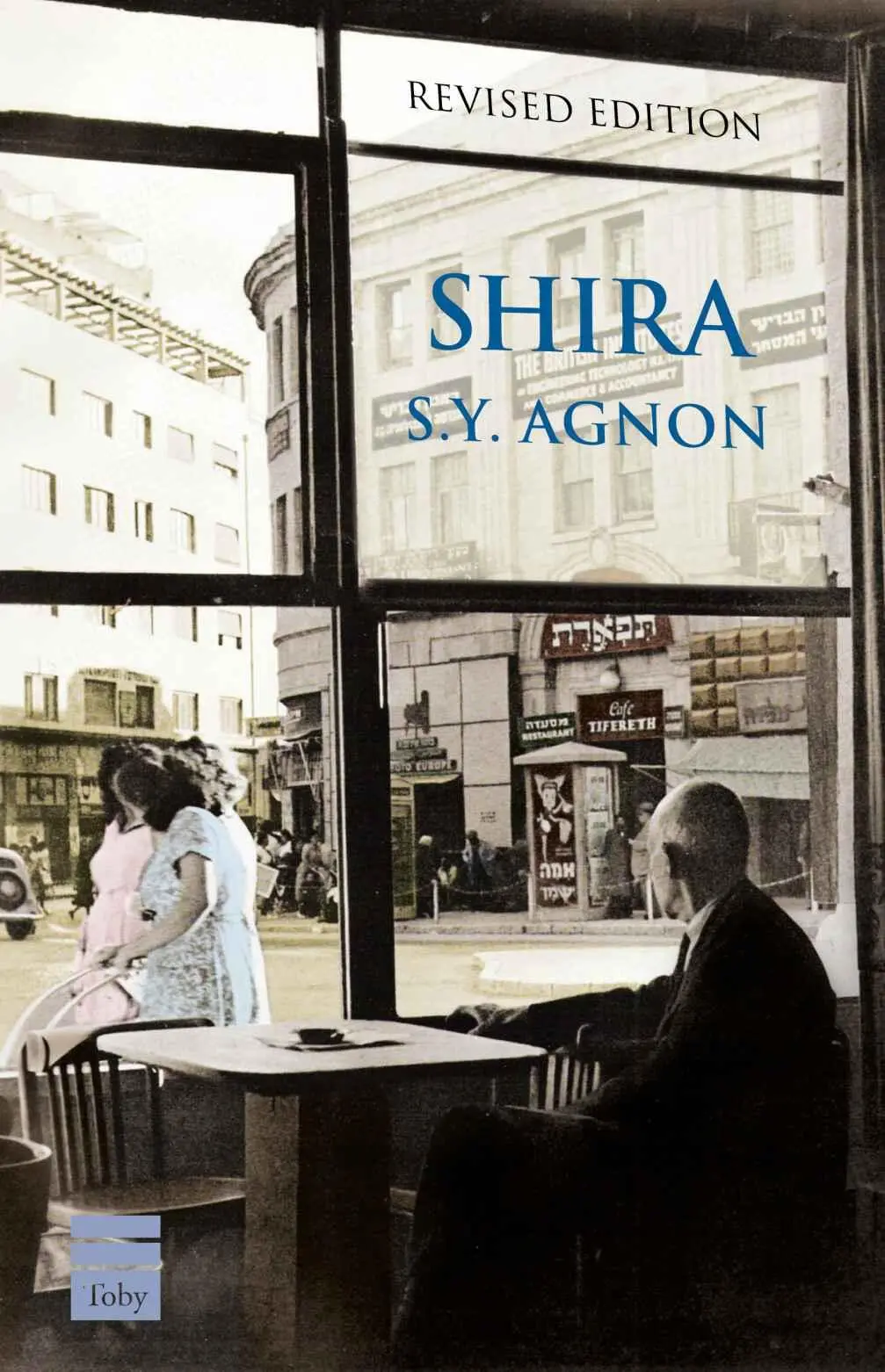
- Название:Shira
- Автор:
- Издательство:Toby Press
- Жанр:
- Год:2014
- ISBN:нет данных
- Рейтинг книги:5 / 5. Голосов: 1
-
Избранное:Добавить в избранное
- Отзывы:
-
Ваша оценка:
Shira: краткое содержание, описание и аннотация
Предлагаем к чтению аннотацию, описание, краткое содержание или предисловие (зависит от того, что написал сам автор книги «Shira»). Если вы не нашли необходимую информацию о книге — напишите в комментариях, мы постараемся отыскать её.
Shira — читать онлайн бесплатно полную книгу (весь текст) целиком
Ниже представлен текст книги, разбитый по страницам. Система сохранения места последней прочитанной страницы, позволяет с удобством читать онлайн бесплатно книгу «Shira», без необходимости каждый раз заново искать на чём Вы остановились. Поставьте закладку, и сможете в любой момент перейти на страницу, на которой закончили чтение.
Интервал:
Закладка:
That little neighborhood sits in darkness, like a rug on which a weaver has outlined houses and gardens in blues and grays. The houses are houses, the gardens are gardens, and their colors are the dusk that envelops them, for those who live in the neighborhood are mostly people of limited means. They skimp wherever possible, certainly on lights on a summer evening, when even the darkness gives off light. And if it doesn’t give light, it’s good to sit in the dark. In the darkness one is unaware of the house’s defects — its sinking floor, a crooked wall, crumbling plaster, a leaky faucet in the kitchen. The sound of a loud radio blares forth from one of the houses, the occupant having pitched its volume to let the neighbors hear, since not everyone has a radio. The tone is political, but the words are from the prophets.
Dr. Herbst and Lisbet Neu traversed the entire neighborhood and were now at the other end. If this was not the end of the world, it was surely the end of civilization. There were no houses here, no tents, no permanent structures, no temporary ones; only rock and bramble. The rock rolls downward, with clefts that form a series of steps. If these clefts were not made by God, they are almost certainly the ones Solomon described in the Song of Songs: “My dove, in the clefts of the rock, hidden in the cliff.” Manfred Herbst and Lisbet Neu are already far from the heart of the neighborhood or any part of it, and another scent and another sound take over — the fragrance of grass and the sound of wind stirring the grass; the scent of thorns sun-dried by day and dampened by evening dew. Along with the sound of the wind in the grass, a two-part song is being sung by a girl and boy perched in a cleft of the rock, a song with words that are in the melody, words to suit each listener. The fine scent from the rock and bramble, along with the singing, make this night like those Jerusalem nights long ago when even we were young.
Lisbet Neu withdrew her arm from Herbst’s and said, “Let’s turn back.” Herbst was surprised, though there was no reason for surprise. He had, in fact, meant to see her home, and now that she was there, it was time for her to go in. Herbst asked Lisbet, “What’s the hurry?” Lisbet said, “They’re playing Mozart tonight, and the man with the radio invited me to listen. I’ve been wanting to hear Mozart for so long.” If Herbst had put his thoughts into words, he would have said to Lisbet, “Forget Mozart, and let’s go down to the rocks and sit there like that boy and girl.” But not all of a person’s thoughts are put into words. Herbst kept thinking: If I run my hand through her lovely hair, she won’t object; she might even let her lovely head slip down and rest on my heart. Herbst glanced at her and saw that her ears were tiny, her eyes sparkling. A woman with small ears likes to listen and doesn’t turn one away. He continued to look at her. Alarmed by his evil thoughts, he began to scrutinize himself: How depraved this man is, buying a gift for Shira, giving the gift to Lisbet, and telling her, “I bought it for my daughter.” He is on his way to Shira, yet he seeks to amuse himself with an innocent young girl.
They were walking away from the steps. Lisbet stopped at one of the houses and said, “This is where I live.” “Here?” Herbst asked in despair. Lisbet said, “Most nights I sit inside with Mother. If you ever have some time, Dr. Herbst, you could come over.” Herbst said, “I won’t come.” Lisbet said, “Why won’t you come to our house?” Herbst said, “Because of the young lady’s mother.” “My mother?” Herbst said, “Old women tend to see me as a peer and engage me in conversation, so I don’t get to talk to their daughters.” Lisbet said, “My mother isn’t old.” Herbst said, “In any case, my age is closer to hers than to her daughter’s. And another thing, my dear Miss Lisbet: I don’t want your neighbors to gossip. Now, be well, enjoy the Mozart, and I’ll go home.” Lisbet said, “I’m sorry I took the professor this far. By now, the last bus has left, and you will have to walk back to town.” Herbst said, “Never mind, my feet will find the way. Goodbye.”
When Herbst reached the bus station, there was no bus in sight. Had it already left? Was it about to arrive? There was no one to ask. Herbst stood waiting for the bus, as people do in Jerusalem at night, especially then, during the riots, when Jews were being killed and injured every day. Standing there, he heard the sound of violins, harps, drums, and dancing. He looked up and saw that the two Rabinowitz hotels were filled with people in holiday attire. Some were dancing, some clapping, their shtreimels bobbing up and down, to and fro. Herbst thought to himself: On the one hand, death and injury, mourning and dirge; on the other, brides and grooms, joy and exultation. He soon grew tired of waiting. He soon grew weary of the instruments and the tunes, which were all one motif repeated over and over. He shifted his mind to Mozart and to Lisbet Neu, who, at that very moment, was sitting near the radio. His mind drifted to his book on burial customs of the poor in Byzantium, which was still a heap of notes and, if he didn’t idle away his time, would be a great book. He was sorry to be wasting time waiting for a bus, with no way of knowing when it was due. He decided to walk home. He took a few steps and turned back, took a few more steps and turned back again, thinking the bus might come in the meanwhile, and the driver, seeing no one waiting, would leave. This had happened to him on several occasions, when he was waiting for a bus and stepped back to read the bulletin board, only to be ignored by the driver and forced to wait for the next one or walk.
The driver appeared and saw Herbst waiting. He told him the bus was stuck on the road with holes in its tires, thanks to the nails with which Arabs immobilize our vehicles to disrupt transportation and cut off those living in outlying districts, so they will come to loathe their isolation.
The two of them, Dr. Herbst and the driver, stood discussing the subjects one discussed during the riots, when events were cruel and bitter, when the Arabs conspired to restrict us in every possible way. One of the things they would do was to scatter nails on roads frequented by Jewish vehicles. A bus or car filled with Jews would be traveling along and stop suddenly because a nail in the tire had caused a blowout. The driver would get down to change the tire, and a stone would be thrown at him or at the passengers. Given a miracle, the injuries would be slight. Often, they were serious. The Arabs would stand by laughing while the English policeman meted out justice. How would he do that? He would grab a Jew and order him to get the nails off the road.
Herbst stands listening to the news the driver has to tell. Actually, there is nothing new. Yesterday is the same as today. The only change is in the number of casualties. Still, there is no day without something novel. Since it is novel, I will tell about it.
An old Jewish woman lived at the edge of one of the settlements in the Sharon. Her home was open to passersby, offering shade from the heat of day and shelter from the rain. That day, her house wasn’t open, because her years weighed on her, making it hard for her to get out of bed. She had lived almost a hundred years, enduring poverty, grief, and bereavement. She found consolation in the fact that most of the settlement’s children, as well as the children of the Arabs in the surrounding villages, were her nurslings, for she had assisted either at their birth or at the birth of their mother and father, perhaps even of their grandmother and grandfather. She had seen them through childhood illnesses and the maladies of the region. From her bed, she heard a knock at the door, followed by a call for water. She managed to get up and open the door. She saw two Arab youths, who asked for a drink. She handed them the water jug. They turned on her and killed her. The driver had other news to tell. What is known is known; what is unknown, who will believe?
Читать дальшеИнтервал:
Закладка:
Похожие книги на «Shira»
Представляем Вашему вниманию похожие книги на «Shira» списком для выбора. Мы отобрали схожую по названию и смыслу литературу в надежде предоставить читателям больше вариантов отыскать новые, интересные, ещё непрочитанные произведения.







Обсуждение, отзывы о книге «Shira» и просто собственные мнения читателей. Оставьте ваши комментарии, напишите, что Вы думаете о произведении, его смысле или главных героях. Укажите что конкретно понравилось, а что нет, и почему Вы так считаете.