S. Agnon - Shira
Здесь есть возможность читать онлайн «S. Agnon - Shira» весь текст электронной книги совершенно бесплатно (целиком полную версию без сокращений). В некоторых случаях можно слушать аудио, скачать через торрент в формате fb2 и присутствует краткое содержание. Год выпуска: 2014, Издательство: Toby Press, Жанр: Современная проза, на английском языке. Описание произведения, (предисловие) а так же отзывы посетителей доступны на портале библиотеки ЛибКат.
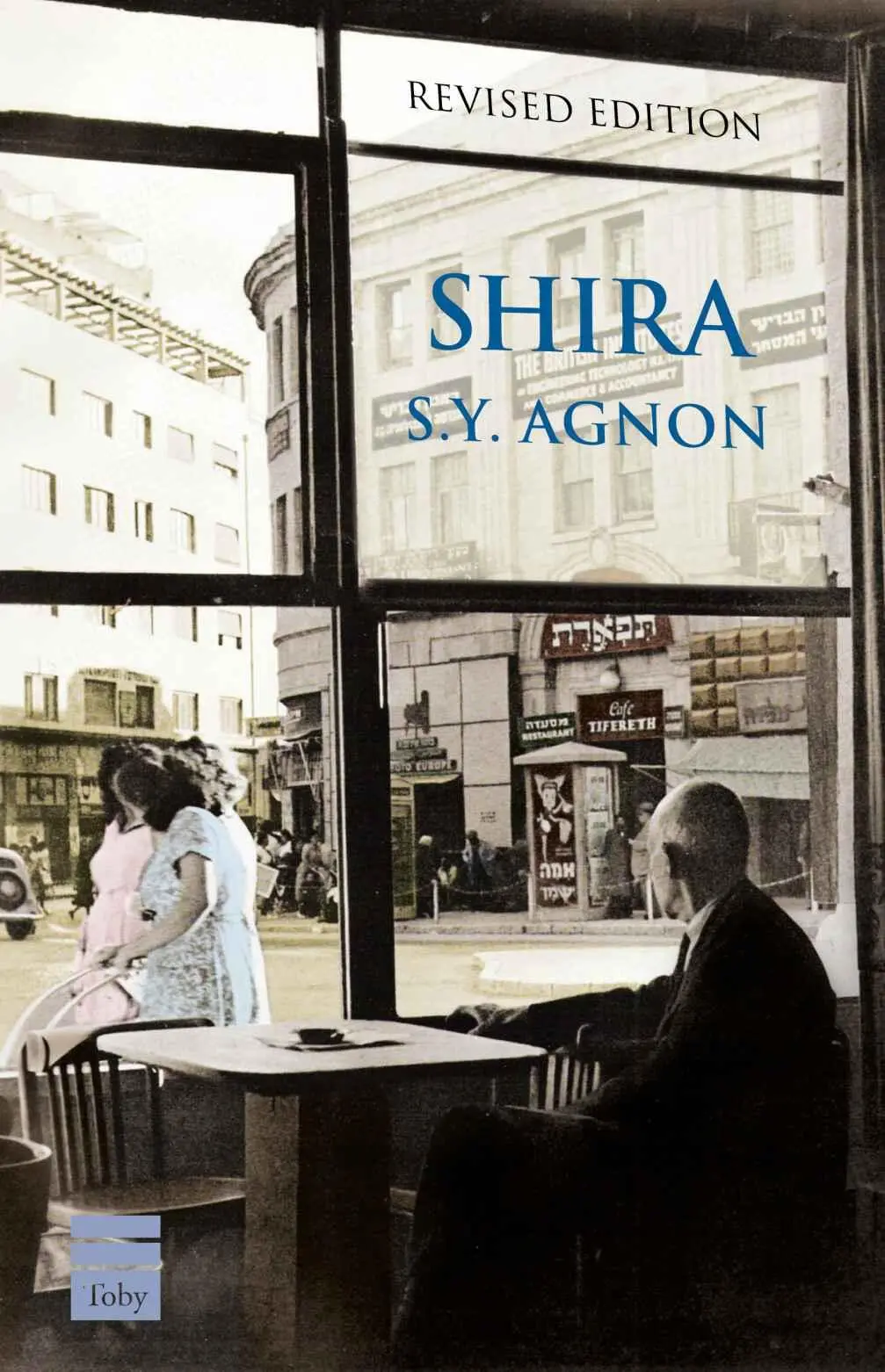
- Название:Shira
- Автор:
- Издательство:Toby Press
- Жанр:
- Год:2014
- ISBN:нет данных
- Рейтинг книги:5 / 5. Голосов: 1
-
Избранное:Добавить в избранное
- Отзывы:
-
Ваша оценка:
Shira: краткое содержание, описание и аннотация
Предлагаем к чтению аннотацию, описание, краткое содержание или предисловие (зависит от того, что написал сам автор книги «Shira»). Если вы не нашли необходимую информацию о книге — напишите в комментариях, мы постараемся отыскать её.
Shira — читать онлайн бесплатно полную книгу (весь текст) целиком
Ниже представлен текст книги, разбитый по страницам. Система сохранения места последней прочитанной страницы, позволяет с удобством читать онлайн бесплатно книгу «Shira», без необходимости каждый раз заново искать на чём Вы остановились. Поставьте закладку, и сможете в любой момент перейти на страницу, на которой закончили чтение.
Интервал:
Закладка:
He went out, meaning to walk, but he saw a bus coming from Talpiot and jumped on it. The bus was nearly empty. There were only a few passengers. Because of Arab attacks, people from Talpiot were reluctant to go into town at night. Those who went into town couldn’t be sure they would make it back that night, for the authorities could suddenly proclaim a curfew, which would bring transportation to a standstill. Still, the inspector sent out buses rather than disrupt the system. When Herbst arrived in town, he was astonished to see the streetlamps lit as usual, the streets filled with men and women, ambling in a leisurely manner, in no hurry to find refuge at home. Even the shoeshine boys were there, plying their trade. People get their shoes shined, not in order to wear them in bed, but to walk in them, which suggests that the night has not closed in on us and there is no danger of a curfew.
Worried by what he saw and worried by his thoughts, Herbst strolled down Jaffa Road, which was as crowded with people as in peacetime. Soldiers of the Mandate government added to the bustle. Whether they ambled along like everyone else or stood like observers or inspectors, they were different, not only because of their uniforms, or because they were armed, but because of the expression on their faces.
I will dwell on this matter for a moment and explain my remark about the expression on the Englishmen’s faces. It seems to me that I speak for Herbst. I may be slightly mistaken in this matter, but surely not by very much.
Before Herbst came to the Land of Israel, he had little contact with other nationalities. Except for Jews and Germans of foreign extraction, he knew no other nation. When he came to this country and saw various peoples, distinct from each other, he became interested in their characters. When he knew a person well, he tried to determine which of his qualities were national traits and which were unique to that individual. I don’t know what he achieved or what he failed to achieve. It is clear that, of all the nations and tribes in this country, he was least acquainted with the English. And I would not be straying far from the truth if I were to say he made no effort to know them, although he often had the opportunity for close contact with the English. At public events, such as concerts and exhibits, for example, and even in private homes. I will try to explain why he didn’t get to know the English and why he made no attempt to do so.
As soon as Herbst arrived in the Land of Israel, he was imbued with a spirit that was totally new to him. It could be called the spirit of freedom. Herbst suddenly felt that he was in his own land, with his own people, with others like him, who shared many of his qualities and many of whose qualities he shared. He felt that he no longer needed to strain to be like others, for he simply was like them, which had not been the case before. As long as he was living in Germany, he made an effort to accommodate his ways to those of the Germans and to be like them. Even after becoming a Zionist, he didn’t change very much; nor did his Zionist friends.
As for all the other peoples to be found in this country — be they ordinary people or scholars and intellectuals — whether he considered them natives or guests who are here today and gone tomorrow, should this suit them, he saw no reason to change his character on their account. But the Englishman, lording it over a land to which he had no claim, considering himself superior to all its inhabitants, was strange in Herbst’s eyes, and he had no wish to make his acquaintance. Since the English were strange to him, the expression on their faces was equally strange.
Herbst was jostled, sometimes by a drunken sailor, sometimes by an ordinary person. Still, Herbst functioned under his own power, dispatching his eyes in whatever direction he chose: at the pedestrians, the houses and stores, the vehicles and their passengers, those little houses in Nahlat Shiva with larger structures and stores built to the right and left of them, about to swallow them up, along with all of Nahlat Shiva. The neighborhood, being modest and discreet, accepted its fate in silence. But, as you and I well remember, it paved the way for the building of modern Jerusalem, providing it with the vigor and courage to expand. When Herbst first arrived in Jerusalem, Nahlat Shiva, with its stone buildings, was still a defined neighborhood. Now it is overshadowed by houses built of concrete and stores with goods Jerusalem had no need of until they appeared, or, let’s say, until the shopkeeper explained how necessary they were. Herbst, who generally stayed at home, whose shifts and changes led him from workroom to dining room to bedroom, is suddenly in the midst of a crowd. There are many people on the street, so many that he can’t see if there is a friend or acquaintance among them. He doesn’t recognize anyone, yet he feels he is a partner, though the nature of the partnership is unclear. He sees himself as part of the crowd. He suddenly finds himself standing in front of a large store. Its windows are brightly lit, and the wares are skillfully arranged to catch the eye of strollers.
What did I want to look at? Herbst asked himself. I didn’t want to look at anything. Actually, I did. Before he could decide whether or not he did, he was interrupted by a bell being rung by the shoeshine boy sitting in ambush at the edge of the street. Herbst’s thoughts were interrupted. He looked up and saw a small boy sitting at the entrance to an office building, one hand on a bell, the other on a bristled implement. The boy jingled the bell again and said to him, “Here, here, sir. Let me shine your shoes. I’ll do it tiptop.” The word appealed to Herbst. He laughed and said, “If you can really do it tiptop, I’ll let you shine my shoes.” The boy said, “If I don’t do a good job, you don’t have to pay.” Herbst said, “That’s not the point. Just make it tiptop.” The boy said, “All right, sir.” Herbst extended his foot. The boy picked up his tools and began to work. Herbst watched him and said, “I see you are really making it tiptop. What do you earn in a day?” Herbst also asked the boy where he lived and if he had a father, a mother, brothers, sisters. I’m not sure just how interested Dr. Herbst really was. But the boy answered, adding even more information than was asked for.
This is roughly his story. His father had left his mother for someone younger, his mother having aged rapidly because she worked so hard, at home and away from home, in the homes of Ashkenazim, who are so rich that they don’t have to work and their work is done by others. As for his brothers, one of them, sort of a halutz , who studies at night and can even read a newspaper, was in partnership with a Yemenite. The Yemenite would give him a pile of newspapers to distribute and a share of the profits. On Friday nights, he would bring home a newspaper and sit reading it, like a scholar with a sacred text. And what about the sisters? They were up to no good. Victoria went with some Englishman. She was attacked by fanatics, who beat her up and poured acid on her face, which ruined her looks. When the Englishman saw this, he got angry and said he would kill all the Jews. Balfouria heard this and began to cry inconsolably. She said to the Englishman, “Don’t kill the Jews.” He took her to the movies, and she didn’t come back. When she came home in the morning, Victoria jumped on her, bit her, pulled her hair, shouted, and wept. Our brother Musa appeared and beat up Victoria and Balfouria, screaming, “I’ll kill all the English! They’re making our girls into whores! Even if they kill me, I’ll kill them first.” Then he joined forces with Fat Musa, who loved Balfouria dearly. They planned to ambush the Englishman, and Mother was terrified that Musa would kill him. Musa has a fierce temper, and, when he is angry, he turns red as a bull’s blood; his eyes get twice as red, so he can’t see what he is doing. He pounds with his fists, kicks, and thrusts his head into the enemy’s belly until the victim collapses in defeat.
Читать дальшеИнтервал:
Закладка:
Похожие книги на «Shira»
Представляем Вашему вниманию похожие книги на «Shira» списком для выбора. Мы отобрали схожую по названию и смыслу литературу в надежде предоставить читателям больше вариантов отыскать новые, интересные, ещё непрочитанные произведения.






Обсуждение, отзывы о книге «Shira» и просто собственные мнения читателей. Оставьте ваши комментарии, напишите, что Вы думаете о произведении, его смысле или главных героях. Укажите что конкретно понравилось, а что нет, и почему Вы так считаете.