Gail Hareven - Lies, First Person
Здесь есть возможность читать онлайн «Gail Hareven - Lies, First Person» весь текст электронной книги совершенно бесплатно (целиком полную версию без сокращений). В некоторых случаях можно слушать аудио, скачать через торрент в формате fb2 и присутствует краткое содержание. Год выпуска: 2015, Издательство: Open Letter, Жанр: Современная проза, на английском языке. Описание произведения, (предисловие) а так же отзывы посетителей доступны на портале библиотеки ЛибКат.
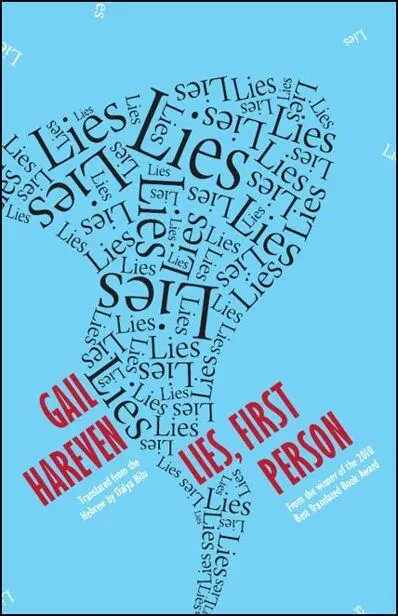
- Название:Lies, First Person
- Автор:
- Издательство:Open Letter
- Жанр:
- Год:2015
- ISBN:нет данных
- Рейтинг книги:3 / 5. Голосов: 1
-
Избранное:Добавить в избранное
- Отзывы:
-
Ваша оценка:
Lies, First Person: краткое содержание, описание и аннотация
Предлагаем к чтению аннотацию, описание, краткое содержание или предисловие (зависит от того, что написал сам автор книги «Lies, First Person»). Если вы не нашли необходимую информацию о книге — напишите в комментариях, мы постараемся отыскать её.
Elinor's comfortable life — popular newspaper column, stable marriage, well-adjusted kids — is totally upended when she finds out that her estranged uncle is coming to Jerusalem to give a speech asking forgiveness for his decades-old book,
.
A shocking novel that galvanized the Jewish diaspora,
was Aaron Gotthilf's attempt to understand — and explain — what it would have been like to be Hitler. As if that wasn't disturbing enough, while writing this controversial novel, Gotthilf stayed in Elinor's parent's house and sexually assaulted her "slow" sister.
In the time leading up to Gotthilf's visit, Elinor will relive the reprehensible events of that time so long ago, over and over, compulsively, while building up the courage — and plan — to avenge her sister in the most conclusive way possible: by murdering Gotthilf, her own personal Hilter.
Along the way to the inevitable confrontation, Gail Hareven uses an obsessive, circular writing style to raise questions about Elinor's mental state, which in turn makes the reader question the veracity of the supposed memoir that they're reading. Is it possible that Elinor is following in her uncle's writerly footpaths, using a first-person narrative to manipulate the reader into forgiving a horrific crime?
Lies, First Person — читать онлайн бесплатно полную книгу (весь текст) целиком
Ниже представлен текст книги, разбитый по страницам. Система сохранения места последней прочитанной страницы, позволяет с удобством читать онлайн бесплатно книгу «Lies, First Person», без необходимости каждый раз заново искать на чём Вы остановились. Поставьте закладку, и сможете в любой момент перейти на страницу, на которой закончили чтение.
Интервал:
Закладка:
I missed those accessible waves of joy, I missed the joy, but I didn’t miss my sons themselves. There is a time for embracing and there is a time to desist from embracing, and I was responsible enough and balanced enough to know that this was not the time to embrace.
The pictures my sister had in her head seeped into me, and the smell of my sweaty visions began to stick to Oded. The sound of the ferment that reached my mother-in-law’s ears was the sound of the sights crowding and seething inside me, threatening to overflow and spill out. Sights that I didn’t know existed rose up in me and clamored loudly. And I could only be thankful that Yachin and Nimrod were far from the poison, which could burn holes in socks too. The harm I had caused in Seattle was enough.
At another Saturday lunch my mother-in-law showed me an article she had cut out of the newspaper about the various advantages of eating tofu, especially for women of a certain age. She even started cooking it for us, the white stuff that “constituted a natural source of estrogen and calcium. Many studies show that Asian women do not suffer from the change-of-life syndrome, and exhibit a very low incidence of cancer of the uterus and the ovaries. Isn’t that interesting? The Asians, it says here, eat tofu all the time, even children and young people like you eat it. The Japanese and the Chinese put a big emphasis on preventative medicine.”
The white stuff did not prevent anything or rid her daughter-in-law’s system of the dirt, and soon afterward she began to refer mysteriously to “experiences that take time to digest.” As much as I loved her, as much as I remembered that I loved her, these metaphoric ramblings about “digestion” only enflamed my rage: as if I needed some mental castor oil to accelerate the exorcism of the vileness from my twisted bowels. As if the vileness had no poisonous life outside my bowels. As if its pollution was only a metaphor and not something real.
It occurred to me to tell her that her son and I had tried psychotherapy, but I didn’t want to give her any opening. And in the end my good mother-in-law dared to ask me directly if I thought a lot about my meeting with my sister, because it was only natural for such a meeting after so many years to give rise to all kinds of memories, and it was only natural for me to think about it.
“I never asked you if your sister felt the same as you do, you know, about your parents.”
Of all the emotional problems I had brought with me as a dowry, the only one that really worried her was my undisguised hostility toward my mother. She regarded the enmity as an armor with which I covered my wounds, and even more, as the result of a regrettable misunderstanding: a hot-headedness that might be expected to cool down and disappear with the onset of maturity.
“At my age, Elinor, we understand that in our relations with our parents, and definitely with our mothers, there is no black and white.”
When Yachin was a baby and suffered from colic, and Oded and I were suffering from a lack of sleep, my angelic mother-in-law would come by almost every day to allow me to rest. And when she cradled her screaming grandson in her arms, I could see how she was secretly cherishing the fantasy that my motherhood would help me understand my own weak-hearted mother, and to make peace with the dead.
Once, out of the blue, she asked me when exactly the anniversary of my mother’s death fell, and whether I never felt the urge to visit her grave.
I tried to brush it off by saying that in general “graveyards didn’t mean anything to me,” but she, with uncharacteristic stubbornness, persevered: “I can tell you that for many years Menachem was in the habit of declaring that he was going to donate his body to science. With all his modesty, and he really is modest, you know he can sometimes be a bit of a show-off too. So for years he would boast to us about how rational his attitude was, but he never put it in his will. In any event, I’m surprised to hear such intellectualism from you. I’m not judging, God forbid, or telling you what’s right, but if you ever feel that you would like to visit the grave, just remember that we’ll all be with you.”
My new motherhood did indeed give rise in me to various thoughts about my own mother; mainly, it finished off any hint of understanding I might have felt for her desertion.
Rachel, in her womanly way, gave in to me without really giving in. She went on cherishing a sentimental fantasy about reconciliation with the past, and after we returned from America and the contamination flared up and silently threatened us all, she got it into her head again that for me to find peace of mind it was necessary for me to make peace with my dead mother. Not everything was black and white, there were also pastel shades and nuances, and the way to heal both body and soul was to come to terms with your ghosts. I was burning up in the loathsome intimacy of my knowledge of the vermin — for the pot will boil and the water will roil — and she, in her pastel ignorance, wanted me lukewarm.
‘Does your sister feel the same as you do, you know. .?”
I swallowed and spat out that my sister had always been a better person than I was and so, apparently, she was in this case too. I saw how my mother-in-law’s eyes clouded over in sorrow, I think because of the coarseness of my tone more than my words, and I made haste to add: “Look, I imagine that we both experienced our parents a little differently, that happens with a lot of siblings. But all that’s over and done with, and as far as I’m concerned, at least, it’s fine for us to feel a little differently.”
Quick to take fright and quick to retire graciously from the field, my mother-in-law agreed that “everyone is entitled to feel what they feel. You were sent to boarding school and your sister wasn’t, so it’s natural for you to feel differently. Being in boarding school probably isn’t so simple. Just don’t say about yourself that you’re not a good person, because if you run yourself down like that in the end I’ll tell Oded on you.”
Good intentions, only good intentions were behind the following scene:
We sat around the lunch table, the same heirloom wooden table to which an eon ago a young man had brought a tattooed girl to horrify his parents.
“This week Menachem received an interesting invitation”—it was exactly the same tone my mother-in-law would use to say to her grandsons “Let’s see if there’s something here for you,” before she set her bag down in front of them and invited them to open it and look inside. Only this time it was Menachem who opened it.
“It seems that a week after Passover, in less than a month’s time, a big international conference is going to be held here in Jerusalem, on ‘Representations of the Holocaust in Art.’ I understand that they’ve been working on it for some time already, because a good number of institutions in Israel and abroad are involved in the project. A friend of ours, Mordechai Kushnir — I think you met him, Elinor, on my birthday, Hanita’s husband — he’s in charge of most of the logistical aspects. Artists and scholars from all over the world are coming, at one stage they even thought that Spielberg was going to come, and Mordechai is responsible for hosting them. To cut a long story short, on Tuesday Mordechai calls to tell me that among the participants is Professor Aaron Gotthilf. Let me say that your controversial uncle is not among the guests of honor, he’s apparently paying for his own flight and hotel expenses, but in any case he appears among the list of speakers. One of Mordechai’s initiatives, one of the things he’s in charge of, is the organization of informal meetings between the scholars. Most of the forums of the conference will be open to the public and will take place not only at the university. The opening, I understand, will be held at the International Conference Center, and among other things they’re planning some kind of marathon at the Cinematheque. What my friend refers to as a ‘multifocal event.’”
Читать дальшеИнтервал:
Закладка:
Похожие книги на «Lies, First Person»
Представляем Вашему вниманию похожие книги на «Lies, First Person» списком для выбора. Мы отобрали схожую по названию и смыслу литературу в надежде предоставить читателям больше вариантов отыскать новые, интересные, ещё непрочитанные произведения.







Обсуждение, отзывы о книге «Lies, First Person» и просто собственные мнения читателей. Оставьте ваши комментарии, напишите, что Вы думаете о произведении, его смысле или главных героях. Укажите что конкретно понравилось, а что нет, и почему Вы так считаете.