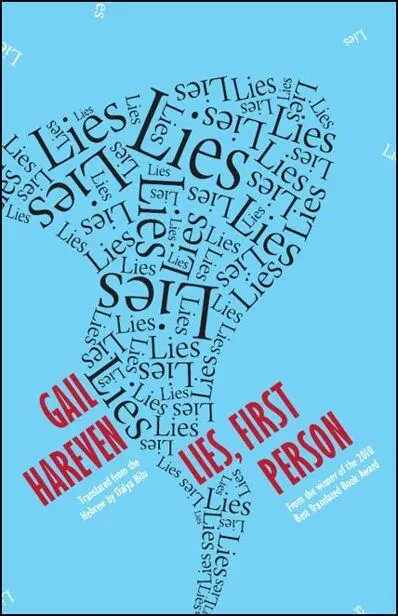
Gail Hareven - Lies, First Person
Здесь есть возможность читать онлайн «Gail Hareven - Lies, First Person» весь текст электронной книги совершенно бесплатно (целиком полную версию без сокращений). В некоторых случаях можно слушать аудио, скачать через торрент в формате fb2 и присутствует краткое содержание. Год выпуска: 2015, Издательство: Open Letter, Жанр: Современная проза, на английском языке. Описание произведения, (предисловие) а так же отзывы посетителей доступны на портале библиотеки ЛибКат.
- Название:Lies, First Person
- Автор:
- Издательство:Open Letter
- Жанр:
- Год:2015
- ISBN:нет данных
- Рейтинг книги:3 / 5. Голосов: 1
-
Избранное:Добавить в избранное
- Отзывы:
-
Ваша оценка:
Lies, First Person: краткое содержание, описание и аннотация
Предлагаем к чтению аннотацию, описание, краткое содержание или предисловие (зависит от того, что написал сам автор книги «Lies, First Person»). Если вы не нашли необходимую информацию о книге — напишите в комментариях, мы постараемся отыскать её.
Elinor's comfortable life — popular newspaper column, stable marriage, well-adjusted kids — is totally upended when she finds out that her estranged uncle is coming to Jerusalem to give a speech asking forgiveness for his decades-old book,
.
A shocking novel that galvanized the Jewish diaspora,
was Aaron Gotthilf's attempt to understand — and explain — what it would have been like to be Hitler. As if that wasn't disturbing enough, while writing this controversial novel, Gotthilf stayed in Elinor's parent's house and sexually assaulted her "slow" sister.
In the time leading up to Gotthilf's visit, Elinor will relive the reprehensible events of that time so long ago, over and over, compulsively, while building up the courage — and plan — to avenge her sister in the most conclusive way possible: by murdering Gotthilf, her own personal Hilter.
Along the way to the inevitable confrontation, Gail Hareven uses an obsessive, circular writing style to raise questions about Elinor's mental state, which in turn makes the reader question the veracity of the supposed memoir that they're reading. Is it possible that Elinor is following in her uncle's writerly footpaths, using a first-person narrative to manipulate the reader into forgiving a horrific crime?
Lies, First Person — читать онлайн бесплатно полную книгу (весь текст) целиком
Ниже представлен текст книги, разбитый по страницам. Система сохранения места последней прочитанной страницы, позволяет с удобством читать онлайн бесплатно книгу «Lies, First Person», без необходимости каждый раз заново искать на чём Вы остановились. Поставьте закладку, и сможете в любой момент перейти на страницу, на которой закончили чтение.
Интервал:
Закладка:
In the face of this outburst, the therapist said, “So many painful things, so many painful feelings,” and something else about “inundation,” as if I had opened the sewage pipes under her cream carpet. On my left, on my skin, I sensed Oded’s tide rising, I sensed it very strongly, but I didn’t turn my head.
“I don’t know how much this word helps, if it helps at all, but what you’re talking about is called trauma. And if I understand correctly, then the far from simple issue that the two of you are coping with is how to live with trauma.”
“How to live?”
“How to live. .” She repeated, and it wasn’t clear if she meant to answer or to ask.
“I’m not talking about life, why life? I’m saying the opposite. The complete opposite. I’m talking about the person who has to pay, about payment, that’s what I’m talking about, about that twisted ha-ha jokiness of his, about the fact that he’s still carrying on out there with his two little girls Tzili and Gili, ha-ha, but also about balance. If I came here in the first place, then obviously I want to be balanced. But for me to be balanced inside, there must first of all be balance outside. That’s what I meant when I asked you if you could help me.”
“To live with injustice, to accept, make peace, or come to terms with injustice, is a very painful thing.”
“Accept? Make peace? Come to terms?” I stood up, recovering my self-respect and my tongue, which obeyed me again. Inarticulateness was never one of my characteristics. “Excuse me,” I said, “I think there’s been a mistake here. I didn’t come here to look for any kind of acceptance/peace/coming to terms. That’s not what I came for at all, and if I gave the wrong impression, then I apologize.”
“Elinor, nobody here. . I would very much like to understand. .”
“I’m sorry.” I grabbed my coat and walked out of the tasteful clinic with its correct proportions, leaving my husband to write a check or make inquiries about how to hospitalize his wife. I didn’t care. I didn’t care, because somehow in the course of this farce something inside me had clarified, leaving me with an unexpected sense of relief, and the social embarrassment I knew I should feel didn’t even materialize once I was outside.
I circled the car, crossed the street, and walked up to the promenade a few buildings higher up, where the view of East Jerusalem lay spread out below me. The sky was cloudless. The strong light of the stars overcame the lights of the city, and a wind blew and dispersed the clean vapors of mist. For a moment, the movement of the wet air dimmed the lights reflected in the stone, and then it once again revealed ancient views — valley, severe wall, inhabitation.
The city found favor in my eyes, and as I stood there with squared shoulders, I had a strange sense that I too found favor in its eyes, that even if there was no one else in sight, I was not alone. Jerusalem that knew no peace. A city of blood and wrath, jealousy and war, hunger and wild beasts and plague. A city whose stones cry out for vengeance. The price will be paid, and the guilty will not be cleared. Whoso sheddeth man’s blood, by man shall his blood be shed. And I will bring this evil upon you, and I will send a fire and cut off man and beast, and break the heads of babes on rocks.
All the weight of the rocks, the stones, and the destruction tilted the scales in my favor to bring balance to the world again. The city was with me in the place where I stood because it could not be otherwise. Supported by the hard, still Jerusalem, I felt steady for the first time since I had parted from my sister. Ever since we parted, I had felt a sense of exile, and now a great city spread out in the darkness before me and spoke to me in my language, and with all the force of its presence it said the things that my tongue, swollen until it was black, had been unable to say. A God of vengeance is the Lord thy God. And He will never pardon the guilty, for the Lord hath a dispute with the inhabitants of the land to rid it of radioactive pollution.
I don’t know how long I stood there before hearing Oded’s footsteps behind me on the pavement. I don’t think it was more than a few minutes before he was at my side.
“So that’s what’s been occupying you all this time. Him? That’s what it’s all about — him?” His voice was free of complaint, surprisingly relaxed. I considered the word “occupying.” A hobby occupies you. Your business affairs. Your job.
“So it seems,” I said.
“Okay, so now I understand a bit better what’s going on. Accepting injustice is a very painful thing,” he said, and for a moment I thought I was mistaken, but I wasn’t mistaken, I had heard right: my husband was teasingly, flirtatiously mimicking the psychologist’s calm, deliberate tone. “I haven’t had a chance to tell you how much I like your haircut,” he went on quickly before I could take in what was happening here. “Can we go to the car now? I don’t know about you, but I’m going to freeze if we keep standing here.”
I accompanied him to the car and we drove home, and so it happened that we began to talk again, my husband and I, thanks to our brief visit to the soul-doctor.
We didn’t talk about everything at once, and we didn’t talk about everything: but there were bits of conversations at night, and in the morning before he left the house — exchanges that meant something took place between us.
And there were longer talks as well, on the Saturdays when he joined me on my walks. Because the restlessness that propelled me didn’t go away, only now it began to seem to me like something that was necessary, and its existence troubled me less.
Volatile Jerusalem changed its face all the time, sometimes it supported me in its clarity, and sometimes it covered itself in a filthy film of pollution. And not for a moment did I forget: First Person was arriving in the spring.
BOOK THREE.HITLER, FIRST PERSON
— 1 -
“So you didn’t save that email. .” I’d gotten up from the computer a few minutes before in order to greet my husband in the way I once did. I no longer needed the screen saver to hide my occupation, nor did I need to explain which email I was asking about.
He had deleted it. “Sorry, it was foolish of me. I would have fired myself if I did something so idiotic at work. I should have saved it in case of the extremely improbable event of his deciding to bother us again. I think I felt a childish need to simply delete it from our lives.”
“And you’re positive he didn’t mention exactly when he’s coming or for what conference.” Oded shrugged his shoulders. He had already answered this question before.
None of my web searches came up with an announcement for a conference in Jerusalem that could conceivably have invited Hitler, First Person to attend, but I assumed that the information must be somewhere in one of the three hundred one thousand tentacles, and that I couldn’t find it because I wasn’t doing the search properly.
I couldn’t keep away from the computer for more than a few hours, but I also wasn’t capable of sitting in front of the proliferating cells for more than fifteen minutes at a time. I sat down, got up, sat down again: Not-man slipped through the holes in the web, and sometimes I had the strange illusion that “Mr. Gotthilf” was not a singular but a plural. I couldn’t find a proper biography, he didn’t have a website of his own, but in different contexts he was represented as professor at six different universities. The last of these was the University of Indiana, where he had written “My Mistake.” Taking into account the frequency with which he changed his place of employment, he could be anywhere.
Читать дальшеИнтервал:
Закладка:
Похожие книги на «Lies, First Person»
Представляем Вашему вниманию похожие книги на «Lies, First Person» списком для выбора. Мы отобрали схожую по названию и смыслу литературу в надежде предоставить читателям больше вариантов отыскать новые, интересные, ещё непрочитанные произведения.







Обсуждение, отзывы о книге «Lies, First Person» и просто собственные мнения читателей. Оставьте ваши комментарии, напишите, что Вы думаете о произведении, его смысле или главных героях. Укажите что конкретно понравилось, а что нет, и почему Вы так считаете.