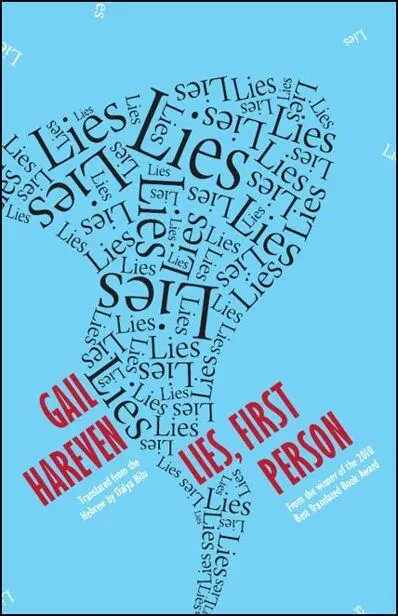
Gail Hareven - Lies, First Person
Здесь есть возможность читать онлайн «Gail Hareven - Lies, First Person» весь текст электронной книги совершенно бесплатно (целиком полную версию без сокращений). В некоторых случаях можно слушать аудио, скачать через торрент в формате fb2 и присутствует краткое содержание. Год выпуска: 2015, Издательство: Open Letter, Жанр: Современная проза, на английском языке. Описание произведения, (предисловие) а так же отзывы посетителей доступны на портале библиотеки ЛибКат.
- Название:Lies, First Person
- Автор:
- Издательство:Open Letter
- Жанр:
- Год:2015
- ISBN:нет данных
- Рейтинг книги:3 / 5. Голосов: 1
-
Избранное:Добавить в избранное
- Отзывы:
-
Ваша оценка:
Lies, First Person: краткое содержание, описание и аннотация
Предлагаем к чтению аннотацию, описание, краткое содержание или предисловие (зависит от того, что написал сам автор книги «Lies, First Person»). Если вы не нашли необходимую информацию о книге — напишите в комментариях, мы постараемся отыскать её.
Elinor's comfortable life — popular newspaper column, stable marriage, well-adjusted kids — is totally upended when she finds out that her estranged uncle is coming to Jerusalem to give a speech asking forgiveness for his decades-old book,
.
A shocking novel that galvanized the Jewish diaspora,
was Aaron Gotthilf's attempt to understand — and explain — what it would have been like to be Hitler. As if that wasn't disturbing enough, while writing this controversial novel, Gotthilf stayed in Elinor's parent's house and sexually assaulted her "slow" sister.
In the time leading up to Gotthilf's visit, Elinor will relive the reprehensible events of that time so long ago, over and over, compulsively, while building up the courage — and plan — to avenge her sister in the most conclusive way possible: by murdering Gotthilf, her own personal Hilter.
Along the way to the inevitable confrontation, Gail Hareven uses an obsessive, circular writing style to raise questions about Elinor's mental state, which in turn makes the reader question the veracity of the supposed memoir that they're reading. Is it possible that Elinor is following in her uncle's writerly footpaths, using a first-person narrative to manipulate the reader into forgiving a horrific crime?
Lies, First Person — читать онлайн бесплатно полную книгу (весь текст) целиком
Ниже представлен текст книги, разбитый по страницам. Система сохранения места последней прочитанной страницы, позволяет с удобством читать онлайн бесплатно книгу «Lies, First Person», без необходимости каждый раз заново искать на чём Вы остановились. Поставьте закладку, и сможете в любой момент перейти на страницу, на которой закончили чтение.
Интервал:
Закладка:
My husband talked about Nimrod and his vague plans for the future, and when I was miserly with my responses, he went on to talk at length about himself.
He asked with a certain coyness if, in my opinion, he had been a good father to our sons, and immediately announced that in his estimation “he had done quite a good job with them.” He had actually particularly enjoyed the boys during the period of their adolescence, which was supposed to be so difficult. The sincerity of their seeking, their rebelliousness, the totality they had possessed then — in some strange way it appeared that he found it easy to connect to the mind-set characteristic of this age: which led him to think that one day, when he retired from the firm, he should work with adolescents. It could be fun. When he was still doing reserve duty, he had never complained when he was sent to command young soldiers. At the age of fifteen, he picked up playing sports and lost more than ten kilos. The guy who had influenced him then — I probably remembered — was a substitute biology teacher, biology of all things. Every teacher, it seemed, could have a decisive influence. And this was why he was coming around more and more to the idea that perhaps his true vocation was to be a high school homeroom teacher. He was also beginning to think seriously that, in a few years time, he might even go ahead and check out this possibility.
I told him that my sister had always hated school, that she hadn’t had the good fortune to come across an influential educator there, and then I added that I didn’t know what things were like during the period of the abuse. I wasn’t there to see what was happening to her. I was in boarding school, and there, far away from her, I actually did come into the orbit of a number of impressive teachers — but perhaps at that time school actually served as an escape from the things he was doing to her, because school could be a kind of refuge.
“I know that he turned her into a piece of furniture,” I said, without having clearly decided to tell him. From his reaction I understood that he thought “furniture” was simply a metaphor I had thrown out instead of saying “object,” and so it came about that I explained to him: he wiped his shoes on her. He put a suitcase on her and remarked that in every normal hotel room there was a special stool provided for this purpose.
And he once explained to her that everything he did was a kind of experiment, only she was too stupid to understand what he was talking about.
While I was telling my husband this, the potted plant he brought her came into my head, and the final significance of the orchid became clear: that flower was like the banana offered to the monkey after the rubber gloves are removed at the conclusion of the experiment. But I kept this insight to myself.
“So tell me, is there some article in your law book, is there some punishment that covers a situation in which a high-school student is turned into a stool?”
Oded’s face twisted. “I don’t know about the law. Personally, I would castrate him, and I’m not talking about the chemical variety.”
“Is that what you would do? Really?”
“I think so. And I would give him time, too, enough to think about what I was going to do to him.”
His mouth remained twisted. I touched the corner with the tip of my finger. “What do you think?”
“I actually thought about a cage. I would shut him up in a glass cage and then would put the cage somewhere where people could come and look. Look at him until he died.”
“A glass coffin or box,” he said without turning to face me, as if absent-mindedly. He stroked my bare neck. “Armor-plated glass. That man should be stuck standing up in a glass box where he can’t move: not sit, not bend down, nothing.”
Our car was the only one standing in the parking lot. Our breath covered the windshield with vapors, and Oded wiped them away with his sleeve so we could go on seeing the hard, gray city below us. I think that the sight of the city supported him like it supported me, because the Saturday after that, when we left his parents’ house after lunch, he again suggested that we drive to the promenade.
Writers are not in the business of sticking strictly to the facts, and the scenes I’ve chosen to describe above could give the impression that there was nothing but contention, strife, the Not-man between my husband and myself. But there were other things too, and there are also other images: a woman vacuums, and a husband and wife carry the carpet outside together and hang it on the clothesline to air out; a gardener comes to dig up a tree, and the couple visit various nurseries together to decide what to plant in its place; a father and mother look at the photographs their younger son has sent them from a trip he took to a pueblo reservation, and speculate about the bespectacled young woman with the yellow backpack who appears in most of them.
Oded rolls his Sabbath joint. I make popcorn. I smooth and straighten his eyebrows. We sit together on the sofa, our legs parallel on the coffee table, and watch a movie. We watched quite a lot of movies then, and my husband chose them all, because during that period when I had a hard time making him happy in other ways, I learned to enjoy the movies he liked with him. Aliens, germs, terrorists, a comet, a storm, or a volcano — something threatens to wreak destruction on the world. A good man finds himself in an intolerable situation, and in order to rescue whoever needs to be rescued, he sets the place on fire. He does what has to be done.
I discovered that blood and fire and columns of smoke calmed my feverish imagination, and when we sat like brother and sister and watched Oded’s guy flicks, I had no difficulty sitting still in one place for even two hours at a time. The cinematic adrenaline was an efficient antiseptic, and I occasionally fell asleep on the sofa when the movie was over.
— 2 -
Idon’t know what other people thought of me during this period. I have no doubt that my concerned and observant mother-in-law, keeping a watchful eye on her household and loved ones, heard the seething of my inner ferment, and that she went on hearing it even after her son and I started meeting each other’s eyes again.
It’s clear to me, and in fact it was clear to me even then, that after a while she no longer accepted my “Alice crisis” as a cause, and began to see it as part of a syndrome.
Personal temperament, family culture, and the hidden but rigid rules that had been laid down between us from the day we met prevented any direct interrogation, but they did not stop her from buzzing discreetly around the subject.
One Saturday she launched into a long monologue about two of her friends who suffered from “empty nest syndrome” after the last of their children left home.
“When the children are in the army it’s different, as long as you do their laundry they’re still your babies. When Oded moved into his first apartment, he went on bringing me his laundry, and I’ll tell you honestly, even if it’s anti-feminist, doing his laundry for him gave me a good feeling. They say that the telephone and the computer cancel out distances, but in my opinion, and from the experience of my friends, there’s simply no substitute for being face to face. It’s only natural for a mother to want to see her child’s face, and also to know if he has holes in his socks.”
A woman who didn’t want to see her children face to face was beyond the bounds of her imagination. If she had been compelled to acknowledge such a possibility she would have been outraged, and she would have regarded me as a monster. But I wasn’t a monster, not at all.
I remembered the times before the spoiling, the days when it was enough for me to imagine one of my sons — Yachin kicking his legs in his bay carriage as if he was already in a hurry to run, Nimrod learning from his brother the correct way to lace his army boots — these memories were enough for me to brim over with a great joy at the mere fact of my beautiful sons’ existence in the world.
Читать дальшеИнтервал:
Закладка:
Похожие книги на «Lies, First Person»
Представляем Вашему вниманию похожие книги на «Lies, First Person» списком для выбора. Мы отобрали схожую по названию и смыслу литературу в надежде предоставить читателям больше вариантов отыскать новые, интересные, ещё непрочитанные произведения.











Обсуждение, отзывы о книге «Lies, First Person» и просто собственные мнения читателей. Оставьте ваши комментарии, напишите, что Вы думаете о произведении, его смысле или главных героях. Укажите что конкретно понравилось, а что нет, и почему Вы так считаете.