Gail Hareven - Lies, First Person
Здесь есть возможность читать онлайн «Gail Hareven - Lies, First Person» весь текст электронной книги совершенно бесплатно (целиком полную версию без сокращений). В некоторых случаях можно слушать аудио, скачать через торрент в формате fb2 и присутствует краткое содержание. Год выпуска: 2015, Издательство: Open Letter, Жанр: Современная проза, на английском языке. Описание произведения, (предисловие) а так же отзывы посетителей доступны на портале библиотеки ЛибКат.
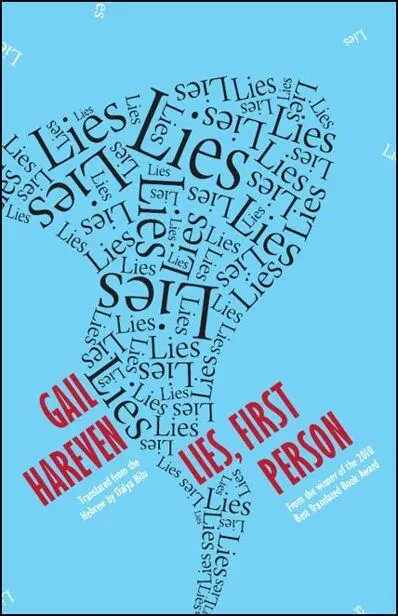
- Название:Lies, First Person
- Автор:
- Издательство:Open Letter
- Жанр:
- Год:2015
- ISBN:нет данных
- Рейтинг книги:3 / 5. Голосов: 1
-
Избранное:Добавить в избранное
- Отзывы:
-
Ваша оценка:
Lies, First Person: краткое содержание, описание и аннотация
Предлагаем к чтению аннотацию, описание, краткое содержание или предисловие (зависит от того, что написал сам автор книги «Lies, First Person»). Если вы не нашли необходимую информацию о книге — напишите в комментариях, мы постараемся отыскать её.
Elinor's comfortable life — popular newspaper column, stable marriage, well-adjusted kids — is totally upended when she finds out that her estranged uncle is coming to Jerusalem to give a speech asking forgiveness for his decades-old book,
.
A shocking novel that galvanized the Jewish diaspora,
was Aaron Gotthilf's attempt to understand — and explain — what it would have been like to be Hitler. As if that wasn't disturbing enough, while writing this controversial novel, Gotthilf stayed in Elinor's parent's house and sexually assaulted her "slow" sister.
In the time leading up to Gotthilf's visit, Elinor will relive the reprehensible events of that time so long ago, over and over, compulsively, while building up the courage — and plan — to avenge her sister in the most conclusive way possible: by murdering Gotthilf, her own personal Hilter.
Along the way to the inevitable confrontation, Gail Hareven uses an obsessive, circular writing style to raise questions about Elinor's mental state, which in turn makes the reader question the veracity of the supposed memoir that they're reading. Is it possible that Elinor is following in her uncle's writerly footpaths, using a first-person narrative to manipulate the reader into forgiving a horrific crime?
Lies, First Person — читать онлайн бесплатно полную книгу (весь текст) целиком
Ниже представлен текст книги, разбитый по страницам. Система сохранения места последней прочитанной страницы, позволяет с удобством читать онлайн бесплатно книгу «Lies, First Person», без необходимости каждый раз заново искать на чём Вы остановились. Поставьте закладку, и сможете в любой момент перейти на страницу, на которой закончили чтение.
Интервал:
Закладка:
About what happens afterward, about Winston’s betrayal, about how he pleads for his beloved to be tortured instead of him, about the monstrous passage when he screams “Do it to her,” about the chapter where it says in so many words, “I’m taking the photograph. Take my sister as my ransom, take her instead of me”—about this I said nothing. This chapter was forgotten for the moment.
This chapter was forgotten, and maybe it isn’t important. In the end it turns out that Winston’s lover underwent the torture too, that she would have undergone it anyway, without any connection to his betrayal and what he screamed.
Saturday afternoon, people walk with measured steps, pious Jews on their way to visit their families.
“Let’s go for a little walk.”
I drove my husband to the place where I had refused to take him during the time when we started living together. Jerusalem is small, but it’s easy to avoid the end of a street that was once on the outskirts of the neighborhood of Beth Hakerem, but no longer. I hadn’t been there on my own either since my father got into a taxi with my sister and me to accompany us to our basement apartment and our folie à deux .
In my memory I see that taxi driving away in a cloud of loose pages. The developer who purchased the property from my father conditioned the purchase on its immediate evacuation — so Shaya explained to us — and under the pressure of the haste and the mourning there was no time to find a buyer for the library my father had collected over the years. Works in French, Russian, Polish, Serbian, Romanian, piles of books he didn’t know how to read—“my foundlings” he called them — were hurriedly parceled up to be sent to the shredders. Jamilla, the cleaning woman, sympathized with the three of us — for Elisheva, I knew, she had always felt a measure of affection — but Jamilla was already too old to climb up a ladder, and I was the one who climbed the ladder and threw the volumes down to Shaya. There were no fond farewells, books hit the floor and sent up clouds of dust. Covers split apart. Parts of books were trampled. Pages came out and flew about the room. But, as should be obvious to any person of sense, the pages couldn’t possibly have flown into the street and remained floating of their own accord — it was my literary imagination that sent them flying around the taxi and left them suspended in the air. Ever since I can remember myself I have attached an exaggerated importance to books.
My parents met when the place was still called “Palm Pension.” The young employee took the heart of the owners’ daughter by storm. The student who came to support himself while he studied was snared in the daughter’s net — with the Gotthilf family you can never know what the truth may be.
But wherever the truth lies, after Shaya had become a partner in the business, and once he realized that his wife would never allow him to sell their common property, one day he decided to make his fate his choice, and in a flamboyant gesture of commitment he changed the name of the place to his own: Pension Gotthilf.
“The truth is that there was never a palm growing here,” I said to Oded. “But this fact never bothered anyone, certainly not my parents.”
The developer who bought the property demolished the hotel and put up a new building in its place: four stories with balconies for Sukkoth booths and a thin coating of industrial stone. The garden was turned into a parking lot. Residents on the third floor had grown cascading geraniums in planters on their balcony: white, red, purple and mauve.
The demolished hotel was a Jerusalem palace whose stones had all been hewn by hand. Each stone with its own shade of rosy pink. Lovingly cultivated, luxuriantly leafy trees spread their shade from the swing in the garden to the upper windows. In the cool summer evening the guests would sit outside around little tables set with Armenian tiles. A glass chandelier, the sole survivor of European elegance, twinkled at them from inside the house, and the smell of the coffee on the copper trays mingled with the scent of the jasmine.
With the dying down of the fever of my impatience, the spirit of literary imagination rested on me again, and for a moment I was tempted to lie to my husband like a tourist guide or the pigtail-sucker. The destruction of the old hotel prepared the ground for the sprouting of any fancy that came into my head. Because the truth is that not only was there no palm tree, there weren’t any Armenian tables or copper trays either, and the uniqueness of the pink stones was a blatant lie too. Pension Gotthilf was a perfectly ordinary building, and the air was not scented by anything except for the dust of the cypresses that clung to the chandelier, which was never cleaned.
But even though there were many things I had kept to myself and never told Oded, I had never lied to him or prettified anything. I had been taken into the land of the salt of the earth from an insignificant and pretentious nowhere, but it was nevertheless the place that for many years, all the years of my childhood, I had called home.
Does Satan’s evil begin with his attack on the “downstairs people”? The insignificant people with their foolish pretensions? Because he was elegant, the First Person. He drank his coffee elegantly, declined the cake made with margarine elegantly. “Elinor and Elisheva, Eli and Eli,” he said and kissed my hand.
Oded has to understand without my dragging Armenian tables and copper trays into the picture.
“They gave him the corner room on the second floor,” I said. On the end of the North side, at the back. He insisted that he required maximum privacy. He even prevented Jamilla from coming in to clean on the grounds that he was busy with his research in the mornings. It was supposed to be a quiet room, but from downstairs, especially from the garden, you could hear the noise of the typewriter.”
“Trash,” said Oded. “Just stinking trash and not a human being. You know what I think I would do to a creature like him? What I would really do with that trash? I would bury him in the Ramat Hovev landfill in the Negev. Let him choke there under the mountains of garbage. That’s the best thing for him.”
The new image he offered me caught my fancy and I lingered on it. A bulldozer trundles up. A blade turns the garbage over. Another bulldozer approaches and covers it up. Something twitches in the mound, something stirs among the garbage, or perhaps not. Garbage covers a multitude of sins. The camera moves away, and now we see a clean, arid desert. The noise of the bulldozers fades. In the distance they look like two upturned yellow scorpions. There is no sound.
As my husband said, that would be good. Better than room 101, considerably better than a mask and rats. Dirty things get thrown out in the garbage, and the imagination has no need to fasten the mask to the face and at the same time look into the face of the trash. In Ramat Hovev, the imagination does not drown in the picture and the throat does not choke.
“So your parents are going to sit down to dinner with him. Okay. I knew it. From the beginning I said he’d find a way to get to us in the end.”
“I’m sorry,” my knight repeated, and refrained from questioning my logic. “But there’s still some time before it happens, more than a month in fact. Let me see what I can do.”
I opened a window. “I’m not saying that he initiated or plotted this dinner, I’m not completely crazy, so you needn’t look at me like that. I’m just saying that he’s not coming here for nothing. Nothing’s changed. He wants something. I’m sure. This isn’t paranoia on my part, I just know.”
“Don’t you want to get out of the car? To see how the street has changed?”
Читать дальшеИнтервал:
Закладка:
Похожие книги на «Lies, First Person»
Представляем Вашему вниманию похожие книги на «Lies, First Person» списком для выбора. Мы отобрали схожую по названию и смыслу литературу в надежде предоставить читателям больше вариантов отыскать новые, интересные, ещё непрочитанные произведения.






Обсуждение, отзывы о книге «Lies, First Person» и просто собственные мнения читателей. Оставьте ваши комментарии, напишите, что Вы думаете о произведении, его смысле или главных героях. Укажите что конкретно понравилось, а что нет, и почему Вы так считаете.