Gail Hareven - Lies, First Person
Здесь есть возможность читать онлайн «Gail Hareven - Lies, First Person» весь текст электронной книги совершенно бесплатно (целиком полную версию без сокращений). В некоторых случаях можно слушать аудио, скачать через торрент в формате fb2 и присутствует краткое содержание. Год выпуска: 2015, Издательство: Open Letter, Жанр: Современная проза, на английском языке. Описание произведения, (предисловие) а так же отзывы посетителей доступны на портале библиотеки ЛибКат.
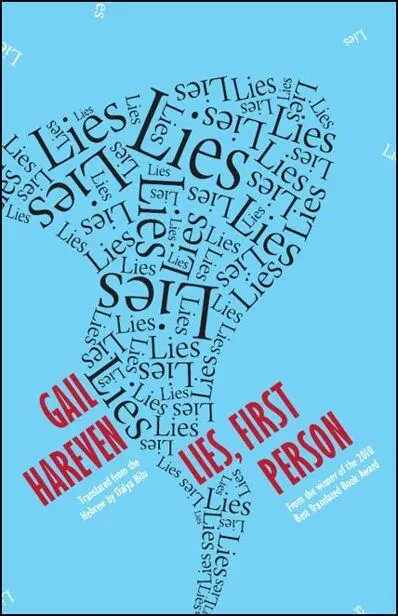
- Название:Lies, First Person
- Автор:
- Издательство:Open Letter
- Жанр:
- Год:2015
- ISBN:нет данных
- Рейтинг книги:3 / 5. Голосов: 1
-
Избранное:Добавить в избранное
- Отзывы:
-
Ваша оценка:
Lies, First Person: краткое содержание, описание и аннотация
Предлагаем к чтению аннотацию, описание, краткое содержание или предисловие (зависит от того, что написал сам автор книги «Lies, First Person»). Если вы не нашли необходимую информацию о книге — напишите в комментариях, мы постараемся отыскать её.
Elinor's comfortable life — popular newspaper column, stable marriage, well-adjusted kids — is totally upended when she finds out that her estranged uncle is coming to Jerusalem to give a speech asking forgiveness for his decades-old book,
.
A shocking novel that galvanized the Jewish diaspora,
was Aaron Gotthilf's attempt to understand — and explain — what it would have been like to be Hitler. As if that wasn't disturbing enough, while writing this controversial novel, Gotthilf stayed in Elinor's parent's house and sexually assaulted her "slow" sister.
In the time leading up to Gotthilf's visit, Elinor will relive the reprehensible events of that time so long ago, over and over, compulsively, while building up the courage — and plan — to avenge her sister in the most conclusive way possible: by murdering Gotthilf, her own personal Hilter.
Along the way to the inevitable confrontation, Gail Hareven uses an obsessive, circular writing style to raise questions about Elinor's mental state, which in turn makes the reader question the veracity of the supposed memoir that they're reading. Is it possible that Elinor is following in her uncle's writerly footpaths, using a first-person narrative to manipulate the reader into forgiving a horrific crime?
Lies, First Person — читать онлайн бесплатно полную книгу (весь текст) целиком
Ниже представлен текст книги, разбитый по страницам. Система сохранения места последней прочитанной страницы, позволяет с удобством читать онлайн бесплатно книгу «Lies, First Person», без необходимости каждый раз заново искать на чём Вы остановились. Поставьте закладку, и сможете в любой момент перейти на страницу, на которой закончили чтение.
Интервал:
Закладка:
“My father sometimes gets carried away, that’s true. Lately in the office. . but that doesn’t mean that in relation to you he. .”
“And besides, after all these years, you know, it’s a little late to come down on them,” I said and leaned over to gently take the pencil from his fingers. Because I felt gentleness toward him in those days. All kinds of gentle feelings popped up again, sometimes accompanied by a sensation of déjà vu and sometimes the opposite, in a kind of anticipated nostalgia.
One Friday noon, after three days without rain, I stood and watched him diligently scrubbing at some invisible stain on the door of the Jeep, and my heart went out to his childish concentration.
Another time I saw him beheading a wilted anemone in the garden, and it seemed to me that I had already experienced this very moment, my man and the white, wet, wilted, beheaded anemone, before. He turned his head toward me over his shoulder, and I felt a pang at the knowledge of how I would one day remember this exact movement, this smile of his, and this beautiful shoulder.
Like an old woman full of experiences I rose above time again and again: I mourned the passing of the moment even before it passed, and I tasted the past and the future in the present.
When the consciousness of the conductivity of time broadened, and events increasingly poured through the insulation of the tenses, I sometimes brimmed over to our sons too. One night after Nimrod called and told us about some trivial matter of etiquette in which he had failed in relation to one of his teachers, I sent him a mail whose lines I would prefer to forget. “Whatever happens and whatever they tell you, remember that your mother will always, always love you more than anything in the world”—this is the kind of thing I wrote. Such outpourings were not our style, certainly not since the boys had grown up, and presumably it only embarrassed him. It was a letter that a sentimental drunk might have written, and I wasn’t drunk. And long before morning broke I knew that it was a good thing that Nimrod was grown up and living safely in Atlanta, far from my cloying convulsions.
I didn’t behave like this all the time — Oded testifies that I looked “disconnected and detached,” and so I apparently was for most of the time — but every few days the picture of a particular moment would begin to vibrate inside me, and all of a tremor I would shower people with out-of-place emotions.
I bought a girlfriend an expensive antique alarm clock, even though her birthday was two months away.
I baked a pecan pie and took it to the neighbors, “in honor of the fact that we finally uprooted the Ailanthus tree and it won’t be undermining our fence any more.” This was the kind of thing I did.
•
One afternoon I dropped in on my mother-in-law without letting her know in advance.
“That haircut really suits you, but tell me, don’t you feel cold? I remember when I was a little girl and my mother made me get my hair cut, I was cold all winter.”
I put down my cup of tea and got up and kissed her on the top of her head. Since the day that Oded had brought me to their house her hair had gone completely white, but it still felt to me as if this were that very first time, and that this good woman was now stroking my tiger face and asking me if it didn’t hurt.
“You always ask the right questions,” I gushed, and as if this wasn’t enough I added tastelessly: “You should have had a daughter. If you’d had a daughter, I’m sure she would have been the happiest woman in the world.”
In the moronic fantasy world I was now inhabiting, my mother-in-law would have kissed me back and said: “But I have a daughter, you’re my daughter,” but instead of this Rachel gave me a suspicious look and asked: “So what are your plans for the rest of the day?”
It was obvious that she wanted me to finish my tea and leave.
The question of what I was planning to do kept coming up, with my husband returning to it almost every morning.
The liquidation of Alice left me with a lot of time on my hands, not only writing time as such. Alice had been regularly invited to cultural events in the city, and ever since her disappearance the invitations, which I had no desire for in the first place, had dried up.
My family used to joke about my ability to fall asleep and dream at will, but this ability had abandoned me.
I fell asleep only when I was exhausted. I slept lightly. I would be awoken by sounds that fell silent the second I opened my eyes, and I could remember only snatches of my dreams.
Oded, who loved my dreams and the wife who dreamed them, was worried, but what worried him even more was the fact that I had completely stopped reading books.
“What are you reading now?”
“Nothing interesting. The truth is, nothing at all.”
I went on buying books. The books piled up next to the bed, but ever since Hitler, First Person , the interest I had in fictional worlds had simply vanished. I would read a paragraph, see no point in it, and immediately forget it. First Person had deprived me of my ability to read.
Everyone around me thought that I would have a problem “filling my time,” but as far as I was concerned time was brim-full of itself and in no need of filling. Everyday activities, when I paid attention to them, swelled with meaning, and each and every one of them thrilled and moved me in its own right. One day I sat down to write a check to the electric company, and I remember how the check and the account focused my mind as intently as the finest of the poetry I had read.
Two monthly account
To: Oded and Elinor Brandeis
7 Bat Yiftah Street Jerusalem
Pay to the account of: The Electric Company
Amount, date, signature.
And at the top right of the check, too, Oded and Elinor Brandeis and our home address.
Like a new bride from some earlier century I signed “Elinor Brandeis,” full of gratitude for the new name that had been given me. Gotthilf, as my father-in-law had pointed out, was not a common name. Gotthilf was a rare name, and it could become extinct.
“Elinor, are you listening at all to what I’m telling you?”
“What?”
“I was talking about the possibility of getting an adjournment in the case. . oh, never mind.”
“But I want you to talk.” And indeed I did, for there was something uniquely beautiful about my husband when he explained legal matters to me. I was eager to see him talk: only listening presented a problem.
“I was going to say that my father interferes for nothing, and that if the judge agrees to an adjournment, there’ll be a possibility. . forget it, it isn’t interesting: legal nonsense.”
“But why do you say that? I want to hear. You know, I had an idea about that dinner, maybe the best solution would be for your father to organize an invitation for me, too.”
— 5 -
The seder that year was the first that both Nimrod and Yachin didn’t come home for, and in the days before Passover this thought saddened their father: “Up to now we’ve been really lucky, at the last minute at least one of them was always able to make it. Just because a person realizes how lucky he was doesn’t mean that he’s prepared to stop being lucky.”
My husband missed our sons; I didn’t, but in my increasingly warped mind the thought occurred to me that the sadness everybody assumed I was feeling could serve as an excuse for my strangeness: April is the cruelest month. Passover is the hardest holiday. Overnight it became very hot, and in the sudden heat the swollen moon turned orange, and the wolves bared their teeth and howled with longing.
All families were tested by this gathering of the clan under the full orange moon, and it was only natural for the mother wolf to grieve the absence of her sons.
Читать дальшеИнтервал:
Закладка:
Похожие книги на «Lies, First Person»
Представляем Вашему вниманию похожие книги на «Lies, First Person» списком для выбора. Мы отобрали схожую по названию и смыслу литературу в надежде предоставить читателям больше вариантов отыскать новые, интересные, ещё непрочитанные произведения.





Обсуждение, отзывы о книге «Lies, First Person» и просто собственные мнения читателей. Оставьте ваши комментарии, напишите, что Вы думаете о произведении, его смысле или главных героях. Укажите что конкретно понравилось, а что нет, и почему Вы так считаете.