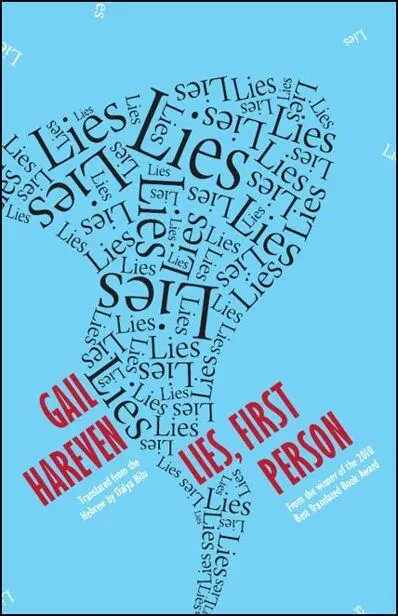
Gail Hareven - Lies, First Person
Здесь есть возможность читать онлайн «Gail Hareven - Lies, First Person» весь текст электронной книги совершенно бесплатно (целиком полную версию без сокращений). В некоторых случаях можно слушать аудио, скачать через торрент в формате fb2 и присутствует краткое содержание. Год выпуска: 2015, Издательство: Open Letter, Жанр: Современная проза, на английском языке. Описание произведения, (предисловие) а так же отзывы посетителей доступны на портале библиотеки ЛибКат.
- Название:Lies, First Person
- Автор:
- Издательство:Open Letter
- Жанр:
- Год:2015
- ISBN:нет данных
- Рейтинг книги:3 / 5. Голосов: 1
-
Избранное:Добавить в избранное
- Отзывы:
-
Ваша оценка:
Lies, First Person: краткое содержание, описание и аннотация
Предлагаем к чтению аннотацию, описание, краткое содержание или предисловие (зависит от того, что написал сам автор книги «Lies, First Person»). Если вы не нашли необходимую информацию о книге — напишите в комментариях, мы постараемся отыскать её.
Elinor's comfortable life — popular newspaper column, stable marriage, well-adjusted kids — is totally upended when she finds out that her estranged uncle is coming to Jerusalem to give a speech asking forgiveness for his decades-old book,
.
A shocking novel that galvanized the Jewish diaspora,
was Aaron Gotthilf's attempt to understand — and explain — what it would have been like to be Hitler. As if that wasn't disturbing enough, while writing this controversial novel, Gotthilf stayed in Elinor's parent's house and sexually assaulted her "slow" sister.
In the time leading up to Gotthilf's visit, Elinor will relive the reprehensible events of that time so long ago, over and over, compulsively, while building up the courage — and plan — to avenge her sister in the most conclusive way possible: by murdering Gotthilf, her own personal Hilter.
Along the way to the inevitable confrontation, Gail Hareven uses an obsessive, circular writing style to raise questions about Elinor's mental state, which in turn makes the reader question the veracity of the supposed memoir that they're reading. Is it possible that Elinor is following in her uncle's writerly footpaths, using a first-person narrative to manipulate the reader into forgiving a horrific crime?
Lies, First Person — читать онлайн бесплатно полную книгу (весь текст) целиком
Ниже представлен текст книги, разбитый по страницам. Система сохранения места последней прочитанной страницы, позволяет с удобством читать онлайн бесплатно книгу «Lies, First Person», без необходимости каждый раз заново искать на чём Вы остановились. Поставьте закладку, и сможете в любой момент перейти на страницу, на которой закончили чтение.
Интервал:
Закладка:
Passover is also the family Day of Atonement, of the mutual settling of accounts. And it seems that there is no better time than this for the plot to take a turn. Isn’t it obvious that the Brandeis family seder should provide the setting for a dramatic turning point?
Here sits the family, reclining around the table, the grandfather at the head and the grandmother opposite him. Old conflicts seethe beneath the surface of the conversation, gradually the conflicts heat up and the tension rises and boils over. Dark secrets are revealed. Forbidden feelings burst and come violently to light. Father against son. Son against father. Daughter-in-law against mother-in-law, fighting in possessive fury for the soul of the only son. Everything held back for years breaks out.
Will anyone believe me when I say that there were no secrets or darkness in the Brandeis family except for mine? That these good people had succeeded in achieving the no-longer-believable: a happy family?
The land of the salt of the earth was clean, and I was cleansed in the sunshine of this land, until the filth came back to infect me.
The natives of the land that adopted me were not foolish or naïve, they knew about the existence of evil. But they had never known it as I was forced to know it, and they never carried it in their guts.
So no family turning-point took place at the Passover seder, I succeeded in damming the darkness, and the only change that took place that night was that I almost stopped talking.
Our movements appeared pleasant and relaxed. Oded wore a blue shirt he had bought in Seattle — for him white shirts belonged to the daily grind of the courts — and I got up from the computer to undo his top button.
Elisheva sent holiday greetings with the usual decoration of deer tracks, and added in Hebrew in English letters: “Next year in Jerusalem.”
“What should I answer her? Happy holiday to you too? Amen? Hallelujah?”
“Whatever you say will make her happy. Come on, let’s go.”
The radio was on, my husband hummed along with “sheaves of wheat standing in the fields” and the newscaster announced that “preparations for the holiday have been completed throughout the land.” I remember that I became a little obsessed with the word “completed”—what was complete here, what had concluded? — but I got over it quite quickly.
I was wearing sandals for the first time since the winter. I took the haroset out of the fridge. Oded carried the salad bowl. When we were already standing at the door, Yachin called, and his father told him we would talk later from his grandparents’ house.
Determined not to let the absence of the boys cloud the occasion, Rachel and Menachem had invited another couple whose four children were abroad or in the army, and a distant relative of Menachem’s who had come for a visit from Argentina with her youth movement, and whom they referred to incorrectly as their “niece.” At the last minute one of the legal clerks in the office had also been invited, after it transpired that he was on bad terms with his parents.
Grandfather sat at the head of the table, Grandmother opposite him. Grandfather rose to say the blessing. We answered “Amen” and read the Haggadah with the businesslike seriousness of people fulfilling a not unpleasant obligation.
Until “blood and fire and pillars of smoke” I sat quietly and behaved normally. I even noticed how the clerk’s expression softened when the Zionist niece read “How is this night different from all other nights” syllable by syllable. Her face was bright red from the Masada sun, and as she read the four questions — which aren’t really four questions at all but only one nagging question — her lowered face grew even redder.
I waited for the reading to be over, for an opportunity to ask if the date for the dinner with the conference guests had already been fixed. It was important for me to know, but the Chinese Mandarin who had taken up residence inside me went on guiding me in the path of patience, and I went on being patient.
Reality descended on me when we dipped our fingers in our glasses to sprinkle blood and fire and pillars of smoke and the other ten plagues, one drop per plague. From the house of the neighbors who had begun the ritual early rose sounds of singing, and with “Once we were slaves” in my ears and the drops of wine that had merged into a red puddle on my plate, all the seders in the country merged into one in my mind, and suddenly I knew with a certain knowledge that the Not-man was also sitting at a seder table, and it seemed that he too was sitting with us and he too was dipping his finger into his glass opposite us. And I also knew that he was already in Israel and I was not yet ready, not ready at all, my preparations had not been completed.
I had not taken leave of my senses: he had an ultra-Orthodox son. Those people, as Erica said, were scrupulous in obeying the commandment to honor their parents, and if the father was coming to Israel anyway, they would certainly have invited him to join them at the seder. So it was only logical to conclude that at this very moment he was sitting with a skullcap on his head and dipping his finger into his wine, perhaps singing. Not singing — I corrected myself — not singing yet. With the religious the reading went on forever, so at this moment he was still reading the Haggadah in his hard-to-place accent.
Soup was served and I ate. A conversation developed and I was silent. At some stage, when my husband was helping his mother clear the soup plates from the table, the Zionist niece asked me: “What do you do?” What did I do? I considered the question seriously. “I think I’m busy going crazy.” Nobody heard me but her. And from her nod it was clear that she wasn’t sure she had heard right. Immediately after that she resumed her conversation with the clerk, and I went back to being quietly driven mad by reality.
•
The opportunity to ask what I wanted to ask came with the roast and green beans and potatoes.
Because of the holiday, and in honor of the Zionist niece who had come to Israel to study and deepen her identity, the conversation turned to the Jewish destiny. And I, from where I was sitting at the archetypical seder table together with all the rest of the House of Israel, went on listening: Rachel mentioned her uncle who had been murdered by the Arabs in 1929. Her friend mentioned a large family lost in the Holocaust. The Zionist niece said something enthusiastic about “the uniqueness of our history.” The clerk said that perhaps the uniqueness lay not in history itself but in the ability to turn it into a story, just as we had done now.
“So what do you say to a Jew, a professor, a survivor of the Holocaust himself, who chooses of all things to tell the story of Hitler?”
Menachem’s voice promised his guests that he was about to serve them a conversational delicacy, and he kept his promise. He set it all before them: the First Person and the professor’s retreat from the First Person, and also the fact that they were going to meet said professor in person. “That professor” Chemi called him, without mentioning his relation to “our Elinor.”
I was given the opportunity and I failed to take advantage of it. The women directed the conversation into less fraught channels: Israeli Prime Ministers, the increasing frequency of allergies in the spring season, the importance of using sun screens, and such matters. And plates were cleared and bowls were brought, more wine was poured, and dessert was served.
I must point out that I had not been struck dumb by hysteria. When I was addressed I replied “yes” and “no” and “apparently,” I went on following the conversation and I can remember every word. My abstinence was voluntary, I retired of my own free will because I had things to do.
Читать дальшеИнтервал:
Закладка:
Похожие книги на «Lies, First Person»
Представляем Вашему вниманию похожие книги на «Lies, First Person» списком для выбора. Мы отобрали схожую по названию и смыслу литературу в надежде предоставить читателям больше вариантов отыскать новые, интересные, ещё непрочитанные произведения.











Обсуждение, отзывы о книге «Lies, First Person» и просто собственные мнения читателей. Оставьте ваши комментарии, напишите, что Вы думаете о произведении, его смысле или главных героях. Укажите что конкретно понравилось, а что нет, и почему Вы так считаете.