Gail Hareven - Lies, First Person
Здесь есть возможность читать онлайн «Gail Hareven - Lies, First Person» весь текст электронной книги совершенно бесплатно (целиком полную версию без сокращений). В некоторых случаях можно слушать аудио, скачать через торрент в формате fb2 и присутствует краткое содержание. Год выпуска: 2015, Издательство: Open Letter, Жанр: Современная проза, на английском языке. Описание произведения, (предисловие) а так же отзывы посетителей доступны на портале библиотеки ЛибКат.
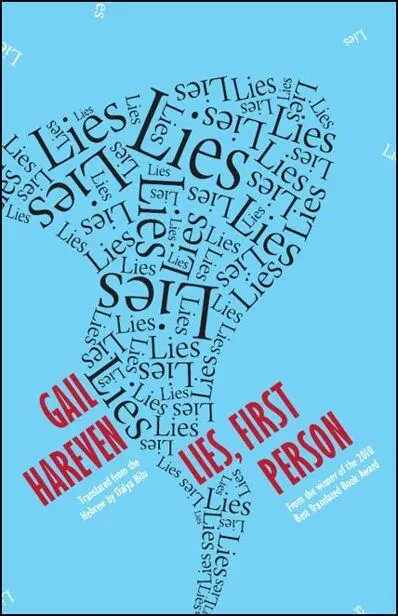
- Название:Lies, First Person
- Автор:
- Издательство:Open Letter
- Жанр:
- Год:2015
- ISBN:нет данных
- Рейтинг книги:3 / 5. Голосов: 1
-
Избранное:Добавить в избранное
- Отзывы:
-
Ваша оценка:
Lies, First Person: краткое содержание, описание и аннотация
Предлагаем к чтению аннотацию, описание, краткое содержание или предисловие (зависит от того, что написал сам автор книги «Lies, First Person»). Если вы не нашли необходимую информацию о книге — напишите в комментариях, мы постараемся отыскать её.
Elinor's comfortable life — popular newspaper column, stable marriage, well-adjusted kids — is totally upended when she finds out that her estranged uncle is coming to Jerusalem to give a speech asking forgiveness for his decades-old book,
.
A shocking novel that galvanized the Jewish diaspora,
was Aaron Gotthilf's attempt to understand — and explain — what it would have been like to be Hitler. As if that wasn't disturbing enough, while writing this controversial novel, Gotthilf stayed in Elinor's parent's house and sexually assaulted her "slow" sister.
In the time leading up to Gotthilf's visit, Elinor will relive the reprehensible events of that time so long ago, over and over, compulsively, while building up the courage — and plan — to avenge her sister in the most conclusive way possible: by murdering Gotthilf, her own personal Hilter.
Along the way to the inevitable confrontation, Gail Hareven uses an obsessive, circular writing style to raise questions about Elinor's mental state, which in turn makes the reader question the veracity of the supposed memoir that they're reading. Is it possible that Elinor is following in her uncle's writerly footpaths, using a first-person narrative to manipulate the reader into forgiving a horrific crime?
Lies, First Person — читать онлайн бесплатно полную книгу (весь текст) целиком
Ниже представлен текст книги, разбитый по страницам. Система сохранения места последней прочитанной страницы, позволяет с удобством читать онлайн бесплатно книгу «Lies, First Person», без необходимости каждый раз заново искать на чём Вы остановились. Поставьте закладку, и сможете в любой момент перейти на страницу, на которой закончили чтение.
Интервал:
Закладка:
I didn’t expect understanding, but I admit that a flicker of anger flared up in me at the thought of some idiot presenting me as a primitive reader. I suffered no confusion as to the facts: Hitler died on the 30 thof April, 1945. He shot himself, apparently at the same time biting down on a capsule of cyanide.
And what about my loved ones? someone will ask. Didn’t you think about all the sorrow and shame you were about to bring down on your loved ones? Didn’t you take them into account?
I thought — I reply to the rebuking questioner — I thought, and the more I thought and took into account, the clearer it became to me that my dearly beloved would be better off without me, because even if they don’t know it, a quick, clean cut is best.
On our visit to Seattle I was a cause of grave concern to our sons, my husband told me so, and even without him I’m not blind. And when we were in Seattle, the gangrene inside me had not yet spread. A mother is not supposed to frighten her cubs, cubs are not supposed to be afraid for their mother, and what happened to us was against nature: the corrosive corruption of Not-man has reached as far as the land of the salt of the earth, and the most faithful of men is already suffocating in its stench.
If my dearly beloved had known what I knew, if they had seen, they themselves would have understood that this was the humane thing to do. I would end it, and afterward I would be locked up and removed. Anyway, it makes no difference if I don’t exist in any case. And in leaving them like this, at least I will leave them a better world.
Is there a prosecutor in existence who would dare to argue that a world in which Not-man draws breath is preferable to one in which he no longer exists? If anyone deserves to suffer, to suffer in agony for far longer than a hundred and twenty days, it’s him, and I only intended to put an end to him quickly and allow myself to breathe. A humane sentence according to any human logic.
At four o’clock on the morning after the Passover seder, I carried six securely tied garbage bags to the bins outside. On my desk I left a stack of files that required patient sorting. My clothes closet demanded more deliberation than anything I was capable of producing during the course of that night; the kitchen, on the other hand, gave me satisfaction. Twelve days until the official appearance of the First Person; at some point during their course I would have to remember to replace the microwave: a man without a wife to cook for him needs a reliable microwave oven.
The streets were deserted, exhausted in the aftermath of the holiday. The streetlamps were still on, and in the rustic quiet I heard a donkey bray in the distance.
My husband was sleeping in same position as he had fallen asleep. And with the nagging thought about the microwave — maybe I should write myself a note so as not to forget — I took a blanket out of the linen chest and collapsed onto the bed in what had once been Yachin’s room, and in recent years had been at the disposal of both boys on their visits.
Ever since I had moved in with Oded, apart from his reserve duty in the army and his business trips, we had always slept together. Is that strictly accurate? Writers tend to round corners for the sake of elegance and beauty, and here too I have rounded a little. Once in a while when I had a bad cold and realized that I was snoring, I’d retire to the living-room sofa. Once in a while Oded fell asleep in the armchair opposite the television and only woke up in the morning, and once when we quarreled. . I enjoyed the privilege of living in the Garden of Eden, on that I insist, but it doesn’t mean that I was an angel.
“Him again?” When my husband paused in the doorway to the boys’ room, to examine the rumpled evidence that I had spent the night there, I was already busy with the coffee. I shrugged.
“I know I haven’t solved the problem of that dinner yet. I promised you, Elinor, I’ll deal with it. But in the meantime, do me a favor, make an effort and just try to put it out of your head.”
The understanding I had reached during the seder had made the meeting between my in-laws and Not-man what my husband called “irrelevant,” and I shrugged again.
“Don’t you trust me?”
“Yes.”
“Yes you do or yes you don’t?”
“Yes I do.”
“Elinor?”
“Yes.”
He stood next to me and blocked my way to the sink. “The landfill in the Negev?” he suggested lamely. I looked at him, a nervous, empty smile distorted his face. If only because of that foreign smile, if only because of the way I had distorted his face, I had to remove myself from him.
After it’s all over, I thought, perhaps he’ll find somebody else, better than me. Of course he’d find another woman, or more likely she would find him, but one way or another she would very soon be found. She would have bigger breasts than me, the kind all men like even if they don’t admit it. Without a doubt she would be an intellectual, because this modest husband of mine admires intellectuals. An artist. Perhaps a painter, come to Israel to capture the desert light.
I don’t want to go into details about what happened in the next twelve days, and it seems there’s no need to, because what had already happened only went on happening. “Are you going to sleep there tonight too?” “Yes.” “Do you want to tell me what’s going on?’ “Not now.”
My husband watches me as I sort out newspaper cuttings, old receipts and photographed texts from my student days. “What are you doing?” “Spring cleaning.” “Don’t you want to go out for a bit?” “No.” “What’s that photograph?” “A poem.”
Robert Lowell to Elizabeth Bishop: I myself am hell/ nobody’s here/ only skunks. .
. . I didn’t crumple up the page, simply added it to the pile to be thrown away.
The weather suddenly turned dry and blazing. The desert invaded the city. Penetrated the houses and covered surfaces with sand. Asthmatics had difficulty breathing. And my husband, who had planned a jeep trip with friends, was reluctant to leave his wife on her own. He came back after only one day and returned to the office, and was still reluctant to leave his wife on her own.
My husband on the phone: “What’s happening?”
“Nothing.”
After a few days I stopped answering the phone and ignored the messages he left me. At some point during the intermediate days of Passover I drove to electrical appliance stores to acquire a new microwave, and there, in Givat Shaul, as I was putting the parcel into the trunk, like a presence behind my back and a kind of intensification inside me, I sensed the presence of Not-man, and then I knew that he was coming closer and that he was already in Jerusalem. I knew — just as I had known before that he had arrived in Israel, and as I knew that he lived in New York even before I saw the program of the conference.
Professor Gotthilf of Queen’s College. According to the college site he taught two seminars to third year students there. One had the complicated name of “‘Abandon hope all ye who enter here’: The Realities of the Marquis de Sade, Friedrich Nietzsche, Heinrich Joder, and Franz Kafka,” while the other was called simply “Stalin and the Jews.”
I did not feel threatened by the closeness of his person. I was going to meet him. For a moment I was even eager for it to happen right away. I only wanted to avoid being taken by surprise, and so in the few days remaining, I seldom left the house. I didn’t miss going out, because with the clarification of reality and the progress of the plan, all traces of the old itch to keep moving had melted away.
My husband on the phone: “Elinor isn’t feeling too well. It’s nothing to worry about. She’ll call you back.”
Читать дальшеИнтервал:
Закладка:
Похожие книги на «Lies, First Person»
Представляем Вашему вниманию похожие книги на «Lies, First Person» списком для выбора. Мы отобрали схожую по названию и смыслу литературу в надежде предоставить читателям больше вариантов отыскать новые, интересные, ещё непрочитанные произведения.








Обсуждение, отзывы о книге «Lies, First Person» и просто собственные мнения читателей. Оставьте ваши комментарии, напишите, что Вы думаете о произведении, его смысле или главных героях. Укажите что конкретно понравилось, а что нет, и почему Вы так считаете.