Gail Hareven - Lies, First Person
Здесь есть возможность читать онлайн «Gail Hareven - Lies, First Person» весь текст электронной книги совершенно бесплатно (целиком полную версию без сокращений). В некоторых случаях можно слушать аудио, скачать через торрент в формате fb2 и присутствует краткое содержание. Год выпуска: 2015, Издательство: Open Letter, Жанр: Современная проза, на английском языке. Описание произведения, (предисловие) а так же отзывы посетителей доступны на портале библиотеки ЛибКат.
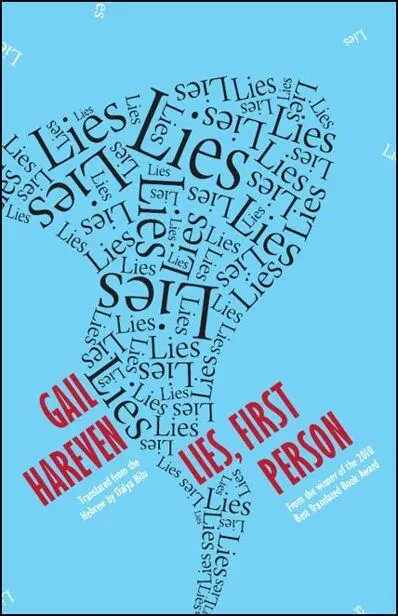
- Название:Lies, First Person
- Автор:
- Издательство:Open Letter
- Жанр:
- Год:2015
- ISBN:нет данных
- Рейтинг книги:3 / 5. Голосов: 1
-
Избранное:Добавить в избранное
- Отзывы:
-
Ваша оценка:
Lies, First Person: краткое содержание, описание и аннотация
Предлагаем к чтению аннотацию, описание, краткое содержание или предисловие (зависит от того, что написал сам автор книги «Lies, First Person»). Если вы не нашли необходимую информацию о книге — напишите в комментариях, мы постараемся отыскать её.
Elinor's comfortable life — popular newspaper column, stable marriage, well-adjusted kids — is totally upended when she finds out that her estranged uncle is coming to Jerusalem to give a speech asking forgiveness for his decades-old book,
.
A shocking novel that galvanized the Jewish diaspora,
was Aaron Gotthilf's attempt to understand — and explain — what it would have been like to be Hitler. As if that wasn't disturbing enough, while writing this controversial novel, Gotthilf stayed in Elinor's parent's house and sexually assaulted her "slow" sister.
In the time leading up to Gotthilf's visit, Elinor will relive the reprehensible events of that time so long ago, over and over, compulsively, while building up the courage — and plan — to avenge her sister in the most conclusive way possible: by murdering Gotthilf, her own personal Hilter.
Along the way to the inevitable confrontation, Gail Hareven uses an obsessive, circular writing style to raise questions about Elinor's mental state, which in turn makes the reader question the veracity of the supposed memoir that they're reading. Is it possible that Elinor is following in her uncle's writerly footpaths, using a first-person narrative to manipulate the reader into forgiving a horrific crime?
Lies, First Person — читать онлайн бесплатно полную книгу (весь текст) целиком
Ниже представлен текст книги, разбитый по страницам. Система сохранения места последней прочитанной страницы, позволяет с удобством читать онлайн бесплатно книгу «Lies, First Person», без необходимости каждый раз заново искать на чём Вы остановились. Поставьте закладку, и сможете в любой момент перейти на страницу, на которой закончили чтение.
Интервал:
Закладка:
I thought that perhaps there was no conference, that this too was a lie meant to mislead us. And perhaps he wasn’t arriving in spring either, but earlier. And what do people mean anyway when they talk about spring? Some people claim that there aren’t any seasons between winter and summer in Israel. Passover is also called the “Festival of Spring” but it often takes place in a heat wave. He has a son in the country, and maybe he’s already here with him.
“In November he’s giving a lecture in Frankfurt,” I said. “‘Is to understand to forgive?’—that’s what he calls it. There’s nothing about Jerusalem.”
“Maybe he’s dead,” said Oded. “What do we know? Maybe he was run over by a truck, or even better: maybe he had a stroke, and now he’s lying drooling in some hospital.”
“Nothing like that happened,” I said.
“No?”
“I just know.” I couldn’t explain to him or to myself how I knew that the pollution was still alive, or how I felt its existence like a presence. But I felt it and I knew, and somehow it was clear to me that when it left the world — I would know. How? Perhaps I would simply get up in the morning and discover that our rapist uncle, Uncle Aaron, the ha-ha uncle had disappeared and I could breathe.
“Good, at least let’s take comfort in the fact that at his age he isn’t capable of raping anyone any more, and it doesn’t look as if he’s going to write another book about Hitler either.”
“And if he was?”
“Capable of raping?” Oded studied his hands. “I imagine that in that case I might think of all kinds of things that aren’t exactly within the bounds of the law.”
“And what about what was?”
“What about it? Go on, Elinor, explain yourself. Don’t run away from me.”
But I didn’t know how to explain that to him either: that there was no such thing as “was,” that everything that was is, and that the past tense was simply a convenient grammatical lie. Nothing passes.
I didn’t know how to explain, but I no longer wanted to run away from him, and so I backed myself into a corner and banged my head against the fridge, over and over again.
“Elinor, don’t.” Oded stood up and took hold of my shoulders.
At this stage we were already touching again, but circumspectly. We embraced, but carefully, avoiding hip to hip contact, the way my husband hugged our sons. Early in the morning, when the heat evaporated from the house, it sometimes happened that one sleeping body wrapped itself around the other. And all this time Oded went on waiting patiently for a sign I did not give. He was patient and respectful and dignified, all anyone could wish for, but the situation made him tense and wore him out; I know very well how tense it made him.
It isn’t my fault, it wasn’t my fault that we had been deprived of all our desire, all our delight, because I was the first to have been robbed, as if something had invaded me and taken my life away. Oded at least went on wanting, and wanting means being alive.
•
“Tell me what you want.” I stood with my back to the fridge, my husband protecting my head and the back of my neck. “Talk to me. At least that. Tell me what I can do. You’re not going to bang your head again. I won’t let you.”
“I don’t know,” I said, “I can’t. You don’t understand.” Over his shoulder, without any connection to anything, I counted nine wine glasses — there were nine on the shelf, we had originally bought twelve, where had the other three disappeared to? — and when I finished counting the answer came out of its own accord, rising in a childish wail: “Make him be gone — that’s what I want.”
We went on standing there for another moment: I with my back to the fridge, and my bodyguard stroking my hair, against the direction of growth, like you do with a child. The caressing hand was confused, and I knew that it felt the absence of the locks it could sink its fingers into.
The weakness, the idiotic, childish weakness was intolerable, as was the disappearance of the control and of everything I had worked so hard to acquire. And after that shameful incident with Oded, it even happened that I thought of Erica and her games with the Digoxin in a new way. Because, but for her desertion, but for who she was, I might have been tempted to put an end to the weakness the same way she did.
It occurred to me that thanks to my mother, the medicine cupboard and the carving knives did not tempt me and that, not only for this reason, I might very well visit her grave one day and clean the dust off it. Elisheva believed that I did so every year, and I let her believe it.
No, the medicine cupboard did not beckon me, and as far as harming myself was concerned the furthest I went in my fantasies was getting another tattoo. I remembered almost with longing the concentrated, draining pain with which my tiger-face appeared on my arm, and I thought that exactly this kind of pain was capable of providing some kind of relief: a burning fire on the calf, or maybe a big one on my back could cool my head.
But I didn’t get a tattoo either. Maybe because it would require me to sit still for a long time, maybe because I hadn’t really gone back to being nineteen, and I hadn’t lost everything. My ability to feel love had gone into hiding. My telephone conversations with the boys no longer brought me joy. But the memory of love had not disappeared, and even though I didn’t feel anything, I still knew with a kind of intellectual knowledge that there were people I loved, even if they weren’t there.
Two weeks after I had asked her not to give our father my email address, Elisheva sent me another message. She reported on the snow, which had not melted but only hardened on the ground, on a field race in which Sarah was supposed to take part and which had been postponed because of the snow hardening on the ground, and at the end she wrote, “Don’t worry your head about Daddy. He’s in a good mood and he’s started learning to play the harmonica. At his age — don’t you think that’s sweet?’
As always, I knew that she was sincere, that she had no demands and bore no grudge. And I had already realized that the moment she finished telling me her story, her interest in me had waned considerably. The robber of her birthright continued to figure in her life, but now she had been sentenced to stand still in one place, like an ice monument.
At this stage I seemed to have two sisters. One in a red sweater, sending emails in English from a town with a musical name and listening to the sound of a harmonica in Verona. The other, plagued by loathsome torments about which my sister never told me. Because every cruel, vicious spectacle I had ever heard about rose up in my mind to haunt me, with my sister in the middle of it: images of rape that went on and on endlessly, because it had no point. Because the boot that set itself directly down on the stomach and trampled it was itself the point. The boot and the laughter.
Images instilled in me during the course of my life merged with one another to spawn new nightmare births, and sometimes in the company of others I was attacked by the fear that the things I saw in my mind’s eye were seeping out of me like sweat, like a radioactive odor. I didn’t want them to see what was happening to me, but at the same time I wanted people to open their eyes and see.
How could I make Oded understand without defiling him with the filth, especially since the filth — something I didn’t forget — was the product of my own imagination? How was it possible to talk at all, without polluting the land of the salt of the earth?
One Saturday I told him something that had happened. We were sitting in the car in the parking lot of the Armon Hanatziv Promenade. My husband told me that if I felt the need to walk, at least let’s walk on the promenade, which was intended for walking. But when we set out, the wind blew so strongly in our faces that we found it difficult to breathe, and we returned to the car and went on sitting there for a while.
Читать дальшеИнтервал:
Закладка:
Похожие книги на «Lies, First Person»
Представляем Вашему вниманию похожие книги на «Lies, First Person» списком для выбора. Мы отобрали схожую по названию и смыслу литературу в надежде предоставить читателям больше вариантов отыскать новые, интересные, ещё непрочитанные произведения.





Обсуждение, отзывы о книге «Lies, First Person» и просто собственные мнения читателей. Оставьте ваши комментарии, напишите, что Вы думаете о произведении, его смысле или главных героях. Укажите что конкретно понравилось, а что нет, и почему Вы так считаете.