Gail Hareven - Lies, First Person
Здесь есть возможность читать онлайн «Gail Hareven - Lies, First Person» весь текст электронной книги совершенно бесплатно (целиком полную версию без сокращений). В некоторых случаях можно слушать аудио, скачать через торрент в формате fb2 и присутствует краткое содержание. Год выпуска: 2015, Издательство: Open Letter, Жанр: Современная проза, на английском языке. Описание произведения, (предисловие) а так же отзывы посетителей доступны на портале библиотеки ЛибКат.
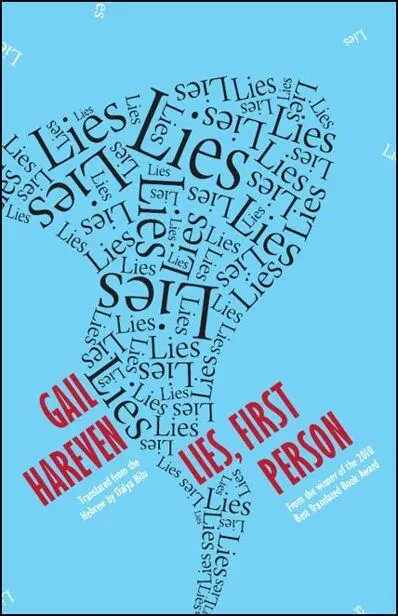
- Название:Lies, First Person
- Автор:
- Издательство:Open Letter
- Жанр:
- Год:2015
- ISBN:нет данных
- Рейтинг книги:3 / 5. Голосов: 1
-
Избранное:Добавить в избранное
- Отзывы:
-
Ваша оценка:
Lies, First Person: краткое содержание, описание и аннотация
Предлагаем к чтению аннотацию, описание, краткое содержание или предисловие (зависит от того, что написал сам автор книги «Lies, First Person»). Если вы не нашли необходимую информацию о книге — напишите в комментариях, мы постараемся отыскать её.
Elinor's comfortable life — popular newspaper column, stable marriage, well-adjusted kids — is totally upended when she finds out that her estranged uncle is coming to Jerusalem to give a speech asking forgiveness for his decades-old book,
.
A shocking novel that galvanized the Jewish diaspora,
was Aaron Gotthilf's attempt to understand — and explain — what it would have been like to be Hitler. As if that wasn't disturbing enough, while writing this controversial novel, Gotthilf stayed in Elinor's parent's house and sexually assaulted her "slow" sister.
In the time leading up to Gotthilf's visit, Elinor will relive the reprehensible events of that time so long ago, over and over, compulsively, while building up the courage — and plan — to avenge her sister in the most conclusive way possible: by murdering Gotthilf, her own personal Hilter.
Along the way to the inevitable confrontation, Gail Hareven uses an obsessive, circular writing style to raise questions about Elinor's mental state, which in turn makes the reader question the veracity of the supposed memoir that they're reading. Is it possible that Elinor is following in her uncle's writerly footpaths, using a first-person narrative to manipulate the reader into forgiving a horrific crime?
Lies, First Person — читать онлайн бесплатно полную книгу (весь текст) целиком
Ниже представлен текст книги, разбитый по страницам. Система сохранения места последней прочитанной страницы, позволяет с удобством читать онлайн бесплатно книгу «Lies, First Person», без необходимости каждый раз заново искать на чём Вы остановились. Поставьте закладку, и сможете в любой момент перейти на страницу, на которой закончили чтение.
Интервал:
Закладка:
Elisheva my darling, my pretty one! Why they call you lame I do not know / Even if you cannot run / Of the usual pair of legs / you are missing only one.
— 12 -
In the end we talked, my husband and I. Rather, it would be more accurate to say that we sat down and my husband talked a lot, while I mainly mumbled that he was right, something was apparently happening to me, and all right, I was sorry.
I really did feel sorry. When he mentioned Seattle, I was sorry for everything that was missed and everything that went sour there — how I had failed to ask Nimrod about his roommate in the dormitories: even when he mentioned his exotic friend and roommate, an original native of Hawaii, I didn’t ask a thing. I was sorry for my evasiveness and for my aimless wandering and for the sleep that evaded me — it crossed my mind that I was really very tired, perhaps because of this, too.
I was sorry for my husband’s sorrowful face, and for his voice that kept trying to feel me out, and for the fact that part of the time I wasn’t really listening to what he said.
At a certain stage when he had almost despaired of me and my replies, he got up and walked around the house, but by the time he passed the computer in my work corner, the screen saver had already come on, and an artificial aquarium with tropical fish hid the First Person.
In the few minutes when Oded was walking around and around like this, I remember that I even felt a certain sorrow for Alice.
Years ago, in my first column, she came to Jerusalem with the intention of learning to paint in desert light. I had invented this detail and later abandoned it, and since I had abandoned it, the girl from Alaska would never, never paint any kind of light, or anything at all.
My Alice would never paint any more — she had hardly managed to paint at all — and I would never learn if such a thing as “desert light’ even existed in painting, because without her, what was the point.
“I don’t know what else to say,” Oded said when he came back and sat down on the edge of the armchair. “I think both of us are stuck here, and that we need some help. I mean psychological help.”
My husband said “both of us,” and it was clear to me what he was saying. “Both of us” was the hook on which he meant to catch the madwoman and lead her to a shrink. My husband, I guessed, was thinking of the complete collapse of our sex life, he was thinking of its death — and being what he was, in other words, the best of all possible men — it never crossed his mind to put all the blame for what had gone wrong on his wife.
Let me say in short that ever since the twenty-four hours in Chicago, this pleasure too had vanished from our lives, and the almost continuous presence of this absence had made all our movements awkward and clumsy. How pathetic and insulting is the choreography of avoidance. Here I am, hurrying past my husband wrapped in a towel, averting my eyes as he looks at me; trying to look like somebody who has forgotten some chore urgently in need of execution. Here I am scouring the oven and the gas rings, and here is my husband already asleep, wrapped in the bedspread, leaving the blanket for me.
“Both of us” my good husband said. But the problem was with me and in me, because it wasn’t Oded who crouched to clean the oven in the middle of the night, and he never avoided my eyes.
Pregnancies and breast-feeding and quarrels and a son in a pilots’ course, examinations for the Bar Association and urgent appeals to the supreme court — nothing in our lives thus far had interfered with the flowing current of our sex. It was the city of refuge to which we retreated, it was also open ground. Sex was perfunctory and sleepy, it was wild and anarchic, sweet and boring, but it was always there. Always there — until it was taken from me in the green woods of a little town with a musical name.
Because even before we returned to Israel something went wrong with our touch. Oded’s hand on my inflamed skin became heavy and oppressive, and sometimes the opposite — it was light and irritating, as if an insect had landed on my belly and I had to brush it off.
Even in sleep it sometimes happened that he touched me, and I reacted by crying out and recoiling. There was no part of my body left that wanted to be touched.
I was familiar with the usual advice in such situations: close your eyes and think of the queen. Go with it, abandon yourself, pretend, and pleasure will find an opening. Go through the motions and the real thing will come. And in general, all couples go through rough patches, and what can you expect after so many years of marriage?
But I didn’t want to. However out of control I was, kicking at rocks and deliberately hurting my toes, one thing was out of bounds. There was one thing at least I would not do: I would not tell a lie with my body.
•
“If that’s what you think, then all right, we’ll go to therapy,” I said. It was clear to me that no Freudian interpretations would give my husband the right touch back. But he laced his fingers, propped his elbows on his thighs, and pressed his knuckles to his forehead. And even after there was no point left, I could not deprive Oded of hope.
“I’m glad,” he said and removed his hands from his face. “Thank you. One of the things you learn in my problematic profession is when to call on expert assistance, and that it’s nothing to be ashamed of, it’s what intelligent people do. The important thing is to find ourselves a good guy, someone we can both respect. I don’t really know how to go about it, it’s not exactly a field. . you know. But maybe one of your girlfriends, someone whose opinion you respect, can give us a name.” Even in stressful negotiations my husband is adept, as he puts it, in “maximizing his achievements.”
I undertook to find us a therapist, and my responsible Oded got up to go back to work, leaving behind him a partner who had become a little more responsible. Like a guest I accompanied him to the door, and we both lingered a moment on the threshold, he rubbing his cheeks, I playing with a lock of hair and tucking in my shirt. For a moment he seemed about to kiss me on the cheek, and then he controlled himself and left. Only as he turned to go I noticed that he had cut himself while shaving in the morning. Once, an eon ago, when he cut himself like this, his wife would have licked the blood from his neck.
A wave of sardonic malice rose in me to the sound of the car driving away, and with this wave the idea of looking up the “expert” soul doctor in the Yellow Pages I had promised to find. I even opened the phone book. “Spiritual psychotherapy”; “Expert clinical psychologist, therapy by hypnosis available”; “Short-term power therapy”; “Dynamic short-term therapy”; “Depression, anxiety, sex”; “Hypnosis and workshops’; “Relationships, dreams, and anger’; “Mid-life transitions.”
Who presumed to know when life ended and when it was at its middle?
Power therapy — I said to Oded in my heart — let’s not pretend at least, because you must see that this will only work by force: perhaps by hypnosis combined with drugs in the water. In any case, no workshops, and we haven’t got the time for “dynamic therapy” because it’s impossible to carry on like this, because how long can we go on suffering like this? You understand — how long? Don’t you understand that an affliction like this can only be eradicated by force?
And yet, I didn’t pluck a magician at random from the Yellow Pages. I was fair, I behaved like a good sport, I gave it a chance. I called a girlfriend, a child psychologist, and told her about some friends of ours “who were experiencing a mid-life crisis in their relationship.” And in order to be even fairer I added that I happened to know that the man — I deliberately avoided saying the woman—“had experienced some sort of trauma at an early age.”
Читать дальшеИнтервал:
Закладка:
Похожие книги на «Lies, First Person»
Представляем Вашему вниманию похожие книги на «Lies, First Person» списком для выбора. Мы отобрали схожую по названию и смыслу литературу в надежде предоставить читателям больше вариантов отыскать новые, интересные, ещё непрочитанные произведения.






Обсуждение, отзывы о книге «Lies, First Person» и просто собственные мнения читателей. Оставьте ваши комментарии, напишите, что Вы думаете о произведении, его смысле или главных героях. Укажите что конкретно понравилось, а что нет, и почему Вы так считаете.