Gail Hareven - Lies, First Person
Здесь есть возможность читать онлайн «Gail Hareven - Lies, First Person» весь текст электронной книги совершенно бесплатно (целиком полную версию без сокращений). В некоторых случаях можно слушать аудио, скачать через торрент в формате fb2 и присутствует краткое содержание. Год выпуска: 2015, Издательство: Open Letter, Жанр: Современная проза, на английском языке. Описание произведения, (предисловие) а так же отзывы посетителей доступны на портале библиотеки ЛибКат.
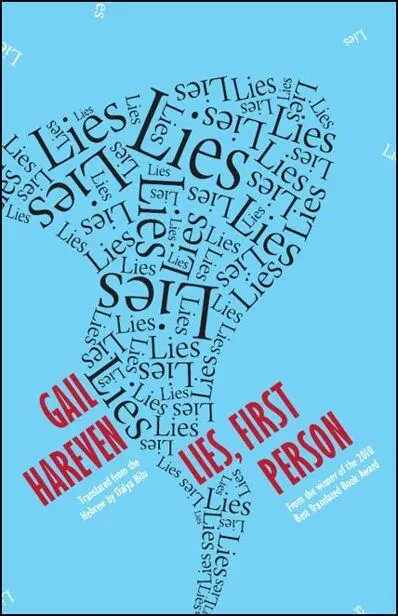
- Название:Lies, First Person
- Автор:
- Издательство:Open Letter
- Жанр:
- Год:2015
- ISBN:нет данных
- Рейтинг книги:3 / 5. Голосов: 1
-
Избранное:Добавить в избранное
- Отзывы:
-
Ваша оценка:
Lies, First Person: краткое содержание, описание и аннотация
Предлагаем к чтению аннотацию, описание, краткое содержание или предисловие (зависит от того, что написал сам автор книги «Lies, First Person»). Если вы не нашли необходимую информацию о книге — напишите в комментариях, мы постараемся отыскать её.
Elinor's comfortable life — popular newspaper column, stable marriage, well-adjusted kids — is totally upended when she finds out that her estranged uncle is coming to Jerusalem to give a speech asking forgiveness for his decades-old book,
.
A shocking novel that galvanized the Jewish diaspora,
was Aaron Gotthilf's attempt to understand — and explain — what it would have been like to be Hitler. As if that wasn't disturbing enough, while writing this controversial novel, Gotthilf stayed in Elinor's parent's house and sexually assaulted her "slow" sister.
In the time leading up to Gotthilf's visit, Elinor will relive the reprehensible events of that time so long ago, over and over, compulsively, while building up the courage — and plan — to avenge her sister in the most conclusive way possible: by murdering Gotthilf, her own personal Hilter.
Along the way to the inevitable confrontation, Gail Hareven uses an obsessive, circular writing style to raise questions about Elinor's mental state, which in turn makes the reader question the veracity of the supposed memoir that they're reading. Is it possible that Elinor is following in her uncle's writerly footpaths, using a first-person narrative to manipulate the reader into forgiving a horrific crime?
Lies, First Person — читать онлайн бесплатно полную книгу (весь текст) целиком
Ниже представлен текст книги, разбитый по страницам. Система сохранения места последней прочитанной страницы, позволяет с удобством читать онлайн бесплатно книгу «Lies, First Person», без необходимости каждый раз заново искать на чём Вы остановились. Поставьте закладку, и сможете в любой момент перейти на страницу, на которой закончили чтение.
Интервал:
Закладка:
The truth is that I avoided inviting people over: I didn’t stuff leaves from my vine, and I didn’t prepare sauces from my figs.
I didn’t have the patience for it. But I did spend time with people.
Acquaintances asked after the boys, and closer friends asked discreetly “And how was your sister?” And my answer to all inquiries was: “An interesting story. Elisheva is an interesting woman. Jesus is good for her.”
My sister was okay. And I was definitely okay, and the world was okay too.
“Christians or Buddhists, what difference does it make. The main thing is, you say she’s happy?”
“Elisheva is one of the happiest people I’ve ever met in my life,” I replied again and again, and I meant it sincerely.
“Good, that’s what’s important and it’s great. The fact that there are all kinds of beliefs in the world is what makes it so fascinating. The way you describe her house and all those Christian types is so picturesque — isn’t it a pity it’s not like that in Jerusalem? What a waste that your Alice is limited to our Holy City. And with all that amazing nature over there too. You could easily have based a column on the whole thing.”
A certain nosy-nelly, who isn’t among my close friends and who presumably picked up various rumors, asked if now, after I’d “broken the ice” with my sister, would my sons go and visit her too: “Wouldn’t they be able to, with the two of them in America anyway?”
“I don’t know,” I replied. “What’s America? From the point of view of distance, from where they are to where she is, it’s like flying from here to Paris. Even farther, because at least there are direct flights to Paris, and my sister’s Monticello is buried somewhere at the end of the world, getting there is a real hassle. “And besides,” I added, “for young people their age, as I’m sure you know, family relations aren’t exactly a big attraction. The last thing they need there is uncles and aunts.”
I made the same sort of reassuring noises to Chemi and my mother-in-law: my sister had left me far behind and she didn’t need me. She had benefactors of her own, leaving me free to enjoy the benevolence of those close to me.
But Rachel did not seem completely reassured. She asked if I had started being more active like Oded — the two of us agreed that the running did him good even though he wasn’t at all overweight. Because he’d been fat as a child, the fear of fatness had remained with him to this day; she asked if I was eating properly; she wanted to know if she was imagining it or if I had really started biting my nails again; if it was very hard for me to part from the boys — when was Nimrod coming home exactly? — in the end she arrived at Alice.
Alice was a problem I was unable to hide. Before we left for America I informed the editor that I was taking a two-week vacation, but soon after our return I discovered that I didn’t have the strength to take my tourist out on her weekly excursion.
Like many other newspaper columnists, I had one column in stock, needing only a little polishing and an appropriate ending.
My pigtail-sucker made friends with a lecturer in the Jewish Philosophy department, who let her in on the secret of the man who had taught him Kabala: it appeared that this admired teacher and scholar, one of the founding fathers of the Hebrew University, was a secret practitioner of Kabalistic magic. In deadly secret the professor had tried to create a Golem, and some said that he had succeeded; some also said that on nights of the new moon the Golem could still be seen wandering the labyrinthine corridors of the Mount Scopus campus.
Did Alice meet the Golem? And if she came across him, what would happen to her?
Every day I opened the file and after a minute or two closed it again without being able to write a single word. The Golem devoured Alice. My Alice was eaten up. A Golem swallowed the Golem.
I told my editor I’d returned from America with a virus — it hadn’t been diagnosed yet, maybe mono, it could take time — the lie came to me with the naturalness of a fiction writer; and to my in-laws I explained that I was suffering from the kind of drought that periodically attacked writers. “Writer’s block. Let’s hope I get over it soon,” I said and spread my hands in a helpless gesture, as if praying for inspiration to drop into them from heaven.
My writer’s block was as a successful alibi for all the eccentricities in my behavior during those days. Our Elinor is coping with a period of drought, it happens to creative people. She understands that such things happen, but it isn’t easy for her. The process of creation is a great mystery.
The truth behind the cliché is that in the midst of my feverish rushing about, I did indeed try to overcome the drying up of the wellsprings that in the past had always provided me with an abundance of ideas: I threaded my way through winding alleys, I peeped into narrow entrances, I eavesdropped on the snatches of conversations coming from all-night bakeries, and I opened galleries. But the pigtail-sucker refused to appear, and her delight in the world was gone.
Jerusalem became filthy. The pouring rain had brought the trash to the surface. And I, without my puppy-Alice, nevertheless went walking, on dug-up pavements filled with water and sludge, between wet piles of building debris. Here an old plastic bag floats up and sticks to a shoe, there a shoe treads on a comb and smashes its teeth. A broken bottle threatens to cut the sole, and in the background a radio screams artificial enthusiasm. A curtain of murky mist was coming down and covering everything.
Discordant neighs of laugher and an affectation of vivacious chatter greeted my ears at every function I forced myself to attend. And the artificiality and pretense and the lies and concealment in all this forced gaiety was almost unbearable. It occurred to me that the authorities had introduced some drug of deception into the city’s drinking water.
A fawning client sent Chemi a present, a purple orchid, magnificent and aggressive. “Would you like to take it?” my mother-in-law asked me.
“No, thank you. I’ll forget to water it and kill it without meaning to.”
“I’m sure your writing will come back to you, you’re so creative,” she dared to console me for what she assumed was making my face fall. “Everything has its own logic, and everything takes its own time. Menachem came up with the idea that, in the meantime, until you recharge your batteries — in the meantime perhaps you should reconsider bringing out what you’ve written up to now as a book. Menachem thinks that perhaps at the time, when the suggestion came up, you didn’t maybe give it enough thought. You’re a writer. You’re our writer. Our friends never stop saying how delightful they find your writing. One of my friends asked me to photocopy your columns about the zoo for her, she wants to make them into a book for her grandchildren and stick in pictures, too. Why don’t you make all Alice’s fans happy and bring out a book?”
The thought of having to go over all the delightful nonsense I’d written was more repellent than ever. I didn’t have the faintest desire to read all Alice’s colorful bullshit, but there were other things I did want to read, I wanted to very much. I went on buying books. The shelf of as yet unread books filled up, but nothing succeeded in catching my attention, and after a few pages they all fell flat.
Reading has always filled a significant part of my day, and the restlessness increased and invaded the new gaps opening in my time. My brain craved the drug of reading, and the same brain rejected the books. Until, in this state of deprivation, the cells started to excrete remnants of matter they had previously absorbed, and to mix them up.
Читать дальшеИнтервал:
Закладка:
Похожие книги на «Lies, First Person»
Представляем Вашему вниманию похожие книги на «Lies, First Person» списком для выбора. Мы отобрали схожую по названию и смыслу литературу в надежде предоставить читателям больше вариантов отыскать новые, интересные, ещё непрочитанные произведения.








Обсуждение, отзывы о книге «Lies, First Person» и просто собственные мнения читателей. Оставьте ваши комментарии, напишите, что Вы думаете о произведении, его смысле или главных героях. Укажите что конкретно понравилось, а что нет, и почему Вы так считаете.