Gail Hareven - Lies, First Person
Здесь есть возможность читать онлайн «Gail Hareven - Lies, First Person» весь текст электронной книги совершенно бесплатно (целиком полную версию без сокращений). В некоторых случаях можно слушать аудио, скачать через торрент в формате fb2 и присутствует краткое содержание. Год выпуска: 2015, Издательство: Open Letter, Жанр: Современная проза, на английском языке. Описание произведения, (предисловие) а так же отзывы посетителей доступны на портале библиотеки ЛибКат.
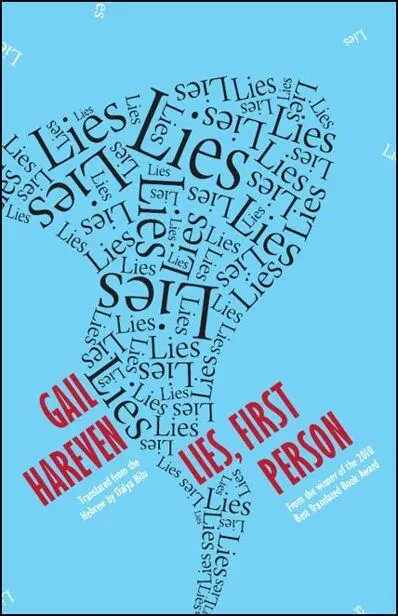
- Название:Lies, First Person
- Автор:
- Издательство:Open Letter
- Жанр:
- Год:2015
- ISBN:нет данных
- Рейтинг книги:3 / 5. Голосов: 1
-
Избранное:Добавить в избранное
- Отзывы:
-
Ваша оценка:
Lies, First Person: краткое содержание, описание и аннотация
Предлагаем к чтению аннотацию, описание, краткое содержание или предисловие (зависит от того, что написал сам автор книги «Lies, First Person»). Если вы не нашли необходимую информацию о книге — напишите в комментариях, мы постараемся отыскать её.
Elinor's comfortable life — popular newspaper column, stable marriage, well-adjusted kids — is totally upended when she finds out that her estranged uncle is coming to Jerusalem to give a speech asking forgiveness for his decades-old book,
.
A shocking novel that galvanized the Jewish diaspora,
was Aaron Gotthilf's attempt to understand — and explain — what it would have been like to be Hitler. As if that wasn't disturbing enough, while writing this controversial novel, Gotthilf stayed in Elinor's parent's house and sexually assaulted her "slow" sister.
In the time leading up to Gotthilf's visit, Elinor will relive the reprehensible events of that time so long ago, over and over, compulsively, while building up the courage — and plan — to avenge her sister in the most conclusive way possible: by murdering Gotthilf, her own personal Hilter.
Along the way to the inevitable confrontation, Gail Hareven uses an obsessive, circular writing style to raise questions about Elinor's mental state, which in turn makes the reader question the veracity of the supposed memoir that they're reading. Is it possible that Elinor is following in her uncle's writerly footpaths, using a first-person narrative to manipulate the reader into forgiving a horrific crime?
Lies, First Person — читать онлайн бесплатно полную книгу (весь текст) целиком
Ниже представлен текст книги, разбитый по страницам. Система сохранения места последней прочитанной страницы, позволяет с удобством читать онлайн бесплатно книгу «Lies, First Person», без необходимости каждый раз заново искать на чём Вы остановились. Поставьте закладку, и сможете в любой момент перейти на страницу, на которой закончили чтение.
Интервал:
Закладка:
I got out of bed and made my way to the kitchen in the dark, and to the sound of the gurgling of the percolator I began to collect myself in anticipation of the men about to wake up and another day of fun in the beautiful city of Seattle.
Fortified by the strong coffee, after I had already stretched my skin tight, it occurred to me to crawl back under the covers, and then to whisper in Oded’s ear and beg him to save me from yet another day of sightseeing, I didn’t have the strength for it, I couldn’t stand another day here, and would he please take me away to somewhere else.
“Where do you want me to take you?” my husband would ask me.
“To an ugly place,” I would answer him — if only I could.
— 8 -
Nimrod left first for Atlanta, where he was to remain until the end of the academic year. Oded and I took off a few hours after him into weather that grew stormier the farther east we flew.
“So what do you say about our sons?” My husband tried to distract me from the rocking of the plane, but there was no need to do so. Every jolt interrupted a thought, and I was glad of the jolting and interruptions, as if this was exactly what my body needed in order to purge itself.
“So what do you say?” Something thudded. The beverage cart. It was jolted from its place and crashed into the back of the plane, and the riders on the Ferris Wheel let out a groan in chorus. A flight attendant grabbed hold of the cart and hurried to sit down and fasten her safety belt, and someone behind us threw up.
“What do I say? I say that we’re blessed,” I gasped out loud.
At the beginning of my relationship with Oded, when I was very much in love, I would sometimes imagine myself bumping into him in places where there was no chance at all of coming across him: what would happen if he suddenly walked into the auditorium of the arts faculty? Would he see me sitting there? Would I signal him in the middle of the class?
Say he had been invited to the party too, and at this very moment he was standing in the kitchen with the people who weren’t dancing, drinking beer.
Say he had been relieved from reserve duty early, say the whole company had been relieved, and on their way home his mates decided to stop at precisely this bit of the beach, and now he was sitting with them in the shade of that hut. All kinds of nonsense along those lines. That’s what people do when they’re in love, and it’s not completely illogical: coincidences sometimes happen, and why shouldn’t they happen to me?
Five weeks after he took me to Mount Scopus, Oded and I were already living together, so that this kind of suspense didn’t last long, and turned into a sweet, vague background to our days in the Garden of Eden.
At the Seattle airport I went back to seeing someone who wasn’t there, just around the corner, and there, opposite the entrance doors, in a kind of sick reversal, I began to see the Not-man.
I hugged Yachin, who drove to the airport twice that day, first for Nimrod, and now for us. I looked at my husband and my son clumsily embracing in the embarrassment of an emotional farewell, and as I looked at them, one hand on the handle of my suitcase, it occurred to me that perhaps First Person was there.
He lived in America. He was invited to lecture all over the country. There were a number of universities in Seattle, maybe one of them had invited him to give a talk, or maybe he was there on vacation, to ski, and in a minute he would get out of a cab, carrying his gear on his back, like the sun-burnt German couple advancing toward us.
I remembered that there were about three hundred million people living in the United States, I knew that the thought of coming across him, of all people, here, was absurd. But coincidences happen, that was a fact, and a rational person needed to be aware of the facts. Things happened. Events could take place.
It never occurred to me for a second that I might not recognize him, but what did occur to me was the fear that the moment I fixed my eyes on him, he would recognize me. I would have to be careful not to stare, because a gaze that lasts too long is the one that betrays. And so is the one that immediately looks away again. What happened would be determined in the blink of an eye, because the first to blink is the one who goes down. Because eyes that fail to keep guard are the ones that leave the throat exposed.
In the line to hand over our luggage, and in the departures hall, and in the narrow sleeve leading to the plane, I didn’t stop looking around alertly, and even after we took our seats I saw fit to peer behind and in front of us, in case he had been among the first to get on the plane. Perhaps he was behind the curtain, traveling business class. Opening his tray and signaling the flight attendant to pour him a glass of wine. Perhaps he was sipping the wine now, nibbling a nut, and studying the menu.
The jolting of the plane did not rid me of the delusion, which continued to obsess me in the New York airport. First Person had once lived in New York, and maybe he still did. Cosmopolitan First Person traveled a lot, he visited many places, and soon he would be in Israel too, in Jerusalem, for the conference.
With this thought and with the darting of my eyes, the awareness that he had a life in the present spread though me like fire.
Not-man was a controversial intellectual. People were curious to hear a controversial intellectual. And a controversial intellectual liked people who listened to him. Perhaps at this very moment he was sitting in a café and dunking a croissant in his coffee — maybe not a croissant, maybe like his hero he had a weakness for cream cakes — never mind, it was nonsense to worry about what he ate — in any case, First Person is sitting in a café and talking to a female student about the Marquis de Sade, explaining how he had preceded “The Penal Colony” in his vision, and how he had foretold the events of the twentieth century. The student sees herself as daring, in anticipation of her meeting with him she wore a black leather skirt, and now she asks him to supervise her doctoral dissertation. In the evening perhaps they would see an art movie at MoMA.
In the evening they would go to MoMA. But now it’s morning in New York. Early morning. Too early to have coffee with a student, but not too early for him to wake up. The person who had forced a blinking child to read The 120 Days of Sodom to him, is presumably awake already, and now as he gets ready to go out he listens to an old record of Wagner’s Rienzi . A record, not a disc, because he is no doubt a collector of old records. Yesterday while strolling in the city he bought it, now he listens to it while he shaves. His tiny bristles dot the washbasin, and the wind blows bits of his hair into the air. Hair doesn’t disintegrate, even after a hundred years it doesn’t disintegrate. For years First Person has been shaving, the air outside is full of microscopic bristles, and people walking in the street breathe Not-man’s invisible bristles into their throats. Pedantic Not-man rinses the washbasin, and water carries the black insects of the bristles to the sea, more of them every day.
Bristles don’t do anything — I thought — there are no bristles, all this is delusional nonsense, I’m coming unhinged. I’m out of my mind because I breathed in the bristles. My sister’s penal colony breathes the air of the city below us, and my sister pardoned him; people breathe in the breath of his mouth.
•
The fire of my imagination spread through me, and as it raged and lit up more pictures, as if at a distance, high above the flames, I realized that I was no longer afraid. The plane leaned sideways, the land slanted below us, Not-man walked the crooked land, and I was not afraid: my imagination was just measuring my strength, testing me with images. There was nothing in the air, nothing microscopic in the sea, I was not a child to be frightened of imaginings. And in reality too, I had the strength to confront the Not-man, as long as it wasn’t by surprise — just not that, not by surprise. I wasn’t a child, but coming face to face with him in person if he took me by surprise, that was even beyond me now.
Читать дальшеИнтервал:
Закладка:
Похожие книги на «Lies, First Person»
Представляем Вашему вниманию похожие книги на «Lies, First Person» списком для выбора. Мы отобрали схожую по названию и смыслу литературу в надежде предоставить читателям больше вариантов отыскать новые, интересные, ещё непрочитанные произведения.











Обсуждение, отзывы о книге «Lies, First Person» и просто собственные мнения читателей. Оставьте ваши комментарии, напишите, что Вы думаете о произведении, его смысле или главных героях. Укажите что конкретно понравилось, а что нет, и почему Вы так считаете.