Gail Hareven - Lies, First Person
Здесь есть возможность читать онлайн «Gail Hareven - Lies, First Person» весь текст электронной книги совершенно бесплатно (целиком полную версию без сокращений). В некоторых случаях можно слушать аудио, скачать через торрент в формате fb2 и присутствует краткое содержание. Год выпуска: 2015, Издательство: Open Letter, Жанр: Современная проза, на английском языке. Описание произведения, (предисловие) а так же отзывы посетителей доступны на портале библиотеки ЛибКат.
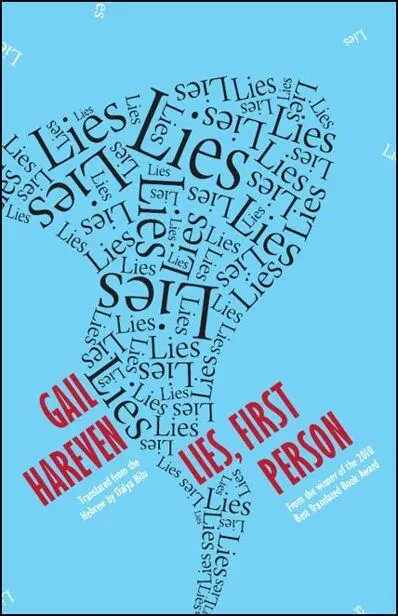
- Название:Lies, First Person
- Автор:
- Издательство:Open Letter
- Жанр:
- Год:2015
- ISBN:нет данных
- Рейтинг книги:3 / 5. Голосов: 1
-
Избранное:Добавить в избранное
- Отзывы:
-
Ваша оценка:
Lies, First Person: краткое содержание, описание и аннотация
Предлагаем к чтению аннотацию, описание, краткое содержание или предисловие (зависит от того, что написал сам автор книги «Lies, First Person»). Если вы не нашли необходимую информацию о книге — напишите в комментариях, мы постараемся отыскать её.
Elinor's comfortable life — popular newspaper column, stable marriage, well-adjusted kids — is totally upended when she finds out that her estranged uncle is coming to Jerusalem to give a speech asking forgiveness for his decades-old book,
.
A shocking novel that galvanized the Jewish diaspora,
was Aaron Gotthilf's attempt to understand — and explain — what it would have been like to be Hitler. As if that wasn't disturbing enough, while writing this controversial novel, Gotthilf stayed in Elinor's parent's house and sexually assaulted her "slow" sister.
In the time leading up to Gotthilf's visit, Elinor will relive the reprehensible events of that time so long ago, over and over, compulsively, while building up the courage — and plan — to avenge her sister in the most conclusive way possible: by murdering Gotthilf, her own personal Hilter.
Along the way to the inevitable confrontation, Gail Hareven uses an obsessive, circular writing style to raise questions about Elinor's mental state, which in turn makes the reader question the veracity of the supposed memoir that they're reading. Is it possible that Elinor is following in her uncle's writerly footpaths, using a first-person narrative to manipulate the reader into forgiving a horrific crime?
Lies, First Person — читать онлайн бесплатно полную книгу (весь текст) целиком
Ниже представлен текст книги, разбитый по страницам. Система сохранения места последней прочитанной страницы, позволяет с удобством читать онлайн бесплатно книгу «Lies, First Person», без необходимости каждый раз заново искать на чём Вы остановились. Поставьте закладку, и сможете в любой момент перейти на страницу, на которой закончили чтение.
Интервал:
Закладка:
Seattle is beautiful: beautiful buildings, beautiful people, a city open to the ocean and the forest. On our first day there I apologized for being tired. Afterward I said things like: “How lovely, a sailboat,” or “What an exquisite design,” but the piercing beauty was unable to penetrate the transparent coat of impermeable insulation tightening around me and cutting me off from anything capable of arousing natural admiration. Because ever since leaving the park with my sister my vision seemed to be clouding, and no amount of blinking on my part could clear the picture.
I stood before the ocean, I knew that the crashing waves were “beautiful,” but the beauty remained external to me, like a concept learned in literature classes: these are metonymies, this is irony, and the gray-blue crashing of the waves is called beauty.
Oded and the boys gazed and gazed and rejoiced in the sight of their eyes, and I alone gave voice to empty exclamations in the faint hope that feeling would somehow come and fill my voice.
•
On the evening of the first candle of Hanukkah Menachem and Rachel called to wish us all a happy holiday. A pair of hands peeled potatoes, another pair grated them, and while I spoke to my in-laws, the three men laughed themselves silly by stamping on the wooden kitchen floor in time to shouts of “to banish the darkness we have come.” A friend of Rachel’s read an old column of mine at the hairdressers: “From that series you wrote about the zoo, the one where Alice rides an elephant all the way to Bethlehem. My friend simply fell in love with your description of how the baby elephant escapes from the convoy and lands up in the square of the Church of the Nativity. She phoned the zoo to ask if the animal trainer really takes the elephants out for a walk on the road, and what nights he does it, but they didn’t want to tell her. She knows you don’t like telling the public what’s true and what isn’t in the Alice stories, but she wonders if you might be willing to make an exception in her case. My friend says that if it’s true, she has to wake her grandchildren up and take them to see the convoy, especially the little baby elephant marching. So what do you say?”
What do I say? A baby elephant didn’t know where to go, and an elephant is liable to trample a child. Elazar the Hasmonean was crushed to death under an elephant, and he wasn’t a child.
“Elinor?”
“Tell her to drop it, I made it all up, there’s no such animal as an elephant.”
“What did you say? I can hardly hear you.”
“The boys are making a lot of noise here.”
“I can hear that you’re enjoying yourselves. We’ll talk when you get home. Kisses to everyone and a happy Hanukkah to all.”
•
Among the holiday greetings that arrived by email was a flowery one from my sister. “May the holiday candles always light your way” she wrote in big letters, and in smaller ones she added: “Daddy and Gemma send warm regards to you all, and join us in wishing you a happy holiday.”
Did she remember our father’s amateur painter from her stay in the pension? Did she ever suspect that his meeting with her in Verona was not as accidental as he made out? And perhaps my sister did remember his Italian mistress sitting in the garden of the pension with her skinny, ugly English girlfriend; perhaps she remembered her and forgave him for that too. Because after pardoning the first person, after lumping the two of us together, how could she fail to pardon her father too? And why not bless his happiness too, which was also perhaps thanks to the grace of God? Because perhaps it was none other than the hand of God that had united the broken-hearted betrayer with his Gemma, and our father too was blessed, and only I was cursed.
I did not investigate Elisheva’s memory and I was not about to investigate her thoughts. A terrible pardon had corroded everything and there was no point. What was the point? Shaya wasn’t important, as far as I was concerned Shaya might as well be dead, and now I alone heard the laughter of the one who had kissed the back of my hand, and bought my sister a potted orchid.
The men fooled around, giggling and nudging each other, as playfully as puppies, while the floorboards creaked under their stamping feet: “Look out, you almost sent Mom flying with the frying pan.”
The more I shrank into myself, the more they increased their hilarity, covering up for me with their noise and exaggerated mirth, for my isolation and everything I was unable to provide.
Again and again I said to them that I was “just thinking,” but most of the things twisting and turning in my mind could hardly be called “thoughts,” and it’s only now that I can put them in any kind of order. Odd lines from children’s rhymes stuck in my mind and kept buzzing repeatedly in my head, as if I was stuck in a telephone exchange, waiting on the line. I thought: “How sweet is Elisheva / how pretty is my dear / lovely is my love.”
I thought: “Two little girls, two little dollies / one called Tzili and one called Gili.”
I thought: “My little candles have so many stories to tell,” and as soon as the words ma raboo , “so many,” came into my head I smiled without thinking.
“What are you smiling about?”
“Nothing. Stories. .” Mom’s thinking about stories. Perhaps she’s writing in her head. Maybe she’s resurrecting the faded figure of a tourist from Verona and soon she’ll put her into Alice’s adventures in the Holy City. Mom’s weaving a plot. Mom’s fine. Everything’s fine.
But I wasn’t weaving anything. I was becoming unraveled. And as I unraveled, the words “ ma raboo / ma raboo ,” so many, so many, kept repeating themselves in my head without rhyme or reason, and at some point it occurred to me that “marabou” was actually the name of a bird. So many birds with curved beaks feeding on flesh. So many birds hovering over the killing fields, laying their eggs in the gaping bellies of the corpses. And from their eggs the parasites of anecdotes are born. Parasites are disgusting, but nobody dies of anecdotes. With them you can live.
On the morning of the holiday I woke at seven o’clock in complete darkness. A story from Hitler, First Person had been gnawing at me while I slept and it was this story that woke me. I don’t know if it is based on some kind of historical truth, but the story is well told from the point of view of the first person. The late thirties, no exact date is given as far as I remember, the Führer meets someone whose name he doesn’t mention in his office, someone he calls “the English Bolshevik.” A Labor member of Parliament who had come to Germany in order to try to persuade its leader to stop the rearmament of the country, and carried away by the passion of his mission he quotes from the New Testament, the Sermon on the Mount. The description focuses on the body of the self-appointed missionary: he looks like a squishy pear that has already begun to rot. All you have to do is touch him for your finger to penetrate the skin, into the liquefaction of the flesh. On the fat Bolshevik pear the writer draws the mouth of a frog, and this self-righteous mouth croaks the gospel of Jesus Christ’s meek and humiliated in so grotesque a manner that even the Fräulein who brings the coffee has to lift up her apron to hide her sniggers. But it is not only in the Fräulein that the self-righteous pear gives rise to ridicule, the reader too feels an impulse to crush; a kind of desire to pinch the juicy flesh of the sermonizer until he shuts his mouth and opens his eyes.
With this picture I woke up, and with the thought of my sister’s letter of pardon and the fact that the First Person did not answer her.
How sweet is Elisheva / how pretty is my dear / a flowered dress I sewed her / exactly like my own.
Читать дальшеИнтервал:
Закладка:
Похожие книги на «Lies, First Person»
Представляем Вашему вниманию похожие книги на «Lies, First Person» списком для выбора. Мы отобрали схожую по названию и смыслу литературу в надежде предоставить читателям больше вариантов отыскать новые, интересные, ещё непрочитанные произведения.









Обсуждение, отзывы о книге «Lies, First Person» и просто собственные мнения читателей. Оставьте ваши комментарии, напишите, что Вы думаете о произведении, его смысле или главных героях. Укажите что конкретно понравилось, а что нет, и почему Вы так считаете.