Gail Hareven - Lies, First Person
Здесь есть возможность читать онлайн «Gail Hareven - Lies, First Person» весь текст электронной книги совершенно бесплатно (целиком полную версию без сокращений). В некоторых случаях можно слушать аудио, скачать через торрент в формате fb2 и присутствует краткое содержание. Год выпуска: 2015, Издательство: Open Letter, Жанр: Современная проза, на английском языке. Описание произведения, (предисловие) а так же отзывы посетителей доступны на портале библиотеки ЛибКат.
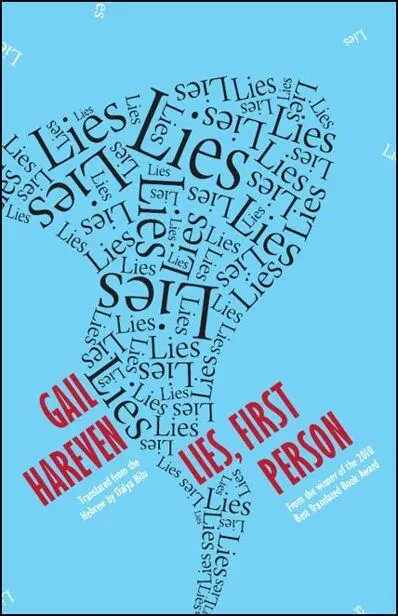
- Название:Lies, First Person
- Автор:
- Издательство:Open Letter
- Жанр:
- Год:2015
- ISBN:нет данных
- Рейтинг книги:3 / 5. Голосов: 1
-
Избранное:Добавить в избранное
- Отзывы:
-
Ваша оценка:
Lies, First Person: краткое содержание, описание и аннотация
Предлагаем к чтению аннотацию, описание, краткое содержание или предисловие (зависит от того, что написал сам автор книги «Lies, First Person»). Если вы не нашли необходимую информацию о книге — напишите в комментариях, мы постараемся отыскать её.
Elinor's comfortable life — popular newspaper column, stable marriage, well-adjusted kids — is totally upended when she finds out that her estranged uncle is coming to Jerusalem to give a speech asking forgiveness for his decades-old book,
.
A shocking novel that galvanized the Jewish diaspora,
was Aaron Gotthilf's attempt to understand — and explain — what it would have been like to be Hitler. As if that wasn't disturbing enough, while writing this controversial novel, Gotthilf stayed in Elinor's parent's house and sexually assaulted her "slow" sister.
In the time leading up to Gotthilf's visit, Elinor will relive the reprehensible events of that time so long ago, over and over, compulsively, while building up the courage — and plan — to avenge her sister in the most conclusive way possible: by murdering Gotthilf, her own personal Hilter.
Along the way to the inevitable confrontation, Gail Hareven uses an obsessive, circular writing style to raise questions about Elinor's mental state, which in turn makes the reader question the veracity of the supposed memoir that they're reading. Is it possible that Elinor is following in her uncle's writerly footpaths, using a first-person narrative to manipulate the reader into forgiving a horrific crime?
Lies, First Person — читать онлайн бесплатно полную книгу (весь текст) целиком
Ниже представлен текст книги, разбитый по страницам. Система сохранения места последней прочитанной страницы, позволяет с удобством читать онлайн бесплатно книгу «Lies, First Person», без необходимости каждый раз заново искать на чём Вы остановились. Поставьте закладку, и сможете в любой момент перейти на страницу, на которой закончили чтение.
Интервал:
Закладка:
Alone, alone, all alone / Alone on the wide wide sea
Alone, alone, all all alone
Water, water everywhere
The ship is sick, it rises and falls
And the eye seeks the sailors everywhere
For the pot will boil and the water will roil
Sail, sail my boat
For I am poured out like water.
A woman takes herself for a walk as if she were a dog. She steps out briskly, rhyming rhymes with her lips grimacing pointlessly. And the ship is sick / it sinks to the depths of the sea / thou hast ravished my heart / my sister my spouse. My ravished sister has ravished me, she has done for me by forgiving me. The day is done, Elisheva has won.
Scrambled sentences like these beat time for my steps, and sometimes they made me giggle to myself like a madwoman. You don’t know, ha-ha, oh no, you don’t know. What do you say? I say, laugh till you’re blue, you haven’t got a clue, soon you’ll be six feet under too.
One afternoon, on the path circling the stadium on the Givat Ram campus, I kicked a rock, because all the way from Musrara I couldn’t come up with a good rhyme for “the wicked will rejoice.” The kick hurt, but since I couldn’t find a rhyme, I had to find an outlet somehow.
— 11 -
Elisheva wrote to say that they were having a winter unlike any they’d seen for the last fifteen years at least. The university closed down for two days. Barnett helped his mother bring the horses in from the meadow, and the poor things were huddled together in the stable now. This morning she went out to clear the snow off the bird feeders, after it had blocked all the openings. Everything was covered in a spectacular blanket of white, and the little birds were having a hard time finding anything to eat. Sarah scattered peanuts on the windowsill, and the squirrels looked grateful. At this very minute, as she wrote, a squirrel was standing and nibbling a peanut on the windowsill.
Only at the end did she add that she had told our father about our wonderful visit, and that he wanted to know if he could have my email address.
I replied to my sister that “even though I wish Shaya nothing but happiness,” I could see no point in corresponding with him.
I imagined that the roundabout nature of the sentence came across well in English. Elisheva’s computer didn’t read Hebrew, and I found that it was easier for me to avoid giving offense in English.
To myself I said that Shaya might as well be dead as far as I was concerned, and that if his ghost was happy in Verona, it was no skin off my nose.
Our father was dead to me, and in any case it wasn’t his death that I wanted.
I sent the email and was about to return to Google. A few hours before I had started to read an article by some bigwig at the Jewish Federation. The article I had opened last night discussed the question of whether the members of our congregation in Los Angeles had been right to invite Professor Gotthilf to talk about “My Mistake.” Judging by what I had managed to read before Oded got up to have a drink of water, the VIP had found reasons both for and against the invitation. “Although we believe the mode veozev yerucham he wrote,” and explained the words in English as “a person who admits his wrongdoing and forswears it should be shown mercy,” “at the same time it should be taken into consideration”—and here I had to stop.
I brought up the article with the intention of finishing it. In these moments of sickening intimacy opposite the screen, the maddening discordance of all the pretense around me disappeared. But I was unable to sit still and read continuously for more than a few minutes at a time. I brought up the article, and then I heard the front door opening.
It was the second week of February. An ordinary weekday at the beginning of the week. Half past ten in the morning. Outside it was flooding. Water poured down from the sky, welled up from the ground. And my husband was supposed to be at work.
I got up quickly, and before I had time to wipe out the evidence I hurried to greet him. The face that filled the space in front of me for a moment sent alarm bells ringing: it was Oded’s face, alien and distorted, the cheeks sucked in with tension. “Okay. I think we need to talk,” he said.
I stood confronting him, and the theatrical nature of this confrontation in the middle of the living room propelled me out of the anxiety like the push of a strong hand. One moment I panicked, the next I felt the tickle of ironic laughter: that tone. That dramatic severity. Those clichéd words.
What could happen? What else could happen that hadn’t already happened?
“I’d like you to tell me what this is.” And without sitting down and without taking off his coat he threw a printout onto the table next to us. A glance from above was enough to identify the column that I had sent my editor sometime during the night. I had sent it, and the idiot had sent it to my husband. Or perhaps he had called my husband first to complain, and my lawyer had asked him to send it to him to read.
“Just a joke, what’s the big deal?”
“Elinor, if this is what you call a joke, then I really don’t know. .” his voice petered out, and the hand that had thrown the document down rose to steady his forehead. “Can I ask you to sit down? Can I? Then will you please sit down.”
I had composed the story of Alice’s last excursion not many hours previously, when sleep continued to evade me. The editor had learned from the heading of the return of the prodigal daughter, and in his delight he sat down to read the text immediately after he entered his office.
In her final adventure, Alice visits the Church of All Nations in Gethsemane. About two weeks earlier my feet had indeed carried me to the church, whose real name is actually “The Basilica of the Agony.” This was the place where the fear of death had come upon Jesus and his sweat “fell like great drops of blood to the ground.” There he prayed to his God to take the cup from him, and there he said to the priests, “This is your hour and this is the reign of darkness.” I know all this because I did the research. Like most of Alice’s trips, this final one also enabled me to occupy myself with research.
The story began with a classic joke; a cliché of a joke. Under the Byzantine pillars of the façade — the pillars were designed by the Italian architect Antonio Barluzzi, and their construction was completed in 1924, as I pointed out punctiliously in my column — under the Byzantine style pillars of the Church of All Nations, Alice meets three men: a Jew, a Christian, and a Muslim. The three are standing together in a group, and the pigtail-sucker is delighted to have come across this manifestation of religious diversity: in the colorful tapestry of the city, religious variety is what delights her above all.
The Jew, the Christian, and the Muslim are also very happy to meet a girl from Alaska, and the interesting conversation between the four of them continues until darkness falls, and they set out together to stroll among the olive trees on the higher slopes of the hill. Someone remarks that “It may have been on one of these very tree trunks that Jesus rested his head,” but from the story it is not clear who the speaker is.
Alice’s body is found the next day — that is to say most of her body. One severed leg is found lying at the entrance to a pottery shop in the Armenian quarter, the other on the fantastic roof of Papa Andreas, a restaurant with one of our city’s finest observation points. The torso is discovered in the Hurva synagogue in the Jewish quarter. Another forty-eight hours pass before a fair, red-tinted pigtail comes to light in a bin of cast-off scraps in the heart of the meat market in the Muslim Quarter.
Читать дальшеИнтервал:
Закладка:
Похожие книги на «Lies, First Person»
Представляем Вашему вниманию похожие книги на «Lies, First Person» списком для выбора. Мы отобрали схожую по названию и смыслу литературу в надежде предоставить читателям больше вариантов отыскать новые, интересные, ещё непрочитанные произведения.








Обсуждение, отзывы о книге «Lies, First Person» и просто собственные мнения читателей. Оставьте ваши комментарии, напишите, что Вы думаете о произведении, его смысле или главных героях. Укажите что конкретно понравилось, а что нет, и почему Вы так считаете.