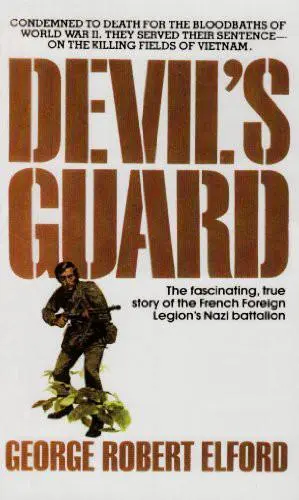
George Elford - Devil's Guard
Здесь есть возможность читать онлайн «George Elford - Devil's Guard» весь текст электронной книги совершенно бесплатно (целиком полную версию без сокращений). В некоторых случаях можно слушать аудио, скачать через торрент в формате fb2 и присутствует краткое содержание. Город: New York, Год выпуска: 1972, ISBN: 1972, Издательство: Dell, Жанр: prose_military, Историческая проза, на английском языке. Описание произведения, (предисловие) а так же отзывы посетителей доступны на портале библиотеки ЛибКат.
- Название:Devil's Guard
- Автор:
- Издательство:Dell
- Жанр:
- Год:1972
- Город:New York
- ISBN:9780440120148
- Рейтинг книги:3 / 5. Голосов: 1
-
Избранное:Добавить в избранное
- Отзывы:
-
Ваша оценка:
Devil's Guard: краткое содержание, описание и аннотация
Предлагаем к чтению аннотацию, описание, краткое содержание или предисловие (зависит от того, что написал сам автор книги «Devil's Guard»). Если вы не нашли необходимую информацию о книге — напишите в комментариях, мы постараемся отыскать её.
WHAT THEY DID IN WORLD WAR II WAS HISTORY’S BLOODIEST NIGHTMARE.
The ashes of World War II were still cooling when France went to war in the jungles of Southeast Asia. In that struggle, its frontline troops were the misfits, criminals and mercenaries of the French Foreign Legion. And among that international army of the desperate and the damned, none were so bloodstained as the fugitive veterans of the German S.S.
WHAT THEY DID IN VIETNAM WAS ITS UGLIEST SECRET — UNTIL NOW.
Loathed by the French, feared and hated by the Vietnamese, the Germans fought not for patriotism or glory but because fighting for France was better than hanging from its gallows. Here now is the untold story of the killer elite whose discipline, ferocity and suicidal courage made them the weapon of last resort.
Devil's Guard — читать онлайн бесплатно полную книгу (весь текст) целиком
Ниже представлен текст книги, разбитый по страницам. Система сохранения места последней прочитанной страницы, позволяет с удобством читать онлайн бесплатно книгу «Devil's Guard», без необходимости каждый раз заново искать на чём Вы остановились. Поставьте закладку, и сможете в любой момент перейти на страницу, на которой закончили чтение.
Интервал:
Закладка:
“How’s the camp?”
“The plague could not have done a better job.”
“The guerrillas killed four of their own cooks, thinking that they were the responsible ones,” Schenk reported excitedly.
“Are they all dead?”
“You bet they are,” Schulze said. “A few of them are probably still breathing but they wouldn’t last long. We finished off a couple of machine gunners in the ravine but they were already on the way to hell anyway.”
Assembling the troops we marched to the ravine with fixed bayonets. Schulze found two more gun emplacements littered with dead and dying guerrillas. We bayoneted them and pushed on.
“Do you think it is safe to enter the camp?” I asked Schulze when the base came into sight.
“It is a morgue, Hans,” he assured me.
“I want no shooting!” I warned the troops. “The village is only two miles away and some guerrilla detachments are absent. I want them to return to home sweet home.”
We found about sixty of the terrorists still alive. Some of them lay in their bunks, others on the ground, writhing and moaning. Only about fifteen Viet Minh had been unaffected by the drugs. They were busy tending the sick ones when we overran them. The body of Nam Hoa sprawled in front of the command post in a pool of partly digested food which he had vomited before he died. We made a photo of him for later reference and to collect the reward. Many of the victims had vomited where they fell before death seized them.
“Suoi,” I said to the girl as I led her into the commander’s hut, “you can help us now. Look through all the papers which you think could be important for us and please put them into this bag.”
I handed her a small canvas bag.
“Oui!” she nodded and began to work immediately.
I wanted to get her inside; the spectacle of bayoneting the dying and captured enemy was not a pleasant one. I posted a man in the door. “Keep her busy until we finish the job.”
“I guess we should have left her with Eisner,” Erich remarked when he joined me on the porch.
“We should have left her in Hanoi!” I growled.
Searching the huts, Sergeant Schenk discovered three girls. They had not been affected by the poison but were much too terrified to stand up, let alone to use their pistols. Schenk escorted them to the mess hut. “Sit down here and don’t move!” he told them harshly. “Otherwise I will cut your slender throats… And don’t utter a sound either.”
With Xuey’s assistance I interrogated them immediately. The girls spoke some French but not enough to understand the implications of my questions. According to them, Trengh and his one hundred and sixty guerrillas had departed two days before our arrival. They had taken a part of the stolen wares to another dump fifteen miles away. More items had been hidden in the village.
“Where is that other dump?” I asked, telling Xuey to interpret my question as sternly as possible. The girls did not know the place.
“We have never been there,” one of them muttered.
“You are lying!” I shouted in her native tongue. The girls shrank away from my outburst and huddled together terrified. One of them began to sob. I knew I had to apply the squeeze right then.
“Sergeant Schenk!” I called Victor. “Tickle them a little with the bayonets.”
Schenk and two of the troopers stepped forward with their bayonets extended, the points touching the girls” throats.
“Have you seen what happened to your sick comrades?” I asked slowly, stressing my words. “I am asking you once more where that other dump is. If you don’t tell us, you will die.”
The blades, still spattered with blood, were a macabre sight. “Please, no,” the smallest girl cried, burying her face in her hands, “please don’t kill us. We are very young.”
“You weren’t so young when you joined the terrorists.”
“We had to,” she mumbled, “we had to go with them.”
“When is Trengh coming back?”
“If we tell you, Trengh will kill us all… our families, too.”
“If you tell us, Trengh won’t kill anybody anymore. When is he coming back?”
“Tonight!” she whispered.
“I want to know—”
“Leave them alone!” A cry from behind interrupted me. Followed by Erich, Suoi came running toward me. She pushed aside the bayonets and stood between us and the girls with her eyes blazing. “You… you cannot do this… You wouldn’t dare… you…”
She was so aroused that she could barely form her words and I couldn’t resist teasing her.
“Oh, yes, Suoi—if necessary I would dare.”
“Not as long as I am here—commander!” I cast a glance of resignation toward Erich, who lifted and dropped his shoulders with a grin and waved the troopers aside.
“I guess this is the end of my interrogation,” I remarked in German. “Maybe you and Suoi can take over.”
I glanced at the captive girls, a frightened bunch of little rabbits; the oldest one of them was probably less than twenty years of age.
“Why did you join those bandits?” Suoi spoke to them softly. “Do you think it is right for young girls to kill people?”
“We did not kill anyone. We were only tending the wounded.”
“Are you nurses?” I cut in.
They nodded.
“All right. You will show us the way to the other dump and we will let you go home.”
They began to cry again and explained something to Suoi between a series of small hysterical sobs.
“They cannot go home,” Suoi translated for me. “The Viet Minh will kill them.”
“That’s too bad, Suoi.”
“You are too bad,” she replied, shaking her head. “You are much too hard and have no heart.”
“There is a war going on around here. Wars are very bad—not me, Suoi.”
“But if they betray the guerrilla camp to you, the guerrillas will kill them all. Can’t you understand? You might as well kill them right here.”
“All right, all right,” I cut her short. “Take care of them, Suoi. I have other things to attend to. We will talk about the dump later. In the meantime the girls can care for our own wounded.”
“We haven’t got any,” Schulze stated, obviously pleased with my decision about the girls.
“We aren’t home yet, Erich,” I reminded him of something that every one of us should always keep in mind.
We soon discovered not only a large quantity of material stolen from the garrison but also hundreds of Soviet-made guns, pistols, and mortars, along with similar weapons manufactured in China. There were Degtyarev light machine guns, Spaghin and Sudaiev submachine guns, Goriunov machine guns which can fire two hundred and fifty bullets per minute to a distance of one thousand meters. There were also Browning automatic rifles, French Mitra Mats, and even MAS rifles produced in 1937.
“What shall we do with all the stuff?” Erich inquired, waving an arm about the depot.
“Don’t worry. The villagers will carry everything back to the stockade. They know the way.”
The troops spent the day preparing a reception for Trengh and his terrorists. Fifty men with fifty machine guns, which we uncrated in the huts, were deployed to cover the entrance of the camp and the ravine behind it. Xuey, Sergeant Schenk, and one platoon occupied the vacant gun emplacements of the Viet Minh. The barrels of their machine guns had been carefully muffled with blankets and rags to deaden sound. Those in the village were still unaware of our presence in the hills and of the destruction of the terrorist base.
The girls had told me the truth. Around six o’clock in the afternoon Eisner radioed the coming of a Viet Minh unit, riding cycles on the road. “Let them pass,” I flashed back. “We have a reception ready for them.”
Читать дальшеИнтервал:
Закладка:
Похожие книги на «Devil's Guard»
Представляем Вашему вниманию похожие книги на «Devil's Guard» списком для выбора. Мы отобрали схожую по названию и смыслу литературу в надежде предоставить читателям больше вариантов отыскать новые, интересные, ещё непрочитанные произведения.












Обсуждение, отзывы о книге «Devil's Guard» и просто собственные мнения читателей. Оставьте ваши комментарии, напишите, что Вы думаете о произведении, его смысле или главных героях. Укажите что конкретно понравилось, а что нет, и почему Вы так считаете.