George Elford - Devil's Guard
Здесь есть возможность читать онлайн «George Elford - Devil's Guard» весь текст электронной книги совершенно бесплатно (целиком полную версию без сокращений). В некоторых случаях можно слушать аудио, скачать через торрент в формате fb2 и присутствует краткое содержание. Город: New York, Год выпуска: 1972, ISBN: 1972, Издательство: Dell, Жанр: prose_military, Историческая проза, на английском языке. Описание произведения, (предисловие) а так же отзывы посетителей доступны на портале библиотеки ЛибКат.
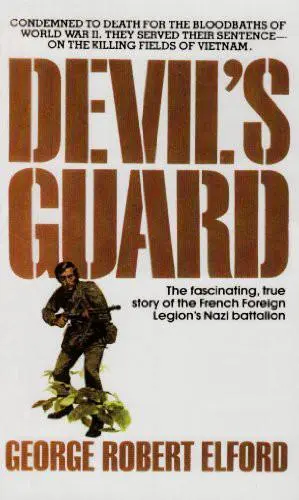
- Название:Devil's Guard
- Автор:
- Издательство:Dell
- Жанр:
- Год:1972
- Город:New York
- ISBN:9780440120148
- Рейтинг книги:3 / 5. Голосов: 1
-
Избранное:Добавить в избранное
- Отзывы:
-
Ваша оценка:
Devil's Guard: краткое содержание, описание и аннотация
Предлагаем к чтению аннотацию, описание, краткое содержание или предисловие (зависит от того, что написал сам автор книги «Devil's Guard»). Если вы не нашли необходимую информацию о книге — напишите в комментариях, мы постараемся отыскать её.
WHAT THEY DID IN WORLD WAR II WAS HISTORY’S BLOODIEST NIGHTMARE.
The ashes of World War II were still cooling when France went to war in the jungles of Southeast Asia. In that struggle, its frontline troops were the misfits, criminals and mercenaries of the French Foreign Legion. And among that international army of the desperate and the damned, none were so bloodstained as the fugitive veterans of the German S.S.
WHAT THEY DID IN VIETNAM WAS ITS UGLIEST SECRET — UNTIL NOW.
Loathed by the French, feared and hated by the Vietnamese, the Germans fought not for patriotism or glory but because fighting for France was better than hanging from its gallows. Here now is the untold story of the killer elite whose discipline, ferocity and suicidal courage made them the weapon of last resort.
Devil's Guard — читать онлайн бесплатно полную книгу (весь текст) целиком
Ниже представлен текст книги, разбитый по страницам. Система сохранения места последней прочитанной страницы, позволяет с удобством читать онлайн бесплатно книгу «Devil's Guard», без необходимости каждый раз заново искать на чём Вы остановились. Поставьте закладку, и сможете в любой момент перейти на страницу, на которой закончили чтение.
Интервал:
Закладка:
Had the terrorists poisoned the well? Bidding us wait, Xuey left for a nearby river and brought back a few frogs and a fish, which he then settled in a can of water drawn from the well. Ten minutes later the creatures were still alive and obviously not affected by any poison. “The well is not poisoned,” Xuey stated, “but there might be something else to look for.”
He examined the surrounding ground, then suddenly called our attention to some brownish stains which Sergeant Krebitz thought was human excrement. Moments later Pfirstenhammer found a pair of buckets with a length of rope attached. The buckets were covered with refuse. We examined the ground between the latrines and the well and spotted more bits of filth. The rest of the story was easy to conclude. The enemy had spoiled the well with refuse. Another Viet Minh joke! I decided that the next macabre joke should be played by us. I remembered having seen a small sack of arsenic in the partly destroyed food storage. The cooks had probably used it to fight rats and other pests. I sent a man to fetch the bag.
“We will preserve those poisonous pegs,” I told Eisner. “We will also take a water sample from the well and photograph the whole area, the buckets, the refuse on the ground… just in case the Reds accuse us of starting chemical warfare.”
They all turned toward me sharply. “What do you mean by chemical warfare?” Riedl queried with a puzzled expression.
I lifted the bag of poison. “This stuff here, Helmut. For if we find the camp of those bastards, I am going to fill their water with rat poison, morphine, and whatever else Sergeant Zeisl might have in excess. We will see how the Viet Minh appreciate that.”
“How about making a few cans of mustard gas?” Pfirstenhammer asked, lighting his pipe. “Its formula is very simple.”
He rattled off the ingredients. “When we return to Hanoi, I will look for the basic chemicals and next time we can mix for the Reds a real cocktail, Hans.”
10. WITH BAYONETS AND ARSENIC
We computed the possible enemy losses by fixing the number of spots where blood had been found but with no corpse to account for it. Karl and Erich were able to establish eighty-two positive and about the same number of likely places where guerrillas might have fallen. More should have fallen outside the stockade, while storming the compound. Schulze calculated over two hundred Viet Minh casualties, including the wounded.
Schulze had other computations as well. “Do you know what?” he exclaimed suddenly, glancing up from his notes. “The terrorists carried away their dead and wounded, which means that at least two hundred or more men transported nothing but corpses and the wounded.”
Before he came to the point, I already grasped the implications of what he was saying.
“How many people do you think were necessary to remove all the weapons, the ammunition, the food stores, blankets, and God knows what else, apart from carrying their own equipment?”
“Over a thousand! Thirteen hundred might be a close bet.”
“Precisely!” Erich agreed. “Nevertheless we know that no Viet Minh unit of such proportions is operating anywhere in the province or Xuey would know about them. I think we had better start looking for additional clues.”
“What clues?” Karl asked.
“Footprints! Those of women and children from ten years upward. The guerrillas alone could never have taken everything that has been removed.”
Shading his eyes he surveyed the neighboring hills. “I think somewhere in those hills we are going to find a guerrilla graveyard and the place where the population of a whole village camped out while waiting for the terrorists to seize the fort.”
I could only agree with Schulze’s reasoning. None of the corpses had been stripped naked—a frequent terrorist practice—probably because of the presence of women and children in the stockade.
“Well, gentlemen,” Erich concluded, “neither women nor children can walk very far laden with crates and sacks. I think we will discover the responsible party in a not too distant settlement, and the Viet Minh camp won’t be far from it either.”
“Trengh’s village!” Xuey added. “That is where we should look.”
I radioed a brief report to Hanoi, suggesting the dispatch of engineers to rebuild the stockade. I waited only for the signal of acknowledgment, then sent the coded signal “unit under enemy attack” and cut the set before any instructions could come through.
“The colonel is going to be mad. We are pulling that on him much too frequently,” Eisner said.
“Do you want to sit here?”
“Not me. I prefer the woods.”
“Well, I know what Hanoi’s answer would have been.”
Pfirstenhammer grinned. “Stay put until the new garrison arrives,” he said.
I nodded. “Exactly.”
That was the very last thing I wanted to do. The head-hunters seldom rested. We would come, do the job, and vanish. Our strength lay in mobility; keeping the enemy uncertain and unsafe was our principal maxim.
Schulze was right about the guerrilla cemetery and the civilian helpers. Barely two miles from the compound Xuey discovered the burial site of the dead terrorists. Their common grave was a shallow one and it took us only an hour to exhume and count the corpses. There were one hundred and twenty-one bodies in the grave, but as Schulze pointed out many of the severely wounded would perish in the coming days from lack of proper medical facilities in the jungle. Not far from the burial site we found the place where a large number of noncombatants had camped down for at least three days. The soft soil showed hundreds of footprints and a ravine was soiled with human excrement.
The village of Nuo Hoy, whose population we suspected had participated in the looting, lay twelve miles to the west, amidst densely forested hills. It was plausible to suppose that the sheer quantity of the stolen material had made it imperative for the enemy to establish several secret dumps. They could not have possibly stored everything in their camp, not with any degree of safety. Natural caves and runnels, either in the hills or beneath the village, were the likely places to look for.
Pondering over the map, we reasoned that the camp itself should be located within a limited area, since to sustain several hundred men the enemy needed plenty of water. A small stream fed by a creek from the mountains flowed through the suspected village. The creek was the only natural source of water in the hilly area. The terrorist camp ought to be somewhere along that creek. We settled for investigating the neighborhood of the village, without revealing ourselves to the enemy. Naturally we could not follow the existing trails that were probably mined and kept under constant surveillance. Although it meant a detour of thirty miles, the alternative route had more appeal for me. It was prudent to suppose that the stockade was still under enemy observation and that Viet Minh lookouts were watching our activities.
We left the compound late in the afternoon when it was still light enough for the snoopers to see us moving in the opposite direction, away from them and our true destination. As soon as darkness prevented further observation we entered the woods and camped down for the night. For all intents and purposes, our battalion had vanished from the sight of the enemy. Now we were on equal terms with the Viet Minh and even had a slight advantage, for we knew where we wanted to strike next but they had no idea where we were.
Shortly after sunrise we set out for the hills. Our trail-blazers needed four days to cut a path through the virgin woods and arrive within two miles of the village. Xuey, Schenk, and four men departed on a long reconnaissance trip into the hills south of the settlement, where I suspected the guerrillas had had their camp along the creek. The sky was overcast and it appeared as if a storm was in the making. We established ourselves a mile inside the woods, close to a brook but high enough not to be washed away by a sudden downpour. It began to rain shortly afterwards and poured for almost a day without stopping. Cooking was out of the question, save for an occasional cup of tea or a soup made of extracts. The men were able to prepare these in their canteens by burning spirit cubes under the protection of their burlaps. We were carrying no tents except for a few canvas sheets to protect our radio gear, maps, and sensitive equipment.
Читать дальшеИнтервал:
Закладка:
Похожие книги на «Devil's Guard»
Представляем Вашему вниманию похожие книги на «Devil's Guard» списком для выбора. Мы отобрали схожую по названию и смыслу литературу в надежде предоставить читателям больше вариантов отыскать новые, интересные, ещё непрочитанные произведения.











Обсуждение, отзывы о книге «Devil's Guard» и просто собственные мнения читателей. Оставьте ваши комментарии, напишите, что Вы думаете о произведении, его смысле или главных героях. Укажите что конкретно понравилось, а что нет, и почему Вы так считаете.