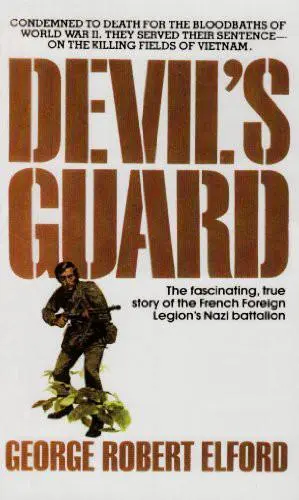
George Elford - Devil's Guard
Здесь есть возможность читать онлайн «George Elford - Devil's Guard» весь текст электронной книги совершенно бесплатно (целиком полную версию без сокращений). В некоторых случаях можно слушать аудио, скачать через торрент в формате fb2 и присутствует краткое содержание. Город: New York, Год выпуска: 1972, ISBN: 1972, Издательство: Dell, Жанр: prose_military, Историческая проза, на английском языке. Описание произведения, (предисловие) а так же отзывы посетителей доступны на портале библиотеки ЛибКат.
- Название:Devil's Guard
- Автор:
- Издательство:Dell
- Жанр:
- Год:1972
- Город:New York
- ISBN:9780440120148
- Рейтинг книги:3 / 5. Голосов: 1
-
Избранное:Добавить в избранное
- Отзывы:
-
Ваша оценка:
Devil's Guard: краткое содержание, описание и аннотация
Предлагаем к чтению аннотацию, описание, краткое содержание или предисловие (зависит от того, что написал сам автор книги «Devil's Guard»). Если вы не нашли необходимую информацию о книге — напишите в комментариях, мы постараемся отыскать её.
WHAT THEY DID IN WORLD WAR II WAS HISTORY’S BLOODIEST NIGHTMARE.
The ashes of World War II were still cooling when France went to war in the jungles of Southeast Asia. In that struggle, its frontline troops were the misfits, criminals and mercenaries of the French Foreign Legion. And among that international army of the desperate and the damned, none were so bloodstained as the fugitive veterans of the German S.S.
WHAT THEY DID IN VIETNAM WAS ITS UGLIEST SECRET — UNTIL NOW.
Loathed by the French, feared and hated by the Vietnamese, the Germans fought not for patriotism or glory but because fighting for France was better than hanging from its gallows. Here now is the untold story of the killer elite whose discipline, ferocity and suicidal courage made them the weapon of last resort.
Devil's Guard — читать онлайн бесплатно полную книгу (весь текст) целиком
Ниже представлен текст книги, разбитый по страницам. Система сохранения места последней прочитанной страницы, позволяет с удобством читать онлайн бесплатно книгу «Devil's Guard», без необходимости каждый раз заново искать на чём Вы остановились. Поставьте закладку, и сможете в любой момент перейти на страницу, на которой закончили чтение.
Интервал:
Закладка:
The rain came down so hard that it penetrated the overhead foliage like bullets, and we had to seek shelter among the trees and under thick branches. Wild torrents of water rushed down from every direction and emptied into the brook, which became a thundering river. Several times we had to move to safer spots but even so the men were soon in deep mud and could not even sit down properly. The roaring of the rain as it hammered on the leaves around us was so intense that we had to shout to make ourselves understood. By evening our small canteens of rum had been consumed. With it went our only source of warmth. A period of constant shivering now began. The troops swallowed aspirin and sulfathiazole pills to head off illness.
Suoi fared better. When the rain started, she put on a long sleek nylon raincoat with a hood. Now she sat on the rucksacks, her head resting in Erich’s lap. He was holding a sandwich for her to bite.
“An idyllic spectacle,” Eisner commented. But I had to concede that she put up with all our hardships bravely. And I wondered how Xuey, Sergeant Schenk, and the party were faring out in the hills, for they carried not even burlaps.
Toward morning the rain abated. The clouds drifted off and the sun began to shine. The temperature rose rapidly. By eleven o’clock the forest had turned into a steam-bath. Stripped to the waist, the troops were strolling off left and right, searching for small patches of sunlight to dry their damp clothes and to warm their chilled bones. The day was spent cleaning weapons, greasing footwear, and learning Indochinese. Ever since Suoi joined our battalion, linguistic studies had gained popularity among the troops. Suoi was a charming and patient teacher and from the moment she took charge of our language courses progress was certain.
The reconnaissance party brought back good news. Sergeant Schenk had discovered the Viet Minh camp and had made a diagram of the area. There was a small cascade in the hills which supplied the enemy camp with water. From a cliff above the cascade, Schenk and Xuey observed the camp for over two hours. Xuey was certain that it sheltered both Nam Hoa and Trengh, along with approximately five hundred terrorists. The camp, Schenk explained, was so cleverly arranged that it was almost impossible to move a large body of troops against it. Save for the one cliff, which could accommodate not more than ten men at a time, there were no other places where troops or automatic weapons could be deployed. The dense vegetation prohibited the use of machine guns elsewhere, and to enter the camp one had to pass along a narrow ravine which the Viet Minh covered with machine guns.
But if the location of the camp prohibited the use of troops and weapons, it certainly invited our bag of rat poison. The creek that fed the Viet Minh water tank could be approached unseen from above. I decided to leave the village alone for the time being but occupy the surrounding hills and trails with a couple of strong detachments. The majority of the troops were to remain with Eisner, Riedl, and Pfirstenhammer to conclude the first phase of the operation—the envelopment of the whole area. Selecting only fifty men, Schulze and I planned to establish a camp close to the guerrilla base, within easy reach of the cascade.
Starting out before daybreak, we broke up into separate groups and proceeded with the occupation of the hills. Suoi insisted on joining Schulze and me and after a brief argument, I bowed to the majority vote. We crossed the stream and the road three miles west of the village, following the trail which Xuey and Schenk had already surveyed. Leaving Suoi with the men in a secluded depression, Xuey, Schenk, Schulze, and I proceeded to the cliff and settled down near the precipice, where jutting boulders covered with shrubs permitted us to survey the enemy base at leisure.
The creek came from high above in the hills. Cold and clear, it flowed past where we were hidden and dropped steeply between the rocks, forming a small cascade a hundred feet below. Near the cascade stood a large water tank made of tin. A circular lid covered the top and it had several taps at the bottom. A system of hollow bamboo served as pipes to convey water from a smaller arm of the cascade to the tank. The tube could be swiveled to and from the water and it was now disconnected. Using canvas bags we dissolved the sack of arsenic in water and added our supply of morphine, digitalis, and a few other drugs to the mixture. Sergeant Zeisl was sure that our cocktail could kill a herd of elephants.
Our major problem was how to convey the preparation to the small branch of the cascade that fed the tank. It would have been of little use to drop the poison into the cascade for only a fraction of it would have reached the branch and consequently the tank. Schulze came up with the idea of using a hollow bamboo to funnel down the poison. There was no bamboo around and Sergeant Schenk had to fetch some from a thicket two miles away.
We occupied the only accessible position in the neighborhood, but the camp was so cleverly hidden among the trees that even we could see only four or five huts. Nearest the tank stood the cooking house, where fires burned in carefully shielded earthen ovens. The overhead foliage was extremely dense, and instead of rising, the smoke dispersed before it reached the treetops. Air reconnaissance could never spot the base, which seemed fairly well established and contained all the necessary components of a permanent base. The mess hut housed a long row of tables made from the sides of ammunition crates which had been nailed to poles driven into the ground. The benches had been contrived in a similar fashion. Along the creek we noticed a spacious natural pool which served as a bath. Farther downstream a couple of empty crates stood in the water, weighed down with boulders; they served as washing stands.
We kept the camp under observation all morning, and I have to admit that I witnessed a great deal of training and discipline, ranging from what were obviously political classes to hand-to-hand combat exercises and grenade throwing. The commissars seemed to keep a rigorous schedule. A roll call took place only a hundred yards from where we lay and I was able to count the guerrillas. There were 322 altogether, among them 58 women. The women, too, were armed and participated in the same routines as the men. But 322 was below the number of terrorists I expected to find in the camp. Schulze reminded me of those who might be lying wounded in the huts. A number of terrorists could also be under way, or in the village. Nam Hoa was present. Xuey spotted him at the pool taking a bath. The local terrorist “fuehrer,” Trengh, was absent.
“He will return,” Xuey said assuredly. “If not today, then tomorrow, but he will return. This is his camp. Nam Hoa is only a guest here.”
Several times the guerrillas came to fetch water from the tank but never to fill it. Dusk was falling and it seemed as if we were to spend a night on the cliff. Then, to my great relief, two men came and mounted the platform on which the tank stood and removed the cover.
“This is it!” Schulze whispered, gesturing us to get ready with the bags. Sergeant Schenk, who was watching the action below the cliff from a narrow parapet, now glanced up and nodded. The pipe had been connected. Schulze steadied the hollow bamboo; Xuey and I kept the bags ready.
Erich signaled.
We emptied the preparation into the brook and sank back relieved. The job was done! We began our careful withdrawal. There was no need for us to spend the night on the cliff. “We shall return in the morning for the burial ceremony,” Schenk remarked.
Shortly before sunrise, Schulze and Schenk set out once again for the cascade. They returned after nearly three hours. Still a hundred yards from me, Erich raised his fist with his thumb turned down. “Total rout!” he exulted, gasping for air.
Читать дальшеИнтервал:
Закладка:
Похожие книги на «Devil's Guard»
Представляем Вашему вниманию похожие книги на «Devil's Guard» списком для выбора. Мы отобрали схожую по названию и смыслу литературу в надежде предоставить читателям больше вариантов отыскать новые, интересные, ещё непрочитанные произведения.












Обсуждение, отзывы о книге «Devil's Guard» и просто собственные мнения читателей. Оставьте ваши комментарии, напишите, что Вы думаете о произведении, его смысле или главных героях. Укажите что конкретно понравилось, а что нет, и почему Вы так считаете.