George Elford - Devil's Guard
Здесь есть возможность читать онлайн «George Elford - Devil's Guard» весь текст электронной книги совершенно бесплатно (целиком полную версию без сокращений). В некоторых случаях можно слушать аудио, скачать через торрент в формате fb2 и присутствует краткое содержание. Город: New York, Год выпуска: 1972, ISBN: 1972, Издательство: Dell, Жанр: prose_military, Историческая проза, на английском языке. Описание произведения, (предисловие) а так же отзывы посетителей доступны на портале библиотеки ЛибКат.
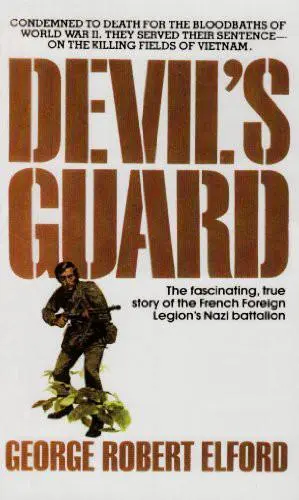
- Название:Devil's Guard
- Автор:
- Издательство:Dell
- Жанр:
- Год:1972
- Город:New York
- ISBN:9780440120148
- Рейтинг книги:3 / 5. Голосов: 1
-
Избранное:Добавить в избранное
- Отзывы:
-
Ваша оценка:
Devil's Guard: краткое содержание, описание и аннотация
Предлагаем к чтению аннотацию, описание, краткое содержание или предисловие (зависит от того, что написал сам автор книги «Devil's Guard»). Если вы не нашли необходимую информацию о книге — напишите в комментариях, мы постараемся отыскать её.
WHAT THEY DID IN WORLD WAR II WAS HISTORY’S BLOODIEST NIGHTMARE.
The ashes of World War II were still cooling when France went to war in the jungles of Southeast Asia. In that struggle, its frontline troops were the misfits, criminals and mercenaries of the French Foreign Legion. And among that international army of the desperate and the damned, none were so bloodstained as the fugitive veterans of the German S.S.
WHAT THEY DID IN VIETNAM WAS ITS UGLIEST SECRET — UNTIL NOW.
Loathed by the French, feared and hated by the Vietnamese, the Germans fought not for patriotism or glory but because fighting for France was better than hanging from its gallows. Here now is the untold story of the killer elite whose discipline, ferocity and suicidal courage made them the weapon of last resort.
Devil's Guard — читать онлайн бесплатно полную книгу (весь текст) целиком
Ниже представлен текст книги, разбитый по страницам. Система сохранения места последней прочитанной страницы, позволяет с удобством читать онлайн бесплатно книгу «Devil's Guard», без необходимости каждый раз заново искать на чём Вы остановились. Поставьте закладку, и сможете в любой момент перейти на страницу, на которой закончили чтение.
Интервал:
Закладка:
Out in the compound the men were busy. From under two of the corpses the demolition squad extracted a pair of primed grenades arranged in such fashion that any casual moving or turning of the bodies would have triggered an explosion. It was an old Russian partisan trick, but one which nevertheless still claimed many ignorant or forgetful victims. We tried our best to preserve the corpses of our comrades for a decent burial but many of them could not be touched with any degree of safety. These had to be turned over by men stretched on the ground, sheltered behind a pair of sandbags and using long poles or ropes. Of them we could gather and bury only bits of flesh and bones—a very unpleasant undertaking.
By noon, Xuey and Sergeant Krebitz had uncovered thirty booby traps and mines inside the stockade. More were forthcoming during the afternoon. We marked the cleared areas with cords laid on the ground to form corridors in which it was safe to walk. Booby-trapped corpses were marked with pebbles. The pools of blood were already congealed or absorbed by the gravel. The men must have been dead for over a day. The scene was truly disheartening but such debacles could no longer shock us. We had seen similar slaughters only too often.
At the command post we discovered more corpses, among them that of the commanding officer, First Lieutenant Roger Martinet, whom I had known since 1948. He lay on the wooden steps of the pile-supported porch. Save for his pants, he was naked, and he had a large, jagged hole in his breast about which a cluster of flies were buzzing. The steps, the porch, and the walls were splintered with shell fragments, some of which must have hit Martinet in the chest. Eisner found another primed grenade in the pocket of the lieutenant and this was exploded outside the compound.
Another ingenious instrument of death was hidden by the closed door of the command post. The guerrillas had placed an antipersonnel mine on the inside floor with a strong, biforked branch wedged between the door handle and the pressure switch of the mine. If one of us had pressed the handle, the entire building would have gone up in the blast. But that single closed door looked wrong to us from the moment we saw it, for all the other doors and windows hung wide open or torn loose. Men with less experience could have easily fallen for it. Similar ruses accounted for our calling most of the Viet Minh tricks naive. Most of them derived from wartime Russian ruses, which we knew well after our years in Russia: one opened a door and the house exploded; turned a water tap, moved a casually placed object, removed a book from a shelf, righted an awkwardly hanging picture on the wall, or pushed down a piano key—a bomb went off.
Sergeant Krebitz entered through a window and removed the mine.
By early afternoon the number of disarmed or exploded booby traps increased to fifty. We combed the stockade yard by yard. From the desk of the commander, Sergeant Krebitz extracted four bombs. It was a very delicate job to get at the charges. Krebitz had to remove the rear panels for the drawers could not be touched.
All the corpses had been stripped to underwear. The guerrillas always collected shirts, belts, and footwear, in addition to watches, pens, lighters, and weapons. Beside Martinet sprawled two officers. Both had been shot at close range; a third victim, a North African sergeant, had been shot and stabbed in the abdomen.
“I guess this carnage is payment for our visit to Man-hao,” Schulze remarked ironically. “Will the French ever learn how to fight the Viet Minh, Bernard?” In the communication room we found the corpse of the signal officer, Lieutenant Mazzoni, and that of a sergeant. The wireless equipment and the telephone exchange were missing and the connecting wires hung as if they had been ripped from the wall. I was puzzled that the guerrillas had taken the heavy radio equipment while leaving behind the converter unit. The set was not a battery-operated one but depended on the electric current generated by a diesel engine. The engine itself was far too heavy for removal, so the terrorists had settled for breaking-it up.
The yard behind the command post was littered with over a hundred corpses. Some of the men had been killed by mortar splinters, others had died in hand-to-hand combat. Near the mess hall we discovered another dead officer.
A Viet Minh unit strong enough to exterminate a garrison of three hundred well-armed Legionnaires must have consisted of at least six hundred men. Nam Hoa was known to have commanded a group of about two hundred guerrillas, but he could have ganged up with a few local units who were equipped with mortars. We counted over a hundred spots where mortar shells had exploded. Coming from far inland, Nam Hoa could not have possessed such powerful artillery.
“There is only one man in the district who commands so many mortars,” Xuey explained. “Trengh. He also commands three hundred men. Maybe even more. His village is about twelve miles from here, on the far side of the hills.”
He showed us the direction.
We had heard of Trengh before. He had been a Hanoi police officer who, conspiring with the Viet Minh in 1949, had engineered a daring terrorist raid on a police station and had assisted the guerrillas in freeing fifty prisoners. With that coup to his credit, Trengh deserted to the Viet Minh. Ever since then his head carried a reward of 75,000 piasters dead or alive. The French had also, posted a reward of 100,000 piasters for Nam Hoa, not a very tempting reward for such an important guerrilla leader. Such financial “courtesies” were mutual. Every member of my battalion had been similarly “price-tagged” dead or alive by the Viet Minh or by the Chinese.
At the entrance to the canteen we counted sixteen European Legionnaires and a young corporal. The corporal’s eyes were open, gazing into the sun; under his hand lay a pistol which the enemy had overlooked. The magazine of the pistol was empty. The mess hall looked as though a hurricane had gone through it. Chairs, benches, tables were overturned or wrecked. Broken glass littered the floor. The smell of blood and decomposition was strong. More men lay under the debris, behind the counter and the overturned tables which they had used for cover. The walls and doors were riddled by hundreds of bullets. There must have been desperate combat inside the building, with the adversaries shooting it out at close range. My men removed twenty or more bodies from the mess hall alone, among them many Europeans. More corpses sprawled outside the building in and about a gaping hole in the wall. Still wearing their white aprons, two of the six cooks had been pressed head first into their ovens. Since, by rule, all open fires had to be extinguished while under attack, the corpses were not burned. Even so we found it a macabre bit of Red humor. The debacle culminated in the sleeping quarters, where the remaining troops had been mercilessly slaughtered. Eighty men altogether. The barracks had been stripped bare. Blankets, sheets, even some of the mattresses had been carried away. The underground ammunition depots were empty.
We stood in sullen silence, watching the demolition men as they moved from corpse to corpse looking for bombs. The bodies which had been checked were carried out to join the long lines of corpses laid out outside the palisade. Eisner dispatched two hundred men to dig a huge grave for the fallen garrison. None of the corpses wore identity tags. The brave men would probably rest as “unknown soldiers.”
Eighteen trucks and jeeps in the parking lot were burned-out steel skeletons; four 75 field howitzers were still hitched to four of the CMC’s—wrecked, but even so we could see that none of the great guns had ever been fired.
The wind wheel, which used to pump water from the well, had been knocked down. The pump mechanism was demolished. The well itself appeared intact and flashlights revealed water thirty feet below. Sergeant Krebitz examined, the well, searching for corpses, but found none. I became even more suspicious, for whenever the Viet Minh seemed to spare something important, it did so on purpose. We became doubly alert.
Читать дальшеИнтервал:
Закладка:
Похожие книги на «Devil's Guard»
Представляем Вашему вниманию похожие книги на «Devil's Guard» списком для выбора. Мы отобрали схожую по названию и смыслу литературу в надежде предоставить читателям больше вариантов отыскать новые, интересные, ещё непрочитанные произведения.












Обсуждение, отзывы о книге «Devil's Guard» и просто собственные мнения читателей. Оставьте ваши комментарии, напишите, что Вы думаете о произведении, его смысле или главных героях. Укажите что конкретно понравилось, а что нет, и почему Вы так считаете.