George Elford - Devil's Guard
Здесь есть возможность читать онлайн «George Elford - Devil's Guard» весь текст электронной книги совершенно бесплатно (целиком полную версию без сокращений). В некоторых случаях можно слушать аудио, скачать через торрент в формате fb2 и присутствует краткое содержание. Город: New York, Год выпуска: 1972, ISBN: 1972, Издательство: Dell, Жанр: prose_military, Историческая проза, на английском языке. Описание произведения, (предисловие) а так же отзывы посетителей доступны на портале библиотеки ЛибКат.
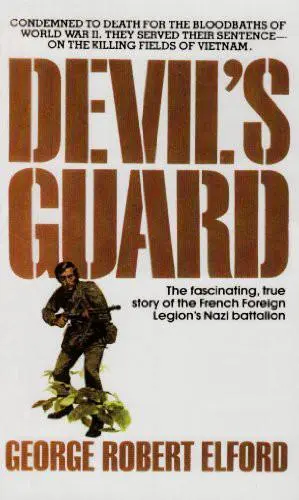
- Название:Devil's Guard
- Автор:
- Издательство:Dell
- Жанр:
- Год:1972
- Город:New York
- ISBN:9780440120148
- Рейтинг книги:3 / 5. Голосов: 1
-
Избранное:Добавить в избранное
- Отзывы:
-
Ваша оценка:
Devil's Guard: краткое содержание, описание и аннотация
Предлагаем к чтению аннотацию, описание, краткое содержание или предисловие (зависит от того, что написал сам автор книги «Devil's Guard»). Если вы не нашли необходимую информацию о книге — напишите в комментариях, мы постараемся отыскать её.
WHAT THEY DID IN WORLD WAR II WAS HISTORY’S BLOODIEST NIGHTMARE.
The ashes of World War II were still cooling when France went to war in the jungles of Southeast Asia. In that struggle, its frontline troops were the misfits, criminals and mercenaries of the French Foreign Legion. And among that international army of the desperate and the damned, none were so bloodstained as the fugitive veterans of the German S.S.
WHAT THEY DID IN VIETNAM WAS ITS UGLIEST SECRET — UNTIL NOW.
Loathed by the French, feared and hated by the Vietnamese, the Germans fought not for patriotism or glory but because fighting for France was better than hanging from its gallows. Here now is the untold story of the killer elite whose discipline, ferocity and suicidal courage made them the weapon of last resort.
Devil's Guard — читать онлайн бесплатно полную книгу (весь текст) целиком
Ниже представлен текст книги, разбитый по страницам. Система сохранения места последней прочитанной страницы, позволяет с удобством читать онлайн бесплатно книгу «Devil's Guard», без необходимости каждый раз заново искать на чём Вы остановились. Поставьте закладку, и сможете в любой момент перейти на страницу, на которой закончили чтение.
Интервал:
Закладка:
Trengh and his guerrillas arrived at sundown. Xuey waved boldly to them as they passed the first gun emplacement, now manned by Schenk and six troops. The guerrillas waved back and the group proceeded through the ravine and entered the camp.
I waited just long enough for them to come out in the open, then ordered fire. The machine guns opened up simultaneously and fired for less than ten seconds. Their chatter was very dull, resembling the popping of champagne corks. During that ten seconds five hundred bullets were poured into the group. The terrorists didn’t know what hit them.
I left a detachment to guard the camp and turned my attention to the village, where shock and consternation was immense, even though we harmed no one. Most of the dead guerrillas were from there. I considered it enough punishment for the people. There was hardly a hut without someone missing. A grim lesson of a cruel war.
From the concealed cellars and tunnels we recovered everything that had been snatched from the stockade. Taking a hundred troops, Eisner escorted a large group of complaining, crying villagers to the camp to bring down more army wares. He allowed the people to bury their dead. The camp was then destroyed with explosive charges.
Taking the three captive girls, Riedl and Pfirstenhammer departed for the other guerrilla dump—supposedly fifteen miles, but it turned out to be over twenty-two miles away. Escorting the villagers—some four hundred people altogether—-laden with stores, we headed back toward the stockade.
A new garrison greeted us when we arrived. Trucks, helicopters, and armored cars crowded the yards, while engineers were busy repairing the damaged buildings and the outer defenses. The perimeter was being improved with minefields and concrete pillboxes near the palisade. A system of covered trenches was to connect the bunkers with the stockade.
“What did I tell you?” Eisner exclaimed when, descending from the hills, we beheld the brisk activity for the first time. “The French are the greatest builders of forts.”
Then he added with a chuckle, “In about five years” time those pillboxes and minefields may have destroyed as many terrorists as we have dispatched in the past five days!” With the goods properly delivered, we sent the civilians home and settled down to enjoy a well-deserved rest. Riedl and Karl returned two days later. In the secret dump, which consisted of a maze of natural caves and tunnels, they discovered a quantity of Soviet weapons.
“How did you blast the place if it was all rocks?” Schulze asked. He was busy preparing our report on the past week.
“Like hell we blasted it!” Karl exclaimed. “We just mined the lot and left everything in order. Who wants to blow up bare hills, Mensch? Sooner or later other guerrillas will come to fetch the stuff. They move a crate and the whole works blow sky-high—with the Viet Minh riding the smoke.”
“A good idea,” Erich complimented.
“My ideas are always good,” Karl stated modestly.
The girls were still with them. “I sent them off near the village,” Riedl explained, “but they kept coming back to us. They seemed scared to death of their own people.”
“They prefer to come to Hanoi,” Karl added. “We couldn’t just dump them in the woods, could we?” He walked off to the canteen and returned with a large bowl of rice and meat. “Here! Take it.”
He handed the bowl to the smallest girl. “Eat! Mangez… essen… niam, niam. Her name is Noy,” he explained to us. “The other two are called Chi and Thi—if I spell it well. Chi is not a local girl. She is from Szechwan, China.”
“We can use them, can’t we, Hans?” Riedl seemed to be suggesting rather than asking a question. “They are trained nurses with hospital experience.”
“We can always use a couple of good nurses,” Schulze put in.
“Sure!” Riedl agreed and began to cite the advantages of having the girls along. They know the woods. They can march like men. They are nurses. They can prepare better food than we are cooking ourselves. Heading off my decision he added hopefully, “They will be an asset to the battalion, Hans.”
“I have heard that already.”
“Besides, Suoi won’t be all alone.”
“Neither will you, I presume.”
Karl grinned. “It could be kind of fun to have them along.”
“I gather that. But suppose they don’t like your proposal?”
“But they do!” Pfirstenhammer exulted. He turned toward the trio who sat on the crates, munching without a worry on earth. “You do want to come with us, don’t you?” The girls looked up and giggled. “Ja, ja,” the one called Noy replied in German. “Karl und Helmut sint gutte manne”—“Karl and Helmut are good men.”
“What did I say?” Karl beamed. “In six months” time they will even speak German, won’t you Noy?”
“Jahfoll… ja, ja,” she answered what one could decipher into “Jawohl!” and giggled. “Yes, yes… we like learning, much learning. Kayl said we can come with you. He will fix up Commander.”
“He will fix me up, eh? That’s what Karl said?”
“Ja, ja,” she nodded, “can we come?”
“Of course you can come,” Suoi answered on my behalf.
Being outnumbered ten to one, I surrendered.
“Voila!” Erich chuckled. “The battalion plus four.”
11. AMBUSHED
We spent four magnificent days in the stockade, sleeping in soft beds; eating cooked meals consisting of meat, vegetables, and salads; sitting at tables, drinking wine, playing cards; reading, relaxing. Then a wireless message arrived marked “Urgent!”
“Commence with plan TRANSIT in the areas 502 and 511. Intelligence reports massive terrorist supplies moving south to reinforce Viet Minh units in the Delta zone. Advance on point 1123 and interrupt enemy convoys and troops. Send detailed situation report.”
Advance on point 1123—Muong Son, a Communist stronghold. Our short “holiday” was over.
I had my misgivings about such detailed wireless dispatches whether they were coded or not. I had often requested a change of code but all in vain. In the German Army we had changed field codes every other day. The Foreign Legion used the same keys for months in a row. Recent events made me suspect that the “ears” of the Viet Minh were wide open both in Hanoi and in the provinces. Besides, we had discovered quite a few Chinese radio listening posts in the frontier areas and Eisner swore that some of them were manned by Russian signal experts. I would not have been surprised if the enemy had known the key to our code.
While in the stockade, we learned that the guerrillas had begun the attack there only two days after the magazines of the fort had been replenished with supplies and only after the departure of the tanks and copters that had escorted the incoming convoy. Moreover, the attack came when our battalion was on its way toward an alleged Viet Minh trail in Laos and was bypassing the stockade—which was within easy marching distance. The prompt terrorist attack on the garrison had diverted us from the trail and the suspected enemy supplies moving south. Had the guerrillas attacked a day later, we would not have turned back toward the stockade but would have moved on to disrupt the enemy convoys deeper inland.
Was it only a coincidence or the result of deliberate and clever planning? Was there something very important moving south which the enemy wanted to preserve by providing a diversion for us? Had some of their spies been very active in Hanoi? Had they managed to break the army code? Three days later I received my answer to that question.
We were camped out on a barren ridge, waiting for dawn, when suddenly we came under intense enemy fire which persisted for over an hour. Shouting savagely, several hundred guerrillas emerged from the forest below. Still firing furiously, those on the flanks streamed across the entire width of the hill and began to ascend. Silhouetted against the moonlit rocks, they came charging up the rugged slope. There were too many boulders to shelter behind. The machine guns could not stop them. The enemy advanced, hopping from boulder to boulder, gaining ground rapidly. The night roared with machine gun clatter and the explosion of grenades; shrieks, yells, and curses rose from below, echoing among the rocks.
Читать дальшеИнтервал:
Закладка:
Похожие книги на «Devil's Guard»
Представляем Вашему вниманию похожие книги на «Devil's Guard» списком для выбора. Мы отобрали схожую по названию и смыслу литературу в надежде предоставить читателям больше вариантов отыскать новые, интересные, ещё непрочитанные произведения.












Обсуждение, отзывы о книге «Devil's Guard» и просто собственные мнения читателей. Оставьте ваши комментарии, напишите, что Вы думаете о произведении, его смысле или главных героях. Укажите что конкретно понравилось, а что нет, и почему Вы так считаете.