George Elford - Devil's Guard
Здесь есть возможность читать онлайн «George Elford - Devil's Guard» весь текст электронной книги совершенно бесплатно (целиком полную версию без сокращений). В некоторых случаях можно слушать аудио, скачать через торрент в формате fb2 и присутствует краткое содержание. Город: New York, Год выпуска: 1972, ISBN: 1972, Издательство: Dell, Жанр: prose_military, Историческая проза, на английском языке. Описание произведения, (предисловие) а так же отзывы посетителей доступны на портале библиотеки ЛибКат.
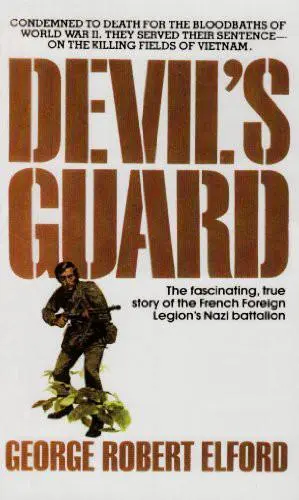
- Название:Devil's Guard
- Автор:
- Издательство:Dell
- Жанр:
- Год:1972
- Город:New York
- ISBN:9780440120148
- Рейтинг книги:3 / 5. Голосов: 1
-
Избранное:Добавить в избранное
- Отзывы:
-
Ваша оценка:
Devil's Guard: краткое содержание, описание и аннотация
Предлагаем к чтению аннотацию, описание, краткое содержание или предисловие (зависит от того, что написал сам автор книги «Devil's Guard»). Если вы не нашли необходимую информацию о книге — напишите в комментариях, мы постараемся отыскать её.
WHAT THEY DID IN WORLD WAR II WAS HISTORY’S BLOODIEST NIGHTMARE.
The ashes of World War II were still cooling when France went to war in the jungles of Southeast Asia. In that struggle, its frontline troops were the misfits, criminals and mercenaries of the French Foreign Legion. And among that international army of the desperate and the damned, none were so bloodstained as the fugitive veterans of the German S.S.
WHAT THEY DID IN VIETNAM WAS ITS UGLIEST SECRET — UNTIL NOW.
Loathed by the French, feared and hated by the Vietnamese, the Germans fought not for patriotism or glory but because fighting for France was better than hanging from its gallows. Here now is the untold story of the killer elite whose discipline, ferocity and suicidal courage made them the weapon of last resort.
Devil's Guard — читать онлайн бесплатно полную книгу (весь текст) целиком
Ниже представлен текст книги, разбитый по страницам. Система сохранения места последней прочитанной страницы, позволяет с удобством читать онлайн бесплатно книгу «Devil's Guard», без необходимости каждый раз заново искать на чём Вы остановились. Поставьте закладку, и сможете в любой момент перейти на страницу, на которой закончили чтение.
Интервал:
Закладка:
“Hell, Hans!” Schulze yelled, as he knelt against a boulder, sweeping the slope with his submachine gun, “There is a whole bloody brigade of them!”
“It isn’t so bad as that, Erich, keep firing!” I shouted back. I glanced at Suio and the nurses, who were sheltered behind a large stone; they appeared more fascinated than scared.
“Take them higher up!” I called to Schulze and pointed at a cluster of boulders twenty feet above us. Erich nodded and sprang to the girls. “Up there!” he commanded briskly. “Lay low.”
He helped them climb into a small natural opening and dumped three submachine guns after them. “If they come as far as here, then shoot!” The next instant he was back firing savagely into the oncoming crowd.
Before the enemy troops were halfway up the hill I could see that we were heavily outnumbered, but I did not consider our situation too difficult; we had the advantage of being better trained, better equipped, and we also held the superior position. The Viet Minh had missed a better chance: They should have attacked us when we were still coming uphill.
The ridge where we deployed was a sort of natural fort formed by large jagged boulders, but it was circular and could be attacked from every side. As we lay prone on the slabs, the enemy proceeded to do exactly what I anticipated—make a concentric assault. With some pessimism, Schulze could have yelled “a division” instead of only a brigade, there were so many of them coming at us.
Traversing the machine guns slowly from side to side, the gunners managed to slow down the enemy but still they advanced, hopping from stone to stone. My men were preparing a defense perimeter with Sergeant Krebitz, Schenk, Corporal Altreiter, and even Kurt Zeisl, our medical officer, shouting orders, running from position to position to bolster the men. We were compressed in a limited area, maybe two hundred yards across, and I could but thank our good fortune that the guerrillas were not carrying mortars.
On each side bullets dealt death. The foremost terrorists fell but others came hurtling on, regardless of losses, in what was obviously a human wave assault. Their advance platoons established themselves barely fifty yards below the ridge, where a depression offered them shelter. I had no doubt that the enemy had known where to look for us and thought we could be trapped and finished off on the coverless ridge. It could not have been just another “coincidence”; rather it was a planned and timely delivered action.
The moon suddenly vanished behind a passing cloud and the short period of darkness was greeted by vicious shrieks and yells in the terrorist ranks. Under the cover of darkness the enemy surged forward. We could do little to stop them.
“A la baionnette!” Eisner commanded. “Fix bayonets!” Corporal Altreiter and Sergeant Schenk passed the word. The firing stopped abruptly, giving way to a multitude of sharp, metallic clicks as the bayonets were snapped onto the gun muzzles.
“Xung! Phong!” came the Viet Minh battle cry. “Forward! Kill!” The leading terrorists were but a dozen yards from us, coming on strong. Howling madly and no longer seeking shelter, they charged. Many of them fell, slithering down the slope dead or wounded. Even so, our last volley could not stop the tide. Only then did I notice Chinese militiamen among the Viet Minh—over a hundred miles inside French Indochina. Nevertheless for Paris, Peking was “neutral,” nonbelligerent; we could not even submit a proper report on our raids into China to be forwarded to Paris. It was against the rules to have been there in the first place.
Indeed the Chinese were nonbelligerent—only bellicose.
“Loose fire! Aim at their guts!” I shouted, bracing myself for the coming melee. More and more of the enemy lurched, spun about, and collapsed, thrashing in agony, but at least a hundred of them reached the plateau, each carrying a rifle or a cutlass.
“Keep shooting!” Schulze yelled. Discarding the empty submachine gun, I drew my automatic and raced up to Riedl, who was already fighting three guerrillas in a desperate hand-to-hand combat. I shot the nearest one through the chest and turned toward the second man, who rushed at me with a broad-bladed cutlass. The terrorist had a submachine gun flung about his chest. Its magazine must have been empty and in the turmoil no one had time to reload. The determination of my adversary was incredible. He saw me lifting my pistol but only howled and kept coming at me. One bullet hit him in the face, the second slug tore out his throat. He stopped, staggered a few steps, and went down.
“Here, Hans!” I heard a yell. A Chinese rifle with Russian bayonet materialized in front of my face. I grabbed the weapon, barely noticing that Sergeant Krebitz handed it to me. “It’s loaded!” Krebitz raced off to Gruppe Drei on the far side of the plateau. I saw him duck the thrust of a militiaman; an instant later he grabbed his adversary by the chest, kicked him in the groin, and as the terrorist doubled up in pain, Krebitz clubbed him with his rifle butt.
The guerrillas were all around us. They came yelling, howling, brandishing bayonets, spears, and even knives. Shooting became very sporadic. Both sides had fired all their bullets and no one had time to change magazines. It was a day of the bayonets.
Firing the Chinese rifle, I managed to drop four of the closest terrorists, then bayoneted two more as they came over the ledge. Some of my own men were going down; others sprawled among the stones—shot, stabbed, or cut open.
“Watch out for Riedl!” Erich cried, hitting and slicing a guerrilla. Wheeling around I saw a couple of militiamen ready to swamp Helmut. The same instant I felt a searing pain in my head and for a moment my world jarred; but my eyes remained open, I could still see and move my limbs and I was still erect. I did not pay any more attention to it. Rushing on, I managed to drop two of the Chinese but emptied my rifle in the process. The third militiaman leaped at Helmut. He, too, must have spent his bullets, for he raised his rifle club-like.
“Look out!” I warned Riedl and as he turned to meet the charge the sinewy Chinese brought down his weapon at an oblique angle. Had it landed the blow could have sent Riedl spinning into the ravine a hundred feet below, but he ducked in time and the stock only grazed his shoulder. Even so the blow was enough to knock the gun from his hand. Sergeant Schenk uttered a savage yell as he smashed the head of a terrorist with a swinging blow, then stabbed another one with such force that not only the bayonet but also a part of the muzzle entered the wound. Lifting his foot, he kicked his adversary backward to free his bayonet, then rushed to Riedl’s side. The militiaman wheeled around and lifted his rifle to ward off the coming thrust. He only managed to divert it. Schenk’s blade ripped across his chest and the two went down in a tangle, barely a yard from the precipice. The diversion enabled Riedl to recover his automatic. Still stooping he shot the Chinese behind the ear. Blood, bone, and brain tissue blew across the stones in a savage spray. Sergeant Schenk rose, covering his ringing ears, dumbfounded by the proximity of the blast; his face and hands were sprinkled with blood and bits of flesh.
“Sorry, Victor,” Helmut apologized, “I had no choice.”
From the hand of the still writhing Chinese he kicked free a short curved knife. “He was about to cut your belly open.”
A tall, lean guerrilla with protruding teeth materialized in front of me. Howling with his mouth wide open, he pushed his bayonet so far forward that he lost his balance and crashed headlong into Schulze. Erich swore. He reeled, steadied himself, and swung his gun up in a savage blow. The barrel caught the terrorist a terrific wallop across the mouth. He stopped howling as a few of his teeth went down his gullet; staggering back he fell on his knees until a kick from Riedl helped him over the precipice.
Читать дальшеИнтервал:
Закладка:
Похожие книги на «Devil's Guard»
Представляем Вашему вниманию похожие книги на «Devil's Guard» списком для выбора. Мы отобрали схожую по названию и смыслу литературу в надежде предоставить читателям больше вариантов отыскать новые, интересные, ещё непрочитанные произведения.












Обсуждение, отзывы о книге «Devil's Guard» и просто собственные мнения читателей. Оставьте ваши комментарии, напишите, что Вы думаете о произведении, его смысле или главных героях. Укажите что конкретно понравилось, а что нет, и почему Вы так считаете.