George Elford - Devil's Guard
Здесь есть возможность читать онлайн «George Elford - Devil's Guard» весь текст электронной книги совершенно бесплатно (целиком полную версию без сокращений). В некоторых случаях можно слушать аудио, скачать через торрент в формате fb2 и присутствует краткое содержание. Город: New York, Год выпуска: 1972, ISBN: 1972, Издательство: Dell, Жанр: prose_military, Историческая проза, на английском языке. Описание произведения, (предисловие) а так же отзывы посетителей доступны на портале библиотеки ЛибКат.
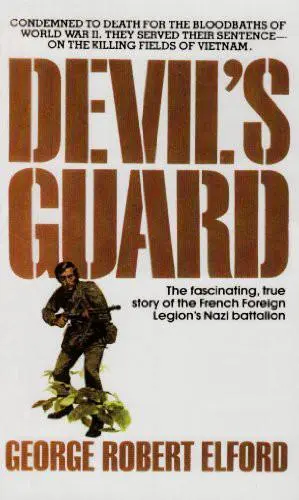
- Название:Devil's Guard
- Автор:
- Издательство:Dell
- Жанр:
- Год:1972
- Город:New York
- ISBN:9780440120148
- Рейтинг книги:3 / 5. Голосов: 1
-
Избранное:Добавить в избранное
- Отзывы:
-
Ваша оценка:
Devil's Guard: краткое содержание, описание и аннотация
Предлагаем к чтению аннотацию, описание, краткое содержание или предисловие (зависит от того, что написал сам автор книги «Devil's Guard»). Если вы не нашли необходимую информацию о книге — напишите в комментариях, мы постараемся отыскать её.
WHAT THEY DID IN WORLD WAR II WAS HISTORY’S BLOODIEST NIGHTMARE.
The ashes of World War II were still cooling when France went to war in the jungles of Southeast Asia. In that struggle, its frontline troops were the misfits, criminals and mercenaries of the French Foreign Legion. And among that international army of the desperate and the damned, none were so bloodstained as the fugitive veterans of the German S.S.
WHAT THEY DID IN VIETNAM WAS ITS UGLIEST SECRET — UNTIL NOW.
Loathed by the French, feared and hated by the Vietnamese, the Germans fought not for patriotism or glory but because fighting for France was better than hanging from its gallows. Here now is the untold story of the killer elite whose discipline, ferocity and suicidal courage made them the weapon of last resort.
Devil's Guard — читать онлайн бесплатно полную книгу (весь текст) целиком
Ниже представлен текст книги, разбитый по страницам. Система сохранения места последней прочитанной страницы, позволяет с удобством читать онлайн бесплатно книгу «Devil's Guard», без необходимости каждый раз заново искать на чём Вы остановились. Поставьте закладку, и сможете в любой момент перейти на страницу, на которой закончили чтение.
Интервал:
Закладка:
Being well aware of the utter corruption which then dominated the Nationalist army, and which contributed greatly to the final collapse of Nationalist China, I reserved my opinion on the matter. As a rule we trusted no Chinese or Indochinese and we also had some misgivings about the judgment of American generals. The Americans had poured into China money and weapons enough to conquer the earth yet they were unable to preserve a single square kilometer of the “Heavenly Empire” that was now gradually turning into a perfect hell.
I had asked Colonel Houssong if our Chinese companions had been informed about “Longhand” in detail.
“I understand what you mean,” he had said, “but rest assured. I did not consider it necessary to reveal all. You may tell them as much as possible under the circumstances.”
My sigh of relief must have been audible for he had added reassuringly, “I am sure they will be all right.”
“They had better be indeed.”
He had laughed and” slapped me on the shoulder in a friendly manner. “I know you wouldn’t trust Chiang Kai-shek himself, Wagemueller.”
“I wouldn’t trust Jesus Christ on a mission like this, mon colonel. The slightest indiscretion and—”
“Would you prefer to go on your own?”
“Without reservation.”
“It would be much more difficult.”
“We may have to climb more hills but we won’t be jittery all the way.”
“Will you be jittery because of them?”
“By your leave, mon colonel, I shall make my own security arrangements.”
“Alors, make them, but return safely.”
So we kept our Chinese quintet under close surveillance, and I made sure that they knew as little as possible of our general plan. The Nationalist Chinese officers could study our immediate objective but nothing else. One of them who spoke good French must have noticed our polite but reserved attitude, for he spoke to me shortly after we had crossed the border.
“You are not sure about our capability to lead this expedition, are you?” he asked me with a hint of sadness in his voice.
“Major Kwang,” I replied in a firm voice, “I am going to be frank with you. We met only five days ago. We don’t know you or where you come from.”
“Colonel Houssong knows,” he ventured. “The colonel is in Hanoi, Major. We are on the way to hell—and back, let us hope. But let me ask you something. Have you known your companions for a long time?”
“I know only Major Cheng,” he replied. “We used to serve in the same battalion. The others we met in the colonel’s office.”
“You see, Major. They are aliens even to you—”
“But the colonel surely knows them.”
“The colonel is only a human being, Major Kwang. Human beings are fallible.”
“The colonel, the generals, the prime minister,” Eisner cut in. “We have been around here for a long time, Major Kwang. We have outlived the average life expectancy of Legionnaires, and I think we are still around because we took nothing for granted—never!” The major smiled politely. “Then you regard every stranger guilty until proven innocent?”
“We regard only one thing, Major—our own survival factors,” I said. “We learned that a long time ago: to think, to plan, to calculate, to evaluate and act—everything related to survival factors. Friendship, relations, rank, sentiments are all only of secondary importance. We are living on borrowed time and abiding by the law of probability, which is the only law we carefully observe. Had we done otherwise, we would now be dead heroes instead of surviving experts. For that’s what we really are, Major Kwang: neither invincible daredevils nor supermen nor heroes—only survival experts. But survival is the most important thing in any war.”
“I will do my best to see that all of us survive during the next few days,” Kwang said.
“You do that, Major,” I nodded. “But keep an eye on those whom you do not know.”
“With regard to my own survival factor?” he asked with a smile.
“You might call it that,” I conceded.
It was nine P.M. Tuesday when we crossed the Chinese frontier eighteen kilometers west of the one time Cao Bang-Tien-pao road. Between us and the road, we knew, ran a guerrilla trail that joined a dirt road three kilometers inland. Here the Chinese maintained a small guardhouse for the militia which patrolled the border section. Farther to the northwest and past the place where we intended to cross the dirt road was a village with a garrison of two hundred troops—whom we wanted to avoid.
Thanks to the moonlight we made good progress but even so the terrain was difficult and it took us almost six hours to cover the eight kilometers to the road. We arrived there shortly before three A.M. Wednesday. I wanted to proceed farther inland without stopping but Sergeant Krebitz called my attention to the numerous truck tire marks, which indicated frequent military traffic along the road. In those days no one but the army possessed heavy vehicles in China but even so the army was very hard pressed on motorized transport, and the troops were often compelled to march extremely long distances because of the lack of trucks. The loss of a few vehicles along the road could be extremely painful for them, especially if some of the trucks were transporting irreplaceable cargo. Krebitz suggested that we should mine the road, which we did at five different points, approximately three hundred paces apart. The pressure switches were set to permit the passage of anything up to one ton, which was about the limit even heavily laden peasant carts would weigh. We had no intention of hurting innocent civilians walking by or carting home their grains.
By five A.M. we were deep in the hills. Daybreak came swiftly and when the sun rose we camped down. Slipping their haversacks and weapons to the ground, the men dropped into the soft grass, weary and exhausted. A general massaging of feet began, a regular feature of every stop. A few troopers began to munch, while others were too spent even for eating. They just stretched out on their burlaps. Breakfast was no problem. Everybody was still carrying cooked rice and minced meat; the men had their canteens full of coffee or tea, except for those who preferred to drink rum. Sergeant Krebitz carried three canteens to have a bit of everything: two dangling from his belt, a third one in his rucksack.
Sitting on a boulder sipping coffee, I surveyed our rugged company. Looking at some troopers one could indeed wonder if our native pajamas would ever deceive the enemy. Maybe from a distance of five hundred meters but not from any closer. They were armed to the teeth with the latest and best equipment France could offer. But, alas, the main point was that we should not look French, and in that respect we certainly succeeded. As a matter of fact we did not look like anything except maybe the forty thieves of Ali Baba.
Except for sentries posted around the camp, the troops were soon sound asleep; their groanings and snorings could have been interpreted as an oncoming armored division ten kilometers away. I had a good rest under the mosquito net which we needed not so much because of mosquitoes as because of flies. Deep in the woods it was cool enough for the mosquitoes to take over the moment the sun dipped below the horizon. Flies and mosquitoes seemed to live in a merry “divide and rule” arrangement, making sure that no one rested in the open during either the day or at night.
We broke camp shortly before noon and soon ran into trouble. Gruppe Drei bumped into four stray peasants from a nearby settlement. Carrying the carcass of a wild boar, the villagers were on their way home from a hunting trip. It was a most unfortunate incident and we had no choice but to manacle them and take them on a long, involuntary trip. Our only alternative was to kill them, for not only the success of our mission but our very existence depended on secrecy.
Читать дальшеИнтервал:
Закладка:
Похожие книги на «Devil's Guard»
Представляем Вашему вниманию похожие книги на «Devil's Guard» списком для выбора. Мы отобрали схожую по названию и смыслу литературу в надежде предоставить читателям больше вариантов отыскать новые, интересные, ещё непрочитанные произведения.












Обсуждение, отзывы о книге «Devil's Guard» и просто собственные мнения читателей. Оставьте ваши комментарии, напишите, что Вы думаете о произведении, его смысле или главных героях. Укажите что конкретно понравилось, а что нет, и почему Вы так считаете.