George Elford - Devil's Guard
Здесь есть возможность читать онлайн «George Elford - Devil's Guard» весь текст электронной книги совершенно бесплатно (целиком полную версию без сокращений). В некоторых случаях можно слушать аудио, скачать через торрент в формате fb2 и присутствует краткое содержание. Город: New York, Год выпуска: 1972, ISBN: 1972, Издательство: Dell, Жанр: prose_military, Историческая проза, на английском языке. Описание произведения, (предисловие) а так же отзывы посетителей доступны на портале библиотеки ЛибКат.
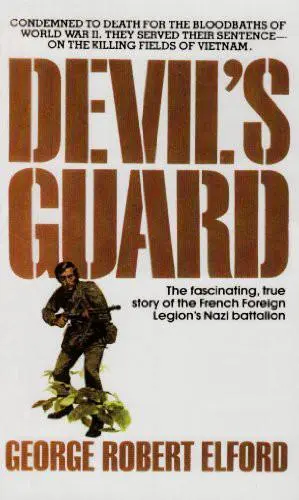
- Название:Devil's Guard
- Автор:
- Издательство:Dell
- Жанр:
- Год:1972
- Город:New York
- ISBN:9780440120148
- Рейтинг книги:3 / 5. Голосов: 1
-
Избранное:Добавить в избранное
- Отзывы:
-
Ваша оценка:
Devil's Guard: краткое содержание, описание и аннотация
Предлагаем к чтению аннотацию, описание, краткое содержание или предисловие (зависит от того, что написал сам автор книги «Devil's Guard»). Если вы не нашли необходимую информацию о книге — напишите в комментариях, мы постараемся отыскать её.
WHAT THEY DID IN WORLD WAR II WAS HISTORY’S BLOODIEST NIGHTMARE.
The ashes of World War II were still cooling when France went to war in the jungles of Southeast Asia. In that struggle, its frontline troops were the misfits, criminals and mercenaries of the French Foreign Legion. And among that international army of the desperate and the damned, none were so bloodstained as the fugitive veterans of the German S.S.
WHAT THEY DID IN VIETNAM WAS ITS UGLIEST SECRET — UNTIL NOW.
Loathed by the French, feared and hated by the Vietnamese, the Germans fought not for patriotism or glory but because fighting for France was better than hanging from its gallows. Here now is the untold story of the killer elite whose discipline, ferocity and suicidal courage made them the weapon of last resort.
Devil's Guard — читать онлайн бесплатно полную книгу (весь текст) целиком
Ниже представлен текст книги, разбитый по страницам. Система сохранения места последней прочитанной страницы, позволяет с удобством читать онлайн бесплатно книгу «Devil's Guard», без необходимости каждый раз заново искать на чём Вы остановились. Поставьте закладку, и сможете в любой момент перейти на страницу, на которой закончили чтение.
Интервал:
Закладка:
Holding his pen lightly over the map, Colonel Houssong swept the upper regions of the map, then circled a smaller area and looked up. “Do you think you can make it here, Wagemueller?”
“We can always make it there, mon colonel. The question is whether we can also make it back?”
“You had better make it back—and without leaving corpses behind. It must be a clean job like the one in Man-hao.”
I rose slightly and bent over the map. It was not just a map but .an operational plan with the essential details already incorporated: the routes were marked out, time elements considered and noted down in brackets: the area between the border and Tien-pao, and eastward to the Sengen highway, featured a number of small red stars, some of them placed within rectangles, others in circles, “As you can see, I spent some time arranging your action in effective patterns,” the colonel said good-humoredly. “The stars are known Viet Minh bases and Chinese garrisons.”
“The size of which, mon colonel?”
“The size of which we can only guess. But it does not really matter for you are to avoid them anyway.”
“But do they know that, mon colonel?” Eisner cut in and everyone began to laugh.
Colonel Houssong paused for a moment, then joined us over the map. “Your principal target will be the establishment marked “A,” which must be destroyed before anything else. It lies thirty kilometers north of the frontier.”
“As the crow flies. Overland it will be fifty,” I remarked.
“Sans doute. Nevertheless you will have to get there. The second objective, “C,” is located only half as far inland but more to the east. As you can see, objective “B1 is unfortunately off limits. It is much too close to Tien-pao and the main garrisons. Two objectives should suffice for the time being. They are large enemy bases and training camps.”
“What are the X-es, mon colonel?”
“Small Chinese guardhouses along road bridges with three to five men in them.”
“What about them?”
“Don’t ask me, Wagemueller, suit yourself. If you find time to demolish also a few bridges it will be an asset.”
The conference lasted for two hours. With all the important problems discussed, the colonel announced, “Needless to say this whole business is strictly between us, messieurs,”
“Of course, mon colonel.”
“Your Man-hao raid was a big shock to the Viet Minh and especially to the Chinese. They have many bases along the border and the General—thinks we should hit them at least once more before Peking decides to decentralize.”
He added with a smile, “// faut piquer dedans— we should hit them where it hurts.”
His eyes focused on the map. “Alas, most of the Viet Minh training bases and supply dumps are still just across the frontier, but soon Giap will move his establishment farther north, to safer locations.”
He lifted his eyes to me. “What do you think of it?”
“It seems to me either glory or court-martial, mon colonel,” I said jokingly.
“You had better forget about the second alternative,” said he. “Since your Man-hao business I am, er, your accomplice in Crime.”
“In crime, mon colonel?”
“What else can you call it? We are not at war with China.”
“Peking doesn’t seem to know it,” Eisner remarked. “We should call such actions only an exchange of mutual courtesies, mon colonel.”
“How about those garrisons at Tien-pao, mon colonel?” I asked, thinking of the thirty thousand Chinese troops.
“They have no transports,” the colonel explained. “Fifteen trucks and some derelict jeeps are all they have. The troops are armed mostly with vintage Russian rifles and for the present their ammo is restricted to about five cartridges per weapon.”
“That’s comforting,” said Karl.
“So keep quiet until you arrive at objective “A” and the garrisons won’t be able to interfere with you in force.”
He folded the map and handed it to me. “This is the only map covering the operation,” he advised me. “Prepare two copies for yourself, then bring it back. Don’t bungle this job, for if you do, you might as well remain in China and go down lighting.”
“I understand that, mon colonel.”
“You will be wearing civilian clothes, of course—”
“Of course.”
Of course, I thought. No papers, no identity tags, no army rations, only native pajamas and foodstuffs.
“What will you do about possible casualties, Wagemueller?” he asked cagily.
“The Chinese will find neither corpses nor graves, mon colonel.”
“So be it.”
He extended his hand. We avoided discussing the gory details.
Corpses were to be destroyed either by grenades or by flamethrowers: blasted to bits, burned beyond recognition, and should there be gravely wounded comrades who could not march while the enemy was pressing us, it was also our duty to turn them into corpses, so that they wouldn’t turn into evidence in Chinese hands.
“You will have a good chance to succeed,” the colonel said before dismissing us. “I have selected your guides personally. They know the area well and they are also professionals.”
We code-named the operation “Longhand” because of its far-reaching implications.
“Here we go, one hundred against half a billion,” Schulze remarked, gazing back toward the moonlit ridges of Bao Lac. Ahead of us loomed the sinister hills of China. We crossed the frontier following the remote trail which native warriors must have cut across the virgin woods decades before. It must have been maintained by smugglers, then cleared again, probably by Nationalist warring parties. After a few miles on the trail I knew that Colonel Houssong’s “blueprint for aggression” had been based on precise data, the result of exhaustive intelligence and even aerial reconnaissance. The colonel did not believe in venturing an important job on the spin of a coin. And since our lives depended on his meticulous exactitude, we indeed appreciated it.
The company advanced in a long line, the men keeping about ten paces apart: pajama-clad dark shapes, wearing coolie hats and crude rubber sandals fashioned from old automobile tires. Everything had been blacked with soot, our faces, our hands, the weapons; nothing glinted in the bright moonlight.
Although we carried only the absolute minimum, the load on each man weighed about fifteen kilos. That included a submachine gun with ten spare mags, food, burlap, a small medical kit, magnetic compass, flashlight, bush knife, mosquito net, and hand grenades. The field gear of Gruppe Drei was divided among the troops.
Gruppe Drei was our advance guard, the “trailblazers,” the unit on which our existence depended. It consisted of only thirty men but they were specially trained. Every member of the group had completed a rigorous six-month training schedule that included bomb detection and demolition, trap detection, tracking, and general woodsmanship. Their tutors were some of the foremost experts of antiguerrilla warfare, both French and foreign: an ex-British army captain who had fought the Communist insurgents for three years in Malaya and a former Japanese colonel, the one-time commander of a counterintelligence unit of the Kempe Tai (former Japanese Secret Police) during the war. Both men wore the uniform of a colonel of the Colonial army but they did not formally belong to the armed forces and received civilian wages, as per contract.
A hundred meters ahead of us marched the advance guard led by Krebitz. Still ahead of them marched four Nationalist Chinese officers, one of them a former guide to the forces of Chiang Kai-shek. They knew the area well. Some of the last Nationalist battles had been fought in the province before the vanquished party was compelled to withdraw into the jungles of northern Burma. Colonel Houssong did not inform me how and where he had gotten hold of the Nationalist Chinese. “You may trust them,” was all he said, “a well-known American general has vouched for them.”
Читать дальшеИнтервал:
Закладка:
Похожие книги на «Devil's Guard»
Представляем Вашему вниманию похожие книги на «Devil's Guard» списком для выбора. Мы отобрали схожую по названию и смыслу литературу в надежде предоставить читателям больше вариантов отыскать новые, интересные, ещё непрочитанные произведения.










Обсуждение, отзывы о книге «Devil's Guard» и просто собственные мнения читателей. Оставьте ваши комментарии, напишите, что Вы думаете о произведении, его смысле или главных героях. Укажите что конкретно понравилось, а что нет, и почему Вы так считаете.