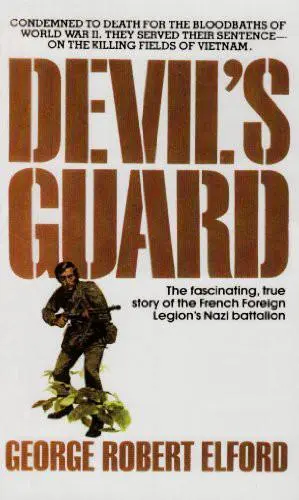
George Elford - Devil's Guard
Здесь есть возможность читать онлайн «George Elford - Devil's Guard» весь текст электронной книги совершенно бесплатно (целиком полную версию без сокращений). В некоторых случаях можно слушать аудио, скачать через торрент в формате fb2 и присутствует краткое содержание. Город: New York, Год выпуска: 1972, ISBN: 1972, Издательство: Dell, Жанр: prose_military, Историческая проза, на английском языке. Описание произведения, (предисловие) а так же отзывы посетителей доступны на портале библиотеки ЛибКат.
- Название:Devil's Guard
- Автор:
- Издательство:Dell
- Жанр:
- Год:1972
- Город:New York
- ISBN:9780440120148
- Рейтинг книги:3 / 5. Голосов: 1
-
Избранное:Добавить в избранное
- Отзывы:
-
Ваша оценка:
Devil's Guard: краткое содержание, описание и аннотация
Предлагаем к чтению аннотацию, описание, краткое содержание или предисловие (зависит от того, что написал сам автор книги «Devil's Guard»). Если вы не нашли необходимую информацию о книге — напишите в комментариях, мы постараемся отыскать её.
WHAT THEY DID IN WORLD WAR II WAS HISTORY’S BLOODIEST NIGHTMARE.
The ashes of World War II were still cooling when France went to war in the jungles of Southeast Asia. In that struggle, its frontline troops were the misfits, criminals and mercenaries of the French Foreign Legion. And among that international army of the desperate and the damned, none were so bloodstained as the fugitive veterans of the German S.S.
WHAT THEY DID IN VIETNAM WAS ITS UGLIEST SECRET — UNTIL NOW.
Loathed by the French, feared and hated by the Vietnamese, the Germans fought not for patriotism or glory but because fighting for France was better than hanging from its gallows. Here now is the untold story of the killer elite whose discipline, ferocity and suicidal courage made them the weapon of last resort.
Devil's Guard — читать онлайн бесплатно полную книгу (весь текст) целиком
Ниже представлен текст книги, разбитый по страницам. Система сохранения места последней прочитанной страницы, позволяет с удобством читать онлайн бесплатно книгу «Devil's Guard», без необходимости каждый раз заново искать на чём Вы остановились. Поставьте закладку, и сможете в любой момент перейти на страницу, на которой закончили чтение.
Интервал:
Закладка:
“I thank you for your decision,” Major Kwang said with gratitude. “They are innocent people and every one of them with a large family to support.”
We roasted and ate the boar during our next stop in a shady ravine that was deep enough to disperse smoke before it reached the open.
After the ravine our going became more difficult. We found no path and the narrow bed of a small river provided the only “road” for about an hour. Although the water level was down, seldom exceeding twenty centimeters in depth, the riverbed itself was rough. Strewn with sharp and slimy boulders it offered the worst possible going. Its banks were steep and covered with thorn thickets, but at least we were safe down there and I knew the ravine would take us to the Cao Bang-Tien-pao road where it ran under a small bridge with the guardhouse, our first objective.
Reaching the road around six P.M., Sergeant Krebitz and a reconnaissance party of Gruppe Drei went ahead to survey the bridge. Finding only four Chinese soldiers in the guardhouse, they captured it forthwith. Having mined the road on either side, Krebitz blasted the bridge with fifty pounds of gelignite distributed along its wooden pylons, causing a series of small explosions rather than a resounding military one. The dead Chinese soldiers were then dumped in the woods.
It was my intention to move on without delay against our first major objective, Viet Minh camp “A,” which lay only about twenty kilometers to the north, along the same road. I hoped that we might be able to reach it without further contact with the Chinese military. Fate, however, decided otherwise, although not to our disadvantage. As we were about to leave the destroyed bridge, we spotted a row of headlights coming downhill on the winding road. It was a small convoy of eight trucks, and we barely had time to deploy along the road, Eisner and Karl taking the eastern, Schulze and Riedl the western slopes, closest to the mined section.
Obviously ignorant of any hostile presence the convoy drove straight onto the mines. The leading vehicle exploded and skidded over the precipice where the bridge had been. Swerving wildly, the second truck careened off the road, hit a boulder, and overturned. The rest of the convoy came to a screaming halt with still more trucks damaged as some of them piled into one another. There were no soldiers in the trucks, only the drivers and a dozen militiamen, who went down the moment we surged onto the road with our guns blazing. The trucks were loaded with rice, salted fish, cane sugar, and cooking fats—most likely to provision the numerous military posts along the frontier. None of the vehicles transported weapons, but the five still-serviceable trucks gave me an idea. I requested Sergeant Krebitz to unload the trucks and turn them around, a job which was carried out with some difficulty on the narrow road. Gruppe Drei poured gasoline over the foodstuff—spoiling everything—then we climbed aboard the trucks. I felt it would be safe to take the road straight to the guerrilla base. There were no privately owned vehicles in Mao’s empire and especially not transport vehicles: a number of trucks moving on the road would likely be taken for an army convoy.
I was about to signal start when a gesture of Major Kwang made me step back. The moment he stopped in front of me I knew that something unpleasant had happened.
“Two of my companions are gone,” he announced grimly, then added with resignation, “I am afraid that you were right about not trusting anyone. I am sorry.”
Had we not gotten hold of the trucks, the major’s statement would have been the worst possible news. The renegades were either Communist plants or had simply decided to switch sides, doing a meritorious service by “delivering” the hated German detachment (or so they thought) to the Chinese. As it happened, however, they were compelled to proceed on foot while we were motorized, so we still had a good chance to destroy both bases before the garrison at Tien-pao could be alerted.
“You are not to blame,” I tried to comfort the unhappy major. “After all they were vouched for, weren’t they?”
“I should have watched them,” he said apologetically, shaking his head slowly, “but the colonel was so sure…”
He wiped his perspiring face with his kerchief. “Shouldn’t we look for them? They cannot be far away yet—”
“Good heavens no!” I exclaimed, mounting the truck. “We have no time to play hide-and-seek. Come aboard, Major.”
We drove north on the bending gravel road, negotiated a few sharp bends, and came up against a small guard-house with a sentry in front of it. “This isn’t on the colonel’s map,” Schulze commented, grabbing his gun.
The guard turned, opened the door, and yelled something inside. Another Chinese soldier appeared. Shading his eyes he stared for a moment toward our incoming vehicles, then with a savage yell he dived behind a pile of logs. The sentry’s rifle came up, Schulze stepped on the brake, somewhere behind us a short burst of a machine pistol crackled, and the windows of the guardhouse shattered. Sergeant Krebitz threw open the door and jumped, his gun blazing even before he hit the ground. The sentry went down and the militiaman behind the logs cried out in pain, staggered a few steps, then crumpled up. From the guardhouse a shot rang out, followed instantly by two more reports. Two men of Gruppe Drei who came running a few steps ahead of Sergeant Krebitz stumbled, made a couple of erratic steps, and fell with blood oozing from neck and chest wounds. Krebitz hurled a grenade into the house, then jumped to the wounded troopers. Sergeant Zeisl came with two medics, examined our unfortunate comrades briefly, and shook his head. “They are both dead,” he said gravely.
I glanced at Krebitz. He nodded quietly. Four troopers lifted the corpses and carried them into the woods. Krebitz shouldered a flamethrower, a few other troopers took spades and a can of gasoline and followed. A couple of minutes later a dull explosion came from the woods, the faint “whoooos” of the flamethrower, then thick, oily smoke rose and spiraled upward.
“Attention!” Eisner shouted. The troops froze where they stood. “Salute!” The hands went up. It was all we could offer our fallen comrades.
Sergeant Krebitz and his troopers returned. Their faces were grim and without a word the men climbed into their vehicle. “It is done,” Krebitz said. “We buried what was left over, Hans.”
“On your trucks, men!” I commanded.
We drove on.
The Viet Minh base was not exactly on the main road but about two kilometers inland. We had to turn off into a narrow dirt road which we might easily have missed, except for the vigilance of Major Kwang. We encountered no more Chinese either on the main road or on the smaller one, but we stirred up so much dust that the enemy must have seen us coming from miles away. Yet the ruse worked. No one challenged us. We were being accepted as a Chinese army transport column.
The base was a spacious quadrangle, fenced off with barbed wire and featuring a number of wooden barracks and crude tents. It was already dusk and most of the camp inmates were gathering for dinner. I wasted no time at the wooden barrier but careened off the road and into the compound, while Eisner shot the bewildered sentry at the gate between the eyes. I shouted at Schulze to stop at the nearest barrack, which he partly demolished by driving into its plank wall.
The other vehicles roared through the gate and stopped right between the buildings in a cloud of dust The troops piled out with their guns blazing; more sentries went down and the camp came alive with screaming terrorists. Grenades began to explode. The barracks and tents split apart and collapsed. Forming six assault groups, our troopers swept the place in a violent free-for-all. Within seconds the air was heavy with the smell of cordite: the clatter of machine guns and the death cries of guerrillas came from every corner. Although the Viet Minh did not yet know it, the destruction of this base snuffed out the comforting doctrine of sanctuaries inside Red China.
Читать дальшеИнтервал:
Закладка:
Похожие книги на «Devil's Guard»
Представляем Вашему вниманию похожие книги на «Devil's Guard» списком для выбора. Мы отобрали схожую по названию и смыслу литературу в надежде предоставить читателям больше вариантов отыскать новые, интересные, ещё непрочитанные произведения.












Обсуждение, отзывы о книге «Devil's Guard» и просто собственные мнения читателей. Оставьте ваши комментарии, напишите, что Вы думаете о произведении, его смысле или главных героях. Укажите что конкретно понравилось, а что нет, и почему Вы так считаете.