George Elford - Devil's Guard
Здесь есть возможность читать онлайн «George Elford - Devil's Guard» весь текст электронной книги совершенно бесплатно (целиком полную версию без сокращений). В некоторых случаях можно слушать аудио, скачать через торрент в формате fb2 и присутствует краткое содержание. Город: New York, Год выпуска: 1972, ISBN: 1972, Издательство: Dell, Жанр: prose_military, Историческая проза, на английском языке. Описание произведения, (предисловие) а так же отзывы посетителей доступны на портале библиотеки ЛибКат.
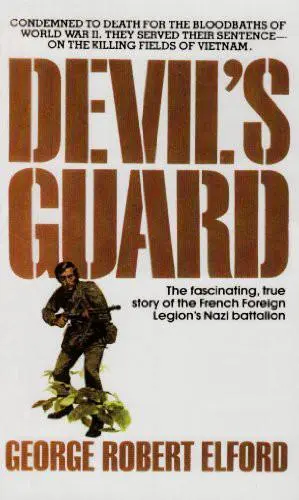
- Название:Devil's Guard
- Автор:
- Издательство:Dell
- Жанр:
- Год:1972
- Город:New York
- ISBN:9780440120148
- Рейтинг книги:3 / 5. Голосов: 1
-
Избранное:Добавить в избранное
- Отзывы:
-
Ваша оценка:
Devil's Guard: краткое содержание, описание и аннотация
Предлагаем к чтению аннотацию, описание, краткое содержание или предисловие (зависит от того, что написал сам автор книги «Devil's Guard»). Если вы не нашли необходимую информацию о книге — напишите в комментариях, мы постараемся отыскать её.
WHAT THEY DID IN WORLD WAR II WAS HISTORY’S BLOODIEST NIGHTMARE.
The ashes of World War II were still cooling when France went to war in the jungles of Southeast Asia. In that struggle, its frontline troops were the misfits, criminals and mercenaries of the French Foreign Legion. And among that international army of the desperate and the damned, none were so bloodstained as the fugitive veterans of the German S.S.
WHAT THEY DID IN VIETNAM WAS ITS UGLIEST SECRET — UNTIL NOW.
Loathed by the French, feared and hated by the Vietnamese, the Germans fought not for patriotism or glory but because fighting for France was better than hanging from its gallows. Here now is the untold story of the killer elite whose discipline, ferocity and suicidal courage made them the weapon of last resort.
Devil's Guard — читать онлайн бесплатно полную книгу (весь текст) целиком
Ниже представлен текст книги, разбитый по страницам. Система сохранения места последней прочитанной страницы, позволяет с удобством читать онлайн бесплатно книгу «Devil's Guard», без необходимости каждый раз заново искать на чём Вы остановились. Поставьте закладку, и сможете в любой момент перейти на страницу, на которой закончили чтение.
Интервал:
Закладка:
I ordered cease-fire. The troops assembled and we marched away. The job was done. The time was 11:23 P.M.
Reaching the railway line, Riedl went ahead with a small party. He found the eight guardsmen crowding atop the guardhouse. They were watching the fire lit skies, chattering excitedly. Helmut mowed them down with a single burst of his submachine gun, then tossed a couple of grenades into the writhing mob for good measure. The guardhouse and the bridge were demolished. Schulze proceeded to plant our remaining mines along the line and the adjoining footpath “to get a few of the bastards later on,” as he put it. Our two Indochinese friends asked my permission to collect the weapons of the dead Chinese, saying that they could use the rifles later on, at home.
It was becoming light when we arrived at the cave where our comrades had been waiting tensely. “You have not missed a thing,” Schulze consoled them. “A bunch of boy scouts could have blasted the camp with all the ammo crates scattered around. You just spared yourselves a long walk.”
The company arrived at Suoi’s village at dusk—dead tired but in very cheerful spirits. We had no way of knowing whether Ming had been among the Man-hao casualties but he was never again spotted in Indochina.
“There was a mighty blast in Man-hao,” Colonel Houssong remarked two weeks later when I submitted to him my report on our recent activities. “The whole militia went up in smoke and the Chinese suffered nearly a thousand casualties, among them a corps commander from Yunnan.”
“Well, isn’t that something, mon colonel?” Schulze exclaimed with enthusiasm. “It’s the first good news for months!” He turned toward me with pretended innocence. “Imagine, Hans… we were only about thirty miles from the place.”
“That’s exactly what I was thinking,” Colonel Houssong cut in, stressing his words.
“We didn’t notice a thing, mon colonel,” I said.
“I wonder.”
“Mon colonel, everyone knows how careless the Chinese are. They probably stored ammunition crates in the open and lightning struck the dump. It has happened before.”
“Lightning my foot!” he cut me short. “There has been no storm around there for weeks. A couple of eighty-caliber lightnings with fins maybe. I wonder if I should check your inventories on the ammo you received and what you brought back. Come on, Wagemueller, how did you pull it?” I told him the whole story and he sent a report saying: “Terrorist group of about two hundred men and a large quantity of ammunition destroyed 35 miles northwest of Lao Kay.”
Needless to say, the General Staff would never bother to check that anyplace thirty-five miles northwest of Lao Kay was well within Red China!
8. RAID INTO CHINA
Three weeks passed before the full impact of our Man-hao raid finally reached Hanoi. We had reason to believe that certain general officers in the High Command suspected the truth but none of them seemed interested in pressing for details. Too much information inevitably leads to too many written reports and those in turn demand the attention of too many people, including civilians, whom the generals scorned and despised, whether members of the press, politicians, clerks in the ministry, or the prime minister himself.
Fortunately for us the raid had been successful. We left no evidence on the scene, neither French Army equipment nor corpses. The Chinese could only sulk over their losses but they were unable to prove anything. Moreover, some diehard Nationalist battalions were still active in the remote southern provinces of China and it would have been easy for the French to credit the Man-hao debacle to Chiang Kai-shek. This token Nationalist presence in what was now Mao’s empire and the total success of our totally illegal expedition seemed to inspire our commander to venture a similar foray but on a much larger scale.
The indirect effects of our raid were soon felt in western Indochina. There was a sharp decrease in terrorist activity in the province, even in the exposed frontier areas of Lao Kay. For the first time in many months the local peasants could harvest their crops and cart their surplus to Lao Kay without being robbed on the road by terrorists requisitioning food and money, Since our raid no French troops had been ambushed and no roads had been mined. Somewhat over-optimistic, Schulze insisted that a few similar “house cleanings” across the border could throw Giap’s marauders back into the “good old days” of the bow and the spear.
After the Man-hao coup, our relations with Colonel Houssong became even more intimate. He began to regard us more as “fellow conspirators” than mere subordinates, and he bestowed on us certain privileges which were denied to other units of the Foreign Legion. The permanent gate pass was the one we appreciated the most. Whenever we returned from a mission my men were free to leave the Army compound from five P.M. till eight A.M. every day. I had free access to the supply dumps and could requisition any amount of food, weapons, and ammunition by simply signing for them. I was given unrestricted access to the top secret intelligence files which dealt with guerrilla activity in certain districts.
Colonel Houssong was proud of us, and I may add without bragging, rightly so. Apart from the famous Paras, my unit was the only force that went into action and returned with results; and more often than not, without a single loss of life. In Indochina it was called a “good result” when troops on a distant mission returned without having accomplished anything, only returned with minimum losses. Many troops of the Legion have entered the jungle never to be heard of again.
Ten days after our return, Colonel Houssong summoned us to his office. We shook hands and he said without preliminaries, “Sit down, messieurs, for what I am going to tell you now will make you sit down anyway.”
He placed a fresh bottle of Calvados on the table and suggested with a mysterious smile, “Have a drink, you will need it.”
Evidently the colonel was in a good mood. His eyes danced with amusement.
“Is it going to be as bad as that?” I asked him, taking my seat opposite him. Eisner and Schulze sat down and placed their map cases on the table. Pfirstenhammer opened his notebook, Riedl took pencil and paper. We were ready for the briefing.
“It depends on the way you look at it,” the colonel answered my question. Reaching for the bottle he poured drinks for us, filled his own cup, and lifted it slightly, “To your success with the Tien-pao raid.”
“You mean the Man-hao raid, mon colonel,” Eisner corrected what he thought was a reference to our excursion into China.
“I said Tien-pao,” Houssong repeated, stressing the last word. “That is the place you will be going shortly.”
There was a curious silence while we digested the implications of that short sentence. “To Tien-pao?” I repeated cautiously.
“To Tien-pao,” said the colonel. His eyes kindled. “You have convinced certain gentlemen in the upper regions that such raids are feasible and can be executed without complications. So, off you go. But this time it isn’t going to be a pushover, messieurs. You will have to work hard to earn a victory.”
“To earn a victory?” Schulze commented with a chuckle. “I will be happy if we can earn a simple return ticket, mon colonel.”
“And rightly so,” Eisner added with emphasis. “There are some thirty thousand Chinese troops at Tien-pao.”
“Eighty to one against,” Riedl said.
“Sometimes it was worse in Russia,” Karl added and lit his pipe.
“I am glad to note your good spirit; a spirited action is already half a success,” the colonel remarked. He unfolded a large map of northern Indochina and spread it on the long table. The map covered the district north of Cao Bang, including Chinese areas as far as the Siang river, thirty kilometers north of Tien-pao. Tien-pao was the town where we believed that Ho Chi Minh’s “government” had been hiding out for the past two years, although Ho himself was thought to be residing in Nan-ning, further to the east.
Читать дальшеИнтервал:
Закладка:
Похожие книги на «Devil's Guard»
Представляем Вашему вниманию похожие книги на «Devil's Guard» списком для выбора. Мы отобрали схожую по названию и смыслу литературу в надежде предоставить читателям больше вариантов отыскать новые, интересные, ещё непрочитанные произведения.









Обсуждение, отзывы о книге «Devil's Guard» и просто собственные мнения читателей. Оставьте ваши комментарии, напишите, что Вы думаете о произведении, его смысле или главных героях. Укажите что конкретно понравилось, а что нет, и почему Вы так считаете.