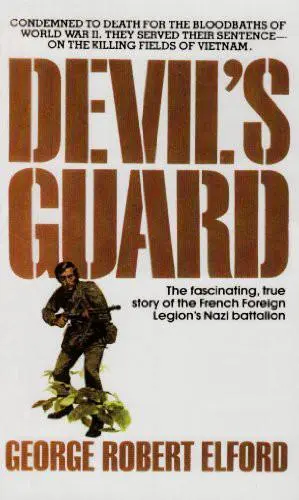
George Elford - Devil's Guard
Здесь есть возможность читать онлайн «George Elford - Devil's Guard» весь текст электронной книги совершенно бесплатно (целиком полную версию без сокращений). В некоторых случаях можно слушать аудио, скачать через торрент в формате fb2 и присутствует краткое содержание. Город: New York, Год выпуска: 1972, ISBN: 1972, Издательство: Dell, Жанр: prose_military, Историческая проза, на английском языке. Описание произведения, (предисловие) а так же отзывы посетителей доступны на портале библиотеки ЛибКат.
- Название:Devil's Guard
- Автор:
- Издательство:Dell
- Жанр:
- Год:1972
- Город:New York
- ISBN:9780440120148
- Рейтинг книги:3 / 5. Голосов: 1
-
Избранное:Добавить в избранное
- Отзывы:
-
Ваша оценка:
Devil's Guard: краткое содержание, описание и аннотация
Предлагаем к чтению аннотацию, описание, краткое содержание или предисловие (зависит от того, что написал сам автор книги «Devil's Guard»). Если вы не нашли необходимую информацию о книге — напишите в комментариях, мы постараемся отыскать её.
WHAT THEY DID IN WORLD WAR II WAS HISTORY’S BLOODIEST NIGHTMARE.
The ashes of World War II were still cooling when France went to war in the jungles of Southeast Asia. In that struggle, its frontline troops were the misfits, criminals and mercenaries of the French Foreign Legion. And among that international army of the desperate and the damned, none were so bloodstained as the fugitive veterans of the German S.S.
WHAT THEY DID IN VIETNAM WAS ITS UGLIEST SECRET — UNTIL NOW.
Loathed by the French, feared and hated by the Vietnamese, the Germans fought not for patriotism or glory but because fighting for France was better than hanging from its gallows. Here now is the untold story of the killer elite whose discipline, ferocity and suicidal courage made them the weapon of last resort.
Devil's Guard — читать онлайн бесплатно полную книгу (весь текст) целиком
Ниже представлен текст книги, разбитый по страницам. Система сохранения места последней прочитанной страницы, позволяет с удобством читать онлайн бесплатно книгу «Devil's Guard», без необходимости каждый раз заново искать на чём Вы остановились. Поставьте закладку, и сможете в любой момент перейти на страницу, на которой закончили чтение.
Интервал:
Закладка:
Schulze nodded. “We sure as hell will.”
“I have nothing left on earth, not even money to buy food or clothes,” the girl whispered as her eyes filled. “What money my father kept at home the Chinese took away. He has much money in a Hanoi bank but I don’t know which one or how to get it.”
“Of course she has money!” Erich exclaimed in German. “Her father must have kept funds in reserve. He was a wealthy man.”
Suoi could not tell us anything else. Whatever papers her father may have had relating to his finances and the family holdings must have been destroyed in the fire.
“A twisted, burned copper chest was all we found in the ruins,” Eisner explained. “Even the corpses were burnt beyond recognition. Nothing as inflammable as paper could have escaped the holocaust.”
“When we get back to Hanoi we will go from bank to bank until we find the right one,” Schulze stated determinedly.
“I doubt if the bank will give her any money before a legal process establishes her as the rightful heir,” Eisner commented. “Why, she cannot even prove who she is.”
“Like hell she can’t,” Riedl exclaimed. “We can testify!”
“That might not be enough, Helmut.”
“You leave the legalities to me,” Schulze said firmly. “Once I get to the right counter she will receive what belongs to her if I have to blast the manager for it.”
Knowing him, I had no doubt that Erich meant what he said. But blasting Viet Minh terrorists and blasting Hanoi bank managers were two different things.
“We will talk to the colonel about Suoi’s inheritance,” I suggested. “You remember Lin? Houssong won’t refuse to help Suoi either. He might vouch for her or get the high brass to interpose.”
“You take care of the colonel; I will take care of the bank,” said Erich. “No red tape is going to deprive the girl of what is still hers.”
“I will handle both the colonel and the bank manager, Erich,” I said somewhat sharply.
“As you wish, Hans.”
The reconnaissance party returned about four o’clock in the afternoon, soaking wet and muddy but bringing good intelligence. Corporal Altreiter had observed the military encampment for over two hours and had drawn a diagram of the area. There were twelve wooden barracks in the compound. Adjoining it, the Viet Minh camp had only tents. The barracks were each about sixty feet long, with eight windows on either side and exits at both ends. One of the buildings, probably the command post, had wireless aerials. Another barrack with more chimneys was obviously the kitchen and mess hall.
That left us with ten living quarters. Since the eight windows were most likely at the intervals between the bunk beds, a quick estimate established the number of bunks at either 30/32 single, or 60/64 double, giving a total number of troops as either 320 or 640. The tents could accommodate about 200 guerrillas.
The possible number of enemy troops in the camp ruled out a direct assault on the enclosure. Hand-to-hand combat was likely to develop and I dared not risk heavy casualties. The presence of fourteen heavy trucks in the compound was welcome news. According to Altreiter the vehicles had just arrived with supplies, most of them ammunition. He saw militiamen and guerrillas unloading the crates and piling them up alongside the barracks. The crates were covered only with tarpaulin sheets. This casual arrangement of storing explosives suggested one of two alternatives, either that the underground ammo depots were loaded to capacity or that the new supplies were to be moved again shortly, for all we knew maybe into Indochina. Either way it was a most fortunate coincidence. A few direct hits on the crates could dispatch the entire camp into the Great Beyond. On his sketch Corporal Altreiter had also marked a row of large drums which he believed contained diesel oil or gasoline. The drums were fairly close to the underground ammunition dumps that the reconnaissance party had detected as a number of earth mounds with ventilation chimneys.
The railway line which we were to cross and recross ran only three miles from the cave. Contrary to my belief, the line was still in use, Altreiter reported. The Chinese used it to ferry supplies to the various border posts facing Lao Kay. “There is a small steel bridge not very far off,” he said. “Sentries are posted on the bridge itself.”
I decided to demolish the bridge and its guardhouse on the way back. Phu said that the adjoining hills were densely forested and offered ample cover. Except for Phu, whom we were resolved to carry if necessary, I wanted the reconnaissance party to remain in the cave. Weary as they were, the men insisted on making the trip for a second time. “We have earned our right to be present at the party, Commander,” the troopers insisted. I consented. And since I no longer intended to storm the Chinese compound I decided to leave Suoi and half of the troops behind. Due to the successful reconnaissance it was unnecessary to take the girl along on the perilous journey.
We departed at dusk, a hundred men altogether, moving at good speed through the hills. Unencumbered by our close-combat weapons which we had left behind, we could move faster. Phu reassured me that except for the guardhouse near the bridge—which we were to bypass by two miles—there was not a soul around. But on arriving at the railway line we almost ran into four militiamen patrolling the tracks. Fortunately Phu spotted them in time and we were able to retreat a few hundred yards and then to proceed half a mile further west. Apart from this interlude our trip was without excitement.
By eleven o’clock we were deploying on the two hills that overlooked the militia barracks some five hundred yards to the south. No raiders could have hoped for an easier target. The windows of the command post were ablaze with lights and we could hear faintly the steady drone of an electric generator. The barracks and the tents were dark but a multitude of external lamps illuminated the entire camp. Beyond the hill the town of Man-hao was blanketed in darkness. Only the militia had the privilege of electricity. The population had to make do with their oil lamps.
Faithfully following the teachings of their great Mao, the Chinese kept a vigorous daily schedule in their army camps. At ten P.M. sharp, the troops had to be in their bunks: “Men who sleep well at night shall march better the next day,” Mao said. For once, Mao was wrong. At least at Man-hao, where his militia would march nowhere the next day, except into oblivion.
At precisely 11:10 P.M. we opened fire on the camp with twenty fifty-caliber machine guns and thirty mortars. The rest of my men fired at individual targets with their rifles. The effect of our unexpected attack was instantaneous. Screaming lines of tracers tore across the valley, peppering the barracks, ripping the tents, blasting the parked trucks, mowing down men. Some shells of the first mortar salvo landed short but thereafter every projectile was on target. Instead of turning out the lights the bewildered militiamen turned on even those that had been out. Our riflemen shot through the lighted windows. Groups of yelling, screaming men ran up and down in the compound and fell under a hail of steel.
Two minutes after our first volley half a dozen mortar shells hit a pile of ammunition crates which exploded instantly with a blinding flash of fire. The blast demolished both the command post and the mess hall, along with the barracks immediately behind them. Seconds later the dumps began to blow up one after another, sending crazily zigzagging fireworks about the hill. The lights went out, but by then the hilltop shone like the rim of a volcano. I doubted if a single soul escaped the ensuing fire and multiple explosions.
The camp had turned into a sea of flames. The drums, containing diesel oil and gasoline, began to burn and burst. The oil leaked into the underground depots like java. The depots, too, began to explode, ripping hundred-foot-wide gaps into the hillside.
Читать дальшеИнтервал:
Закладка:
Похожие книги на «Devil's Guard»
Представляем Вашему вниманию похожие книги на «Devil's Guard» списком для выбора. Мы отобрали схожую по названию и смыслу литературу в надежде предоставить читателям больше вариантов отыскать новые, интересные, ещё непрочитанные произведения.












Обсуждение, отзывы о книге «Devil's Guard» и просто собственные мнения читателей. Оставьте ваши комментарии, напишите, что Вы думаете о произведении, его смысле или главных героях. Укажите что конкретно понравилось, а что нет, и почему Вы так считаете.