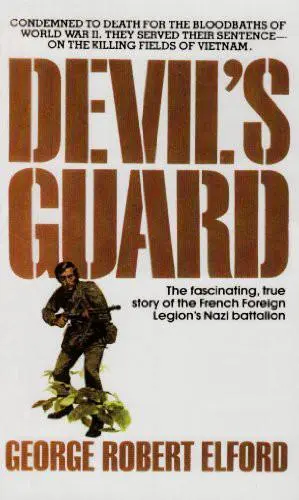
George Elford - Devil's Guard
Здесь есть возможность читать онлайн «George Elford - Devil's Guard» весь текст электронной книги совершенно бесплатно (целиком полную версию без сокращений). В некоторых случаях можно слушать аудио, скачать через торрент в формате fb2 и присутствует краткое содержание. Город: New York, Год выпуска: 1972, ISBN: 1972, Издательство: Dell, Жанр: prose_military, Историческая проза, на английском языке. Описание произведения, (предисловие) а так же отзывы посетителей доступны на портале библиотеки ЛибКат.
- Название:Devil's Guard
- Автор:
- Издательство:Dell
- Жанр:
- Год:1972
- Город:New York
- ISBN:9780440120148
- Рейтинг книги:3 / 5. Голосов: 1
-
Избранное:Добавить в избранное
- Отзывы:
-
Ваша оценка:
Devil's Guard: краткое содержание, описание и аннотация
Предлагаем к чтению аннотацию, описание, краткое содержание или предисловие (зависит от того, что написал сам автор книги «Devil's Guard»). Если вы не нашли необходимую информацию о книге — напишите в комментариях, мы постараемся отыскать её.
WHAT THEY DID IN WORLD WAR II WAS HISTORY’S BLOODIEST NIGHTMARE.
The ashes of World War II were still cooling when France went to war in the jungles of Southeast Asia. In that struggle, its frontline troops were the misfits, criminals and mercenaries of the French Foreign Legion. And among that international army of the desperate and the damned, none were so bloodstained as the fugitive veterans of the German S.S.
WHAT THEY DID IN VIETNAM WAS ITS UGLIEST SECRET — UNTIL NOW.
Loathed by the French, feared and hated by the Vietnamese, the Germans fought not for patriotism or glory but because fighting for France was better than hanging from its gallows. Here now is the untold story of the killer elite whose discipline, ferocity and suicidal courage made them the weapon of last resort.
Devil's Guard — читать онлайн бесплатно полную книгу (весь текст) целиком
Ниже представлен текст книги, разбитый по страницам. Система сохранения места последней прочитанной страницы, позволяет с удобством читать онлайн бесплатно книгу «Devil's Guard», без необходимости каждый раз заново искать на чём Вы остановились. Поставьте закладку, и сможете в любой момент перейти на страницу, на которой закончили чтение.
Интервал:
Закладка:
The flamethrowers went into action. Wood and canvas caught fire. We had to remove our trucks from the compound. Screaming shapes of seminude terrorists ran blindly among the blazing buildings. Only then did we discover that the majority of the Viet Minh carried no weapons. As it turned out, it was a camp for basic training only and no guns had been issued to the trainees. There must have been at least eight hundred Viet Minh recruits at the base, which soon turned into a slaughterhouse with my men literally wading in blood and on top of writhing bodies and blackened corpses. Having realized that the enemy could offer no serious resistance we stopped firing.
Eisner commanded: “A la bdionnette!” It was an evening of the bayonets.
When the skirmish ended half an hour later, except for us there was not a soul alive, not a building standing.
Colonel Houssong’s objective “A” had been erased from the face of earth.
Objective “C,” the second Viet Minh establishment within our reach, lay about fourteen kilometers to the southeast, along the same dirt road. Originally it would have taken us days of hard marching to reach both targets, but our good Russian trucks still had gas in their tanks and the road was still clear. I saw no reason why we should not attack the second base in the early morning hours. The faster we moved the sooner we could return home. Because of the two escaped turncoats three more targets situated further to the north and close to the Tien-pao-Sengen highway had to be ignored, but we were resolved to make our trip profitable by blasting a few additional establishments which lay in our path.
We drove east, bumping and slithering along the narrow road through the woods. There we ran into a platoon of militiamen led by an officer. At least we thought he was an officer, for he was the only one in the group shouldering a submachine gun. Seeing us coming they moved off the road, shading their eyes from the dazzling headlights. The officer raised a hand as though requesting us to stop. It was his last conscious act, for an instant later he doubled up and fell, hit by a salvo from Riedl’s submachine gun in the second truck. A short burst of withering fire roared from the other vehicles, shredding belts, uniforms, and flesh, and the platoon went down. They never had a chance—and we hadn’t even slowed down.
The sun was rising above the horizon when we arrived in the vicinity of objective “C.”
Halting briefly on the edge of the woods, I leveled my field glasses and looked across the grassy flat. About a thousand meters to the southeast a conglomeration of thatched huts, tents, and barracks lay huddled among the paddies. The camp and the village were separated by narrow irrigation ditches. The village consisted of about thirty dwellings, situated at the junction of four dirt roads and a forest trail to the south. We spotted the guerrilla base on the western side of the hamlet. I could count about fifty tents, each capable of accommodating twenty men, and two administration barracks with barred windows. Adjoining it were four barracks in a separate compound for the Chinese militia.
I stopped to survey the compound to search for signs of alertness but found none, “Forward!” Repeating our successful former coup, we drove straight up to the militia compound and within seconds my men were storming the gatehouse, where after a brief exchange of fire the five guardsmen were killed. Again surprise was total and we encountered no organized resistance. My rugged company descended on their quarters, rushing from window to window, pouring steel and grenades into the barracks, spraying the tents with withering salvos. The automaton-like precision of my troops was awesome to behold. Five troopers sprayed a barrack with machine-gun fire and raced on, changing magazines as they ran. Another five then lobbed grenades through the windows. Four troopers kicked open the four doors simultaneously and jumped aside to make way for another team working with flamethrowers. No orders, no shouting, no confusion—it was expert teamwork which never lasted longer than thirty seconds. Although here the enemy did possess weapons, they never had a chance to use them with any effect.
In the camp and among the huts hell erupted. Every tent, every barrack spilled out terrorists and militiamen. Dodging bullets and bayonets they ran for cover. A few of them even tried to stop and fight back but were killed instantly. Like a human avalanche our troopers cascaded onward, shooting, slashing, and bayoneting their bewildered adversaries. From the trucks the light machine guns blazed. Scythed by the merciless hail of slugs, the enemy toppled like grain.
Sergeants Krebitz and Riedl discovered a number of underground depots which were stocked with food and ammunition. The grenades set fire to them, killing those Chinese and guerrillas who had taken shelter there. The shooting jolted the inhabitants of the village and there was an even greater commotion when the population began to flee to the nearby hills. Hens, dogs, goats, and cattle panicked and through the melee raced people, many of them naked and in abject terror, intent only on escape. About two hundred guerrillas and militiamen managed to break out of the compound and were running across the paddies, heading for the woods eight hundred yards away. Bracing their machine guns against the truck sideboards, Schulze’s detachment raked the fleeing mess of flesh out in the field.
The fire spread to the village and soon black smoke blanketed the place. Briefly I spotted Riedl leading a skirmish line, driving into the churning dust and the smoke of blazing huts, pausing only to switch magazines. From behind a barn emerged Corporal Altreiter and six troopers herding a dozen Chinese officers at gunpoint.
“Are you promenading or something?” Karl challenged him.
“We might want to question them,” Altreiter replied.
“To hell with questions. Wipe them out, Horst,” Eisner shouted.
Altreiter shrugged. “You do it, Bernard,” he said quietly. “I am not gunning down prisoners.”
“Put them over there and under guard,” I commanded, pointing toward the paddies. “We will decide about them later.”
Bracing their rifles against a fence, our sharpshooters were busy picking off the escaping enemy. Although the foremost escapees had already covered the better part of the distance between the camp and the hills, those who were caught in our telescopic sights crumpled up one after another. Then, acting on Eisner’s order, Gruppe Drei began to fire mortar shells into the patch of land between the runners and the forest. Some of the guerrillas ran into the explosions and were torn to pieces, others veered off, recoiled, and stopped just in time to receive the full impact of the next salvo sent a hundred yards shorter in anticipation of just such a halt by the fugitives.
Leaving the Viet Minh establishment a corpse-strewn inferno, we moved on, destroying two more bridges and mining the roads behind us. Fortunately for us the Chinese communication system must have been very primitive in the area. Twenty kilometers farther, toward the frontier, we overran yet another militia guardhouse near a Stone bridge. We killed everyone within, but that was as far as our trucks would go. Two of them had run out of gas.
We gave the group of Chinese officers enough food to last during their long walk home and turned them loose. We never bothered with questioning them. Until the very last moment they thought they would be shot. One of them spoke to Major Kwang, then turned toward me bowing twice. I thought he would lose his balance and topple over. He rattled off a long singsong sentence. “He is very thankful to you that you won’t execute them,” he interpreted.
“Why should I execute them?” I replied with a shrug. “It won’t topple the Mao regime.”
Читать дальшеИнтервал:
Закладка:
Похожие книги на «Devil's Guard»
Представляем Вашему вниманию похожие книги на «Devil's Guard» списком для выбора. Мы отобрали схожую по названию и смыслу литературу в надежде предоставить читателям больше вариантов отыскать новые, интересные, ещё непрочитанные произведения.












Обсуждение, отзывы о книге «Devil's Guard» и просто собственные мнения читателей. Оставьте ваши комментарии, напишите, что Вы думаете о произведении, его смысле или главных героях. Укажите что конкретно понравилось, а что нет, и почему Вы так считаете.