William Gerhardie - The Polyglots
Здесь есть возможность читать онлайн «William Gerhardie - The Polyglots» весь текст электронной книги совершенно бесплатно (целиком полную версию без сокращений). В некоторых случаях можно слушать аудио, скачать через торрент в формате fb2 и присутствует краткое содержание. Год выпуска: 2013, Издательство: Melville House, Жанр: Классическая проза, на английском языке. Описание произведения, (предисловие) а так же отзывы посетителей доступны на портале библиотеки ЛибКат.
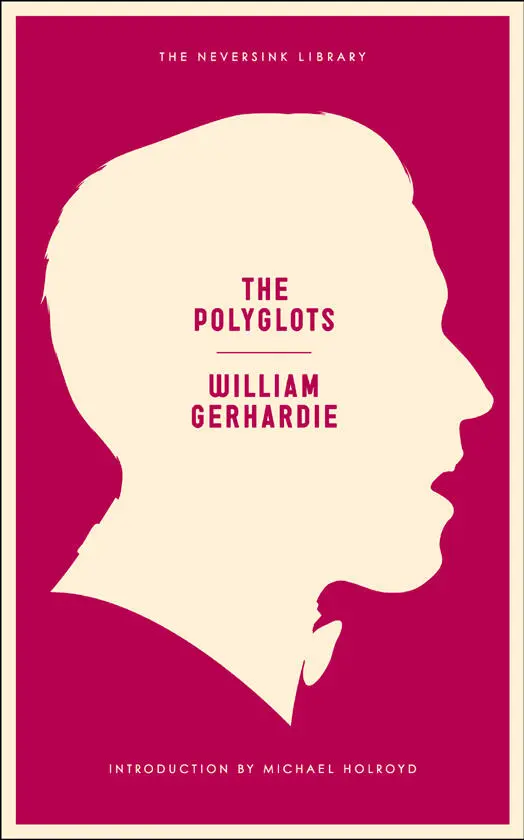
- Название:The Polyglots
- Автор:
- Издательство:Melville House
- Жанр:
- Год:2013
- ISBN:нет данных
- Рейтинг книги:5 / 5. Голосов: 1
-
Избранное:Добавить в избранное
- Отзывы:
-
Ваша оценка:
The Polyglots: краткое содержание, описание и аннотация
Предлагаем к чтению аннотацию, описание, краткое содержание или предисловие (зависит от того, что написал сам автор книги «The Polyglots»). Если вы не нашли необходимую информацию о книге — напишите в комментариях, мы постараемся отыскать её.
The Polyglots — читать онлайн бесплатно полную книгу (весь текст) целиком
Ниже представлен текст книги, разбитый по страницам. Система сохранения места последней прочитанной страницы, позволяет с удобством читать онлайн бесплатно книгу «The Polyglots», без необходимости каждый раз заново искать на чём Вы остановились. Поставьте закладку, и сможете в любой момент перейти на страницу, на которой закончили чтение.
Интервал:
Закладка:
‘An acquisitive state of mind,’ retorted Uncle Lucy, laughing bitterly.
‘Very truly said,’ rejoined the Russian officer, nodding his head. ‘We family men in particular feel the truth of this assertion. I have, Lucy Christophorovich, two daughters: Màsha and Natàsha. Màsha is away with her husband, Ippolit Sergèiech Blagovèschenski, in Novorossiisk. She’s married, as I said, but is not happy. Poor Màsha! But Natàsha’s here. Natàsha!’ he called. ‘This is Natàsha.’
Uncle Lucy beamed at her through his gold-rimmed spectacles, and touched her approvingly with his thumb and forefinger on the delicate chin. He then searched a long time in his pocket-book, and gave her a 200,000 rouble note — then worth about one and a penny. Natàsha curtsied and went away, beaming.
‘Look! Look!’ came her voice from the corridor. ‘Harry, look!’
‘That’s nuffink,’ said Harry. ‘Daddy gives me — oh much more.’
‘Oh, what a nice little girl!’ Aunt Molly patted her cheek.
‘Unfortunately, things being what they are, Marya Nikolaevna, her education is being neglected. Still, she is learning English without knowing it, which pleases me a great deal.’
‘Oh, she can already speak English? What is your name?’ Aunt Molly asked Natàsha in English.
‘I don’t know myself,’ she said. ‘I have two kinds of name, and I don’t know what kinds it is.’
‘She came out under her mother’s maiden name so as to conceal her father’s,’ I explained.
Aunt Molly patted her again on the cheek; then went into her room, and returning gave Natàsha a banana. Natàsha curtsied, and went away beaming.
‘ Ach ! Marya Nikolaevna, my heart aches for poor Màsha,’ Mme Negodyaev was saying. ‘Ippolit is a terrible man. You won’t believe me if I tell you—’
Captain Negodyaev called Harry and gave him a caramel.
‘What do you say?’ said Uncle Lucy.
‘Thank you,’ said Harry.
‘But when they broke into the cabinet and took away the portfolio with all our ready money, well, both Màsha and I don’t think it was a very nice thing to do, anyhow.’
Uncle Lucy, who, after a life of toil and authority, found his enforced idleness very irksome, offered to help Vladislav chop wood. ‘There are so many of us now. All must help.’
‘No, Lucy, don’t be a fool,’ Aunt Molly gently dissuaded him.
And Vladislav himself was not anxious. ‘This is no proper work for a gentleman,’ he was telling Uncle Lucy, who was getting in the way with the axe and retarding the man’s work. ‘You, sir, leave this to us who are used to it. In France—’
But Uncle Lucy, brushing the dust off his palms, had returned to the drawing-room, and, for want of anything better, was examining the pictures on the walls: all as dull as life. The children, strutting with a loud hoof-clatter all over the rooms, were saying:
‘I like this ’.
‘And I like this .’
‘And I like this .’
‘And I like this .’
Till Aunt Teresa issued orders to stop that noise. Nora hopped about on one leg, with her tongue between her teeth in the effort, and her brother Harry, hardly taller, lounged about with an independent mien, his hands in his pockets. ‘I have a dressing-table,’ he said proudly.
‘And I have a dr a ssing-table!’ she echoed — and showed me the mantelshelf.
‘Is this your dressing-table?’
‘Yesh.’
Harry came up and whispered in my ear: ‘We tell her so s’e shouldn’t cry. S’e’s only a baby.’
‘And this is my bad,’ she said.
‘Silly! This is not a bed. It’s a sofa,’ he said.
‘This is my shofa,’ she said.
‘I see this is where you sleep?’
‘Yesh.’
‘Isn’t she a lovely little thing? Come, lovie,’ he said, embracing her.
‘Why do you call her lovie? Is that her name?’
‘No, her name is Nora Rose Di-abologh. Her name is Miss Di-abologh. But I call her lovie. S’e’s only a baby,’ he said.
‘And does Nora love you?’
‘Yes. I love her and s’e loves me.’
‘How do you know?’
‘Because when I tell her: “Nora, put your arm round me”, s’e puts her arm round me — and kisses me.’
‘Your little sister is not a fool, Harry, you know.’
‘No, she isn’t.’
‘And you’re not a fool either, are you, Harry?’
‘No, but daddy is.’
‘Why?’
‘Because mammy says so.’
Uncle Lucy stood in the middle of the drawing-room, his hand on his ear-trumpet and close to his ear (but talking himself all the while), and spoke of the heavy losses he had sustained, and expressed a fear lest soon he would lose all his possessions. ‘Ruin,’ he said. ‘Irretrievable ruin.’
‘ Courage, mon ami! Courage! ’ said Uncle Emmanuel, smoking calmly a long, thick cigar, and he gave a smack on Uncle Lucy’s shoulder — not too hearty, however, because he was still a little uncertain of his beaufrère . Although he had suffered material damage at the hands of the Bolsheviks, Uncle Lucy, I noticed, was not unsympathetic to certain aspects of their programme, and hoped that by their publication of secret diplomatic documents they would put an end to the immoral diplomacies of the past. Among other things, he expressed faith in the League of Nations. Uncle Emmanuel, on the other hand, professed a cynical naïveté in regard to human affairs. He did not believe in the League of Nations, laid stress on the inherent wickedness of human nature which he scornfully considered incapable of improvement and, moreover, had no wish to improve. Uncle Emmanuel had never profited materially by his cynical attitude, and had never had a penny of his own, and had all his life been fated to play a cringing role both before his superiors and his own wife. To Uncle Lucy, who had been a bit of a Socialist and withal a very rich man in his days, Uncle Emmanuel said: ‘I respect your ideals, your impractical aspirations; but I am a man of facts, and have no faith in highfalutin theories: my purse is my politics. Yes.’ And he looked round for applause. But as most of us knew that there was nothing in Uncle Emmanuel’s purse, this statement was received without enthusiasm.
The dining-room was reorganized on the principle of treble shifts, and Aunt Molly, a big, full-blooded woman, presided over the long table surrounded by a multitude of her kin. Aunt Teresa, heavily powdered, bejewelled and wrapped in old lace, sat in a great arm-chair, propped up by pillows, a little to the side, to emphasize as it were that, unlike the others, she was an invalid. When she spoke across to Uncle Lucy she raised her voice with an air of self-sacrifice as though it were a cruel strain on her nerves. ‘Ach!’ she sighed, when he did not catch what she said. And when she repeated louder the words she looked at the others to imply that she did so at the cost of her delicate health. When he spoke to her she closed her eyes, as though it were trying to her to make herself listen to his loud unaccustomed voice, as yet not modulated to her sensitive ear. Uncle Lucy continually asked questions about the progress of the Russo-Polish war, in which he was much interested, but could not hear my answers, and so turned to his wife. But Aunt Molly’s intellectual powers had been sapped by a dozen children to whom she had given birth, and in her rendering of my account she mixed up events and issues in such a way that my uncle, withal a clever man, perceived at once that there was something very wrong about it. In desperation he turned to his son, a lout of eighteen, sitting at his side. ‘What did George say?’ he asked, and listened through the ear-trumpet.
‘The Russkis have defeated the Polyakis,’ the lout said right into the ear-trumpet.
Читать дальшеИнтервал:
Закладка:
Похожие книги на «The Polyglots»
Представляем Вашему вниманию похожие книги на «The Polyglots» списком для выбора. Мы отобрали схожую по названию и смыслу литературу в надежде предоставить читателям больше вариантов отыскать новые, интересные, ещё непрочитанные произведения.

Обсуждение, отзывы о книге «The Polyglots» и просто собственные мнения читателей. Оставьте ваши комментарии, напишите, что Вы думаете о произведении, его смысле или главных героях. Укажите что конкретно понравилось, а что нет, и почему Вы так считаете.