William Gerhardie - The Polyglots
Здесь есть возможность читать онлайн «William Gerhardie - The Polyglots» весь текст электронной книги совершенно бесплатно (целиком полную версию без сокращений). В некоторых случаях можно слушать аудио, скачать через торрент в формате fb2 и присутствует краткое содержание. Год выпуска: 2013, Издательство: Melville House, Жанр: Классическая проза, на английском языке. Описание произведения, (предисловие) а так же отзывы посетителей доступны на портале библиотеки ЛибКат.
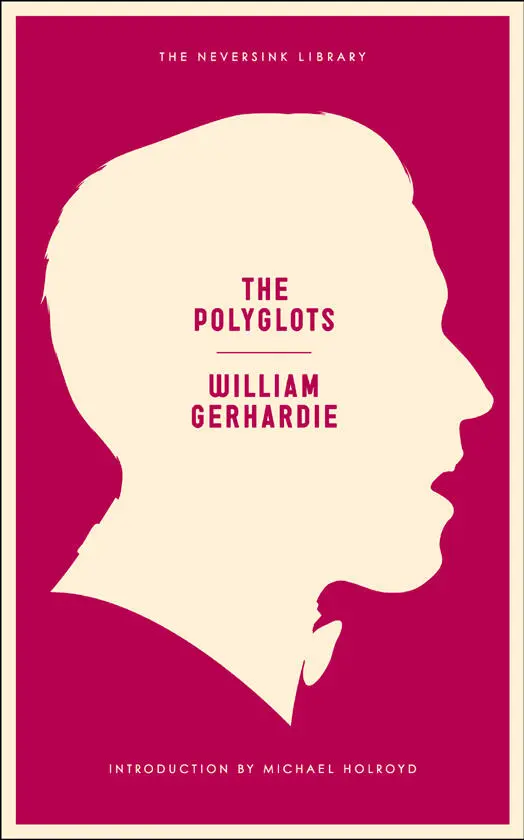
- Название:The Polyglots
- Автор:
- Издательство:Melville House
- Жанр:
- Год:2013
- ISBN:нет данных
- Рейтинг книги:5 / 5. Голосов: 1
-
Избранное:Добавить в избранное
- Отзывы:
-
Ваша оценка:
The Polyglots: краткое содержание, описание и аннотация
Предлагаем к чтению аннотацию, описание, краткое содержание или предисловие (зависит от того, что написал сам автор книги «The Polyglots»). Если вы не нашли необходимую информацию о книге — напишите в комментариях, мы постараемся отыскать её.
The Polyglots — читать онлайн бесплатно полную книгу (весь текст) целиком
Ниже представлен текст книги, разбитый по страницам. Система сохранения места последней прочитанной страницы, позволяет с удобством читать онлайн бесплатно книгу «The Polyglots», без необходимости каждый раз заново искать на чём Вы остановились. Поставьте закладку, и сможете в любой момент перейти на страницу, на которой закончили чтение.
Интервал:
Закладка:
I shrugged my shoulders. ‘I am afraid, Berthe, your philology has been neglected. Ideal is not quite the same as idea , you know.’
‘ À quoi bon? Enfin ,’ she said, ‘I am alone for the whole house. You all sit all day long, no one does anything.’
‘Berthe, my uncle is waiting.’
Dressed at last — without a vest, without even pencilling my brows that morning — I dashed out of the room.
30
IN THE DINING-ROOM, STANDING STILL FOR A WHILE, was Uncle Lucy, a spectacled individual with a modest sandy moustache and a small pointed beard. He was pale; the only colour in his face was in his nose. ‘Quick. Quick. Quick,’ he said, ‘no time to waste.’ He explained that his family who had arrived late in the night were now at the hotel — all the lot of them quartered in three bedrooms, that the hotel was full to overflowing, and ruinous, and asked if he could bring them all over to our flat.
‘But, uncle, we have scarcely any beds,’ I said, with dismay.
He waved his hand — a gesture which reminded me of his sister Teresa. ‘Anything will do,’ he said. ‘We can all sleep on the floor. Plenty of room’—he pointed round at the skirting. ‘Times are different. Come on.’
‘But wait, have some coffee first, Uncle.’
‘No time to waste. Quick. Quick. Quick,’ he said.
The clock on the shelf had just struck half-past six. We helped each other on with our coats, and went out into the street.
At the corner of the street we hailed a cab and drove on to the hotel in the cold early morning air which bit at my ears. My uncle, I noticed, had large hairy ears, and did not turn up his collar. Uncle Lucy was very deaf, and hating to ask me to repeat my questions, replied on the off-chance, or not hearing my answers, nodded and meditated upon them. Before we alighted at the porch of the hotel, Uncle Lucy remarked that the whole back of my British warm had been besmeared with tar by my leaning against the back of the seat, and my uncle became very worried and apologetic as though it had been his fault. ‘A little soap and benzine,’ he said. ‘I’ll get it out for you with soap and benzine when we get back.’ Uncle Lucy kept looking worried and taking another look at my soiled British warm and saying ‘Soap and benzine,’ but I only thought that sitting there without a vest I might catch cold, develop pneumonia, and finally die altogether. He insisted on paying for the cab when we alighted; and took me straight up to his bedroom.
Here I saw Aunt Molly, a tall, stout, milk-and-blood complexioned woman with small, kindly, brown eyes. She kissed me on the cheek, and her own glossy cheeks smelt of scented soap. There were two little girls tucked away in a big bed: one dark, the other fair; for both of whom Uncle Lucy was responsible. Whether Aunt Molly was equally responsible — for both or merely for one, and if so, for which of the two — was altogether less certain. For Uncle Lucy, I believe, was an infidel in these matters. But never mind.
‘Your lost cousins,’ said Aunt Molly.
‘Which is which?’ I asked, bending over them and kissing their wet mouths.
‘This is Bubby — the darkie. And this fair one is Nora, our last.’
‘And how old is Nora?’
‘Two and a half,’ Nora replied for herself.
‘How many children have you got altogether, Uncle Lucy?’ I asked.
He began counting them on his fingers — but got muddled in his score. He had been married more than once. And he had acquired so awfully many.
‘Just wait a moment,’ said Aunt Molly. ‘I will bring Harry to you.’
I waited, and presently I heard muffled exhortations and a stubborn shuffling of feet behind the door. ‘Harry!’ urged my aunt.
‘No!’ said Harry, backing stubbornly and fighting his way out. But she dragged him in by the hand and brought him to me, confused and reluctant — a small boy of four with forget-me-not eyes.
‘This is Harry,’ she said.
He was dreadfully shy; he had seen a photograph of myself in military uniform, and was frightened of the sword. But left alone with me, he soon brightened up and began telling me about a dog he had seen run over in the street. ‘Poor, poor thing!’ he said. ‘It was bleeding all over.’
‘But why didn’t you want to come and see me?’
‘Because I didn’t know what you were like.’
‘Well, am I better than you thought, or worse?’
‘No, I thought you were more worse.
‘Will you play in my room?’ he asked in a while.
‘No. I am — frightened of you.’
He looked at me with encouragement. ‘Why are you frightened of me? I’m very nice. That’s all I can say. Are you frightened of cows?’
We passed into the other rooms. And only now did I understand what it meant to have Uncle Lucy launching on our accommodation. He was accompanied by married daughters, husbands, nurses, fiancées, and relatives-in-law of every sort. I was confronted by strikingly good-looking flappers who turned out to be my own hitherto unseen cousins, by boys of sundry ages, by babes and sucklings, by grown-up men and women, all, I perceived, related to me very closely, and bearing my own disconcerting name. Besides, there was my uncle’s eldest son, a landscape painter, a promising young lad of about thirty-nine, who spoke a lot and drank a lot and painted little. Their knowledge of the English language was unequal. The little ones, who had an English nurse, conversed like natives. Their elders spoke with difficulty. For this their father was to blame. Uncle Lucy did not share Grandpapa Diabologh’s passion for travel; he had been nowhere. Since his birth in Manchester he had not been out of Russia. The only sort of English people Uncle Lucy knew in Russia were Lancashire mill hands and mechanics who called themselves ‘engineers’—a term which, in Russia, implies a College degree. But as the Russian technical graduates possessed less natural aptitude for machinery than the English mechanics, there was some justification in the Englishmen’s claim to the coveted term ‘engineer’. These English mechanics, however, not having impressed Uncle Lucy by their refinement or education, he decided to send his sons to Switzerland and to Germany — countries of which he had had the highest account — and they returned with cheeks disfigured by sword cuts, and talking of a Wechsel in English when what they meant was a bill of exchange. And as Aunt Teresa now greeted them: ‘How are you?’ one of them said: ‘Very nice,’ while the other replied ‘Very good.’
By various means these people and their luggage had been transported to our quarters. In the hall as I arrived was Nora. She stood there — a little mushroom under a mushroom hat. A little walking mushroom grown up in the night, it seemed — while Uncle Lucy wasn’t looking. The children’s overcoats and warm overshoes were removed in the hall, and at once there was heard a loud hoof-clatter — their strutting all over the rooms. Besides, there was a boy of one and a half, Aunt Molly’s half-grandson called Theo, with long flaxen locks, who, having seen Don, at once toddled after him and pulled him by the tail.
I went to the office and returned a little before lunch. But in this short space our flat had already been turned into a squealing nursery and a bear-garden.
There were more human things about than there were beds and chairs and sofas, and when you rose you had to take care lest you stepped on some sprawling little Diabologh. The drawing-room, flooded by a host of relatives, was a babel of voices. Captain Negodyaev was standing talking eagerly to Uncle Lucy, who listened to him, with head slightly bent, through an ear-trumpet. Uncle Lucy had been a bit of a democrat in his day, and when the revolution came he hailed the revolution. But when the revolution, in its evolution, dispossessed him of his property, he thought the revolution was a mistake. Captain Negodyaev also thought the revolution a mistake, and it follows that Uncle Lucy and Captain Negodyaev had that in common that both thought the revolution a mistake. ‘Bolshevism is a state of mind,’ said Captain Negodyaev, with the air of enunciating a profound philosophical truth.
Читать дальшеИнтервал:
Закладка:
Похожие книги на «The Polyglots»
Представляем Вашему вниманию похожие книги на «The Polyglots» списком для выбора. Мы отобрали схожую по названию и смыслу литературу в надежде предоставить читателям больше вариантов отыскать новые, интересные, ещё непрочитанные произведения.






Обсуждение, отзывы о книге «The Polyglots» и просто собственные мнения читателей. Оставьте ваши комментарии, напишите, что Вы думаете о произведении, его смысле или главных героях. Укажите что конкретно понравилось, а что нет, и почему Вы так считаете.