Jack London - Burning Daylight
Здесь есть возможность читать онлайн «Jack London - Burning Daylight» весь текст электронной книги совершенно бесплатно (целиком полную версию без сокращений). В некоторых случаях можно слушать аудио, скачать через торрент в формате fb2 и присутствует краткое содержание. Год выпуска: 1910, Жанр: Классическая проза, Природа и животные, Путешествия и география, на английском языке. Описание произведения, (предисловие) а так же отзывы посетителей доступны на портале библиотеки ЛибКат.
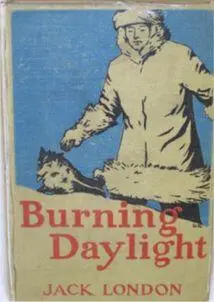
- Название:Burning Daylight
- Автор:
- Жанр:
- Год:1910
- ISBN:нет данных
- Рейтинг книги:5 / 5. Голосов: 1
-
Избранное:Добавить в избранное
- Отзывы:
-
Ваша оценка:
Burning Daylight: краткое содержание, описание и аннотация
Предлагаем к чтению аннотацию, описание, краткое содержание или предисловие (зависит от того, что написал сам автор книги «Burning Daylight»). Если вы не нашли необходимую информацию о книге — напишите в комментариях, мы постараемся отыскать её.
Burning Daylight — читать онлайн бесплатно полную книгу (весь текст) целиком
Ниже представлен текст книги, разбитый по страницам. Система сохранения места последней прочитанной страницы, позволяет с удобством читать онлайн бесплатно книгу «Burning Daylight», без необходимости каждый раз заново искать на чём Вы остановились. Поставьте закладку, и сможете в любой момент перейти на страницу, на которой закончили чтение.
Интервал:
Закладка:
"He's sure the real thing," he told one of his fellow-clubmen afterwards, in the smoking-room of the Alta-Pacific. "I tell you, Gallon, he was a genuine surprise to me. I knew the big ones had to be like that, but I had to see him to really know it. He's one of the fellows that does things. You can see it sticking out all over him. He's one in a thousand, that's straight, a man to tie to. There's no limit to any game he plays, and you can stack on it that he plays right up to the handle. I bet he can lose or win half a dozen million without batting an eye."
Gallon puffed at his cigar, and at the conclusion of the panegyric regarded the other curiously; but Daylight, ordering cocktails, failed to note this curious stare.
"Going in with him on some deal, I suppose," Gallon remarked.
"Nope, not the slightest idea. Here's kindness. I was just explaining that I'd come to understand how these big fellows do big things. Why, d'ye know, he gave me such a feeling that he knew everything, that I was plumb ashamed of myself."
"I guess I could give him cards and spades when it comes to driving a dog-team, though," Daylight observed, after a meditative pause. "And I really believe I could put him on to a few wrinkles in poker and placer mining, and maybe in paddling a birch canoe. And maybe I stand a better chance to learn the game he's been playing all his life than he would stand of learning the game I played up North."
CHAPTER II
It was not long afterward that Daylight came on to New York. A letter from John Dowsett had been the cause—a simple little typewritten letter of several lines. But Daylight had thrilled as he read it. He remembered the thrill that was his, a callow youth of fifteen, when, in Tempas Butte, through lack of a fourth man, Tom Galsworthy, the gambler, had said, "Get in, Kid; take a hand." That thrill was his now. The bald, typewritten sentences seemed gorged with mystery. "Our Mr. Howison will call upon you at your hotel. He is to be trusted. We must not be seen together. You will understand after we have had our talk." Daylight conned the words over and over. That was it. The big game had arrived, and it looked as if he were being invited to sit in and take a hand. Surely, for no other reason would one man so peremptorily invite another man to make a journey across the continent.
They met—thanks to "our" Mr. Howison,—up the Hudson, in a magnificent country home. Daylight, according to instructions, arrived in a private motor-car which had been furnished him. Whose car it was he did not know any more than did he know the owner of the house, with its generous, rolling, tree-studded lawns. Dowsett was already there, and another man whom Daylight recognized before the introduction was begun. It was Nathaniel Letton, and none other. Daylight had seen his face a score of times in the magazines and newspapers, and read about his standing in the financial world and about his endowed University of Daratona. He, likewise, struck Daylight as a man of power, though he was puzzled in that he could find no likeness to Dowsett. Except in the matter of cleanness,—a cleanness that seemed to go down to the deepest fibers of him,—Nathaniel Letton was unlike the other in every particular. Thin to emaciation, he seemed a cold flame of a man, a man of a mysterious, chemic sort of flame, who, under a glacier-like exterior, conveyed, somehow, the impression of the ardent heat of a thousand suns. His large gray eyes were mainly responsible for this feeling, and they blazed out feverishly from what was almost a death's-head, so thin was the face, the skin of which was a ghastly, dull, dead white. Not more than fifty, thatched with a sparse growth of iron-gray hair, he looked several times the age of Dowsett. Yet Nathaniel Letton possessed control—Daylight could see that plainly. He was a thin-faced ascetic, living in a state of high, attenuated calm—a molten planet under a transcontinental ice sheet. And yet, above all most of all, Daylight was impressed by the terrific and almost awful cleanness of the man. There was no dross in him. He had all the seeming of having been purged by fire. Daylight had the feeling that a healthy man-oath would be a deadly offence to his ears, a sacrilege and a blasphemy.
They drank—that is, Nathaniel Letton took mineral water served by the smoothly operating machine of a lackey who inhabited the place, while Dowsett took Scotch and soda and Daylight a cocktail. Nobody seemed to notice the unusualness of a Martini at midnight, though Daylight looked sharply for that very thing; for he had long since learned that Martinis had their strictly appointed times and places. But he liked Martinis, and, being a natural man, he chose deliberately to drink when and how he pleased. Others had noticed this peculiar habit of his, but not so Dowsett and Letton; and Daylight's secret thought was: "They sure wouldn't bat an eye if I called for a glass of corrosive sublimate."
Leon Guggenhammer arrived in the midst of the drink, and ordered Scotch. Daylight studied him curiously. This was one of the great Guggenhammer family; a younger one, but nevertheless one of the crowd with which he had locked grapples in the North. Nor did Leon Guggenhammer fail to mention cognizance of that old affair. He complimented Daylight on his prowess—"The echoes of Ophir came down to us, you know. And I must say, Mr. Daylight—er, Mr. Harnish, that you whipped us roundly in that affair."
Echoes! Daylight could not escape the shock of the phrase—echoes had come down to them of the fight into which he had flung all his strength and the strength of his Klondike millions. The Guggenhammers sure must go some when a fight of that dimension was no more than a skirmish of which they deigned to hear echoes.
"They sure play an almighty big game down here," was his conclusion, accompanied by a corresponding elation that it was just precisely that almighty big game in which he was about to be invited to play a hand. For the moment he poignantly regretted that rumor was not true, and that his eleven millions were not in reality thirty millions. Well, that much he would be frank about; he would let them know exactly how many stacks of chips he could buy.
Leon Guggenhammer was young and fat. Not a day more than thirty, his face, save for the adumbrated puff sacks under the eyes, was as smooth and lineless as a boy's. He, too, gave the impression of cleanness. He showed in the pink of health; his unblemished, smooth-shaven skin shouted advertisement of his splendid physical condition. In the face of that perfect skin, his very fatness and mature, rotund paunch could be nothing other than normal. He was constituted to be prone to fatness, that was all.
The talk soon centred down to business, though Guggenhammer had first to say his say about the forthcoming international yacht race and about his own palatial steam yacht, the Electra, whose recent engines were already antiquated. Dowsett broached the plan, aided by an occasional remark from the other two, while Daylight asked questions. Whatever the proposition was, he was going into it with his eyes open. And they filled his eyes with the practical vision of what they had in mind.
"They will never dream you are with us," Guggenhammer interjected, as the outlining of the matter drew to a close, his handsome Jewish eyes flashing enthusiastically. "They'll think you are raiding on your own in proper buccaneer style."
"Of course, you understand, Mr. Harnish, the absolute need for keeping our alliance in the dark," Nathaniel Letton warned gravely.
Daylight nodded his head. "And you also understand," Letton went on, "that the result can only be productive of good. The thing is legitimate and right, and the only ones who may be hurt are the stock gamblers themselves. It is not an attempt to smash the market. As you see yourself, you are to bull the market. The honest investor will be the gainer."
Читать дальшеИнтервал:
Закладка:
Похожие книги на «Burning Daylight»
Представляем Вашему вниманию похожие книги на «Burning Daylight» списком для выбора. Мы отобрали схожую по названию и смыслу литературу в надежде предоставить читателям больше вариантов отыскать новые, интересные, ещё непрочитанные произведения.







Обсуждение, отзывы о книге «Burning Daylight» и просто собственные мнения читателей. Оставьте ваши комментарии, напишите, что Вы думаете о произведении, его смысле или главных героях. Укажите что конкретно понравилось, а что нет, и почему Вы так считаете.