Jack London - Burning Daylight
Здесь есть возможность читать онлайн «Jack London - Burning Daylight» весь текст электронной книги совершенно бесплатно (целиком полную версию без сокращений). В некоторых случаях можно слушать аудио, скачать через торрент в формате fb2 и присутствует краткое содержание. Год выпуска: 1910, Жанр: Классическая проза, Природа и животные, Путешествия и география, на английском языке. Описание произведения, (предисловие) а так же отзывы посетителей доступны на портале библиотеки ЛибКат.
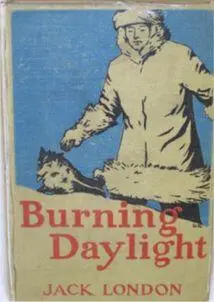
- Название:Burning Daylight
- Автор:
- Жанр:
- Год:1910
- ISBN:нет данных
- Рейтинг книги:5 / 5. Голосов: 1
-
Избранное:Добавить в избранное
- Отзывы:
-
Ваша оценка:
Burning Daylight: краткое содержание, описание и аннотация
Предлагаем к чтению аннотацию, описание, краткое содержание или предисловие (зависит от того, что написал сам автор книги «Burning Daylight»). Если вы не нашли необходимую информацию о книге — напишите в комментариях, мы постараемся отыскать её.
Burning Daylight — читать онлайн бесплатно полную книгу (весь текст) целиком
Ниже представлен текст книги, разбитый по страницам. Система сохранения места последней прочитанной страницы, позволяет с удобством читать онлайн бесплатно книгу «Burning Daylight», без необходимости каждый раз заново искать на чём Вы остановились. Поставьте закладку, и сможете в любой момент перейти на страницу, на которой закончили чтение.
Интервал:
Закладка:
She had fooled him, fool that he was. He had even thought that night that her feeling for him had passed, and he had taken delight in the thought, and caught visions of the satisfying future friendship that would be theirs with this perturbing love out of the way.
And then, when he stood at the door, cap in hand, and said good night. It had struck him at the time as a funny and embarrassing thing, her bending over his hand and kissing it. He had felt like a fool, but he shivered now when he looked back on it and felt again the touch of her lips on his hand. She was saying good-by, an eternal good-by, and he had never guessed. At that very moment, and for all the moments of the evening, coolly and deliberately, as he well knew her way, she had been resolved to die. If he had only known it! Untouched by the contagious malady himself, nevertheless he would have married her if he had had the slightest inkling of what she contemplated. And yet he knew, furthermore, that hers was a certain stiff-kneed pride that would not have permitted her to accept marriage as an act of philanthropy. There had really been no saving her, after all. The love-disease had fastened upon her, and she had been doomed from the first to perish of it.
Her one possible chance had been that he, too, should have caught it. And he had failed to catch it. Most likely, if he had, it would have been from Freda or some other woman. There was Dartworthy, the college man who had staked the rich fraction on Bonanza above Discovery. Everybody knew that old Doolittle's daughter, Bertha, was madly in love with him. Yet, when he contracted the disease, of all women, it had been with the wife of Colonel Walthstone, the great Guggenhammer mining expert. Result, three lunacy cases: Dartworthy selling out his mine for one-tenth its value; the poor woman sacrificing her respectability and sheltered nook in society to flee with him in an open boat down the Yukon; and Colonel Walthstone, breathing murder and destruction, taking out after them in another open boat. The whole impending tragedy had moved on down the muddy Yukon, passing Forty Mile and Circle and losing itself in the wilderness beyond. But there it was, love, disorganizing men's and women's lives, driving toward destruction and death, turning topsy-turvy everything that was sensible and considerate, making bawds or suicides out of virtuous women, and scoundrels and murderers out of men who had always been clean and square.
For the first time in his life Daylight lost his nerve. He was badly and avowedly frightened. Women were terrible creatures, and the love-germ was especially plentiful in their neighborhood.
And they were so reckless, so devoid of fear. THEY were not frightened by what had happened to the Virgin. They held out their arms to him more seductively than ever. Even without his fortune, reckoned as a mere man, just past thirty, magnificently strong and equally good-looking and good-natured, he was a prize for most normal women. But when to his natural excellences were added the romance that linked with his name and the enormous wealth that was his, practically every free woman he encountered measured him with an appraising and delighted eye, to say nothing of more than one woman who was not free. Other men might have been spoiled by this and led to lose their heads; but the only effect on him was to increase his fright. As a result he refused most invitations to houses where women might be met, and frequented bachelor boards and the Moosehorn Saloon, which had no dance-hall attached.
CHAPTER XIII
Six thousand spent the winter of 1897 in Dawson, work on the creeks went on apace, while beyond the passes it was reported that one hundred thousand more were waiting for the spring. Late one brief afternoon, Daylight, on the benches between French Hill and Skookum Hill, caught a wider vision of things. Beneath him lay the richest part of Eldorado Creek, while up and down Bonanza he could see for miles. It was a scene of a vast devastation. The hills, to their tops, had been shorn of trees, and their naked sides showed signs of goring and perforating that even the mantle of snow could not hide. Beneath him, in every direction were the cabins of men. But not many men were visible. A blanket of smoke filled the valleys and turned the gray day to melancholy twilight. Smoke arose from a thousand holes in the snow, where, deep down on bed-rock, in the frozen muck and gravel, men crept and scratched and dug, and ever built more fires to break the grip of the frost. Here and there, where new shafts were starting, these fires flamed redly. Figures of men crawled out of the holes, or disappeared into them, or, on raised platforms of hand-hewn timber, windlassed the thawed gravel to the surface, where it immediately froze. The wreckage of the spring washing appeared everywhere—piles of sluice-boxes, sections of elevated flumes, huge water-wheels,—all the debris of an army of gold-mad men.
"It-all's plain gophering," Daylight muttered aloud.
He looked at the naked hills and realized the enormous wastage of wood that had taken place. From this bird's-eye view he realized the monstrous confusion of their excited workings. It was a gigantic inadequacy. Each worked for himself, and the result was chaos. In this richest of diggings it cost out by their feverish, unthinking methods another dollar was left hopelessly in the earth. Given another year, and most of the claims would be worked out, and the sum of the gold taken out would no more than equal what was left behind.
Organization was what was needed, he decided; and his quick imagination sketched Eldorado Creek, from mouth to source, and from mountain top to mountain top, in the hands of one capable management. Even steam-thawing, as yet untried, but bound to come, he saw would be a makeshift. What should be done was to hydraulic the valley sides and benches, and then, on the creek bottom, to use gold-dredges such as he had heard described as operating in California.
There was the very chance for another big killing. He had wondered just what was precisely the reason for the Guggenhammers and the big English concerns sending in their high-salaried experts. That was their scheme. That was why they had approached him for the sale of worked-out claims and tailings. They were content to let the small mine-owners gopher out what they could, for there would be millions in the leavings.
And, gazing down on the smoky inferno of crude effort, Daylight outlined the new game he would play, a game in which the Guggenhammers and the rest would have to reckon with him. Cut along with the delight in the new conception came a weariness. He was tired of the long Arctic years, and he was curious about the Outside—the great world of which he had heard other men talk and of which he was as ignorant as a child. There were games out there to play. It was a larger table, and there was no reason why he with his millions should not sit in and take a hand. So it was, that afternoon on Skookum Hill, that he resolved to play this last best Klondike hand and pull for the Outside.
It took time, however. He put trusted agents to work on the heels of great experts, and on the creeks where they began to buy he likewise bought. Wherever they tried to corner a worked-out creek, they found him standing in the way, owning blocks of claims or artfully scattered claims that put all their plans to naught.
"I play you-all wide open to win—am I right" he told them once, in a heated conference.
Followed wars, truces, compromises, victories, and defeats. By 1898, sixty thousand men were on the Klondike and all their fortunes and affairs rocked back and forth and were affected by the battles Daylight fought. And more and more the taste for the larger game urged in Daylight's mouth. Here he was already locked in grapples with the great Guggenhammers, and winning, fiercely winning. Possibly the severest struggle was waged on Ophir, the veriest of moose-pastures, whose low-grade dirt was valuable only because of its vastness. The ownership of a block of seven claims in the heart of it gave Daylight his grip and they could not come to terms. The Guggenhammer experts concluded that it was too big for him to handle, and when they gave him an ultimatum to that effect he accepted and bought them out.
Читать дальшеИнтервал:
Закладка:
Похожие книги на «Burning Daylight»
Представляем Вашему вниманию похожие книги на «Burning Daylight» списком для выбора. Мы отобрали схожую по названию и смыслу литературу в надежде предоставить читателям больше вариантов отыскать новые, интересные, ещё непрочитанные произведения.





Обсуждение, отзывы о книге «Burning Daylight» и просто собственные мнения читателей. Оставьте ваши комментарии, напишите, что Вы думаете о произведении, его смысле или главных героях. Укажите что конкретно понравилось, а что нет, и почему Вы так считаете.