Jack London - Burning Daylight
Здесь есть возможность читать онлайн «Jack London - Burning Daylight» весь текст электронной книги совершенно бесплатно (целиком полную версию без сокращений). В некоторых случаях можно слушать аудио, скачать через торрент в формате fb2 и присутствует краткое содержание. Год выпуска: 1910, Жанр: Классическая проза, Природа и животные, Путешествия и география, на английском языке. Описание произведения, (предисловие) а так же отзывы посетителей доступны на портале библиотеки ЛибКат.
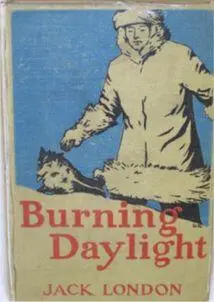
- Название:Burning Daylight
- Автор:
- Жанр:
- Год:1910
- ISBN:нет данных
- Рейтинг книги:5 / 5. Голосов: 1
-
Избранное:Добавить в избранное
- Отзывы:
-
Ваша оценка:
Burning Daylight: краткое содержание, описание и аннотация
Предлагаем к чтению аннотацию, описание, краткое содержание или предисловие (зависит от того, что написал сам автор книги «Burning Daylight»). Если вы не нашли необходимую информацию о книге — напишите в комментариях, мы постараемся отыскать её.
Burning Daylight — читать онлайн бесплатно полную книгу (весь текст) целиком
Ниже представлен текст книги, разбитый по страницам. Система сохранения места последней прочитанной страницы, позволяет с удобством читать онлайн бесплатно книгу «Burning Daylight», без необходимости каждый раз заново искать на чём Вы остановились. Поставьте закладку, и сможете в любой момент перейти на страницу, на которой закончили чтение.
Интервал:
Закладка:
At ten o'clock he arose and pored over the city directory. Then he put on his shoes, took a cab, and departed into the night. Twice he changed cabs, and finally fetched up at the night office of a detective agency. He superintended the thing himself, laid down money in advance in profuse quantities, selected the six men he needed, and gave them their instructions. Never, for so simple a task, had they been so well paid; for, to each, in addition to office charges, he gave a five-hundred-dollar bill, with the promise of another if he succeeded. Some time next day, he was convinced, if not sooner, his three silent partners would come together. To each one two of his detectives were to be attached. Time and place was all he wanted to learn.
"Stop at nothing, boys," were his final instructions. "I must have this information. Whatever you do, whatever happens, I'll sure see you through."
Returning to his hotel, he changed cabs as before, went up to his room, and with one more cocktail for a nightcap, went to bed and to sleep. In the morning he dressed and shaved, ordered breakfast and the newspapers sent up, and waited. But he did not drink. By nine o'clock his telephone began to ring and the reports to come in. Nathaniel Letton was taking the train at Tarrytown. John Dowsett was coming down by the subway. Leon Guggenhammer had not stirred out yet, though he was assuredly within. And in this fashion, with a map of the city spread out before him, Daylight followed the movements of his three men as they drew together. Nathaniel Letton was at his offices in the Mutual-Solander Building. Next arrived Guggenhammer. Dowsett was still in his own offices. But at eleven came the word that he also had arrived, and several minutes later Daylight was in a hired motor-car and speeding for the Mutual-Solander Building.
CHAPTER IV
Nathaniel Letton was talking when the door opened; he ceased, and with his two companions gazed with controlled perturbation at Burning Daylight striding into the room. The free, swinging movements of the trail-traveler were unconsciously exaggerated in that stride of his. In truth, it seemed to him that he felt the trail beneath his feet.
"Howdy, gentlemen, howdy," he remarked, ignoring the unnatural calm with which they greeted his entrance. He shook hands with them in turn, striding from one to another and gripping their hands so heartily that Nathaniel Letton could not forbear to wince. Daylight flung himself into a massive chair and sprawled lazily, with an appearance of fatigue. The leather grip he had brought into the room he dropped carelessly beside him on the floor.
"Goddle mighty, but I've sure been going some," he sighed. "We sure trimmed them beautiful. It was real slick. And the beauty of the play never dawned on me till the very end. It was pure and simple knock down and drag out. And the way they fell for it was amazin'."
The geniality in his lazy Western drawl reassured them. He was not so formidable, after all. Despite the act that he had effected an entrance in the face of Letton's instructions to the outer office, he showed no indication of making a scene or playing rough.
"Well," Daylight demanded good-humoredly, "ain't you-all got a good word for your pardner? Or has his sure enough brilliance plumb dazzled you-all?"
Letton made a dry sound in his throat. Dowsett sat quietly and waited, while Leon Guggenhammer struggled into articulation.
"You have certainly raised Cain," he said.
Daylight's black eyes flashed in a pleased way.
"Didn't I, though!" he proclaimed jubilantly. "And didn't we fool'em! I was totally surprised. I never dreamed they would be that easy.
"And now," he went on, not permitting the pause to grow awkward, "we-all might as well have an accounting. I'm pullin' West this afternoon on that blamed Twentieth Century." He tugged at his grip, got it open, and dipped into it with both his hands. "But don't forget, boys, when you-all want me to hornswoggle Wall Street another flutter, all you-all have to do is whisper the word. I'll sure be right there with the goods."
His hands emerged, clutching a great mass of stubs, check-books, and broker's receipts. These he deposited in a heap on the big table, and dipping again, he fished out the stragglers and added them to the pile. He consulted a slip of paper, drawn from his coat pocket, and read aloud:—
"Ten million twenty-seven thousand and forty-two dollars and sixty-eight cents is my figurin' on my expenses. Of course that-all's taken from the winnings before we-all get to figurin' on the whack-up. Where's your figures? It must a' been a Goddle mighty big clean-up."
The three men looked their bepuzzlement at one another. The man was a bigger fool than they had imagined, or else he was playing a game which they could not divine.
Nathaniel Letton moistened his lips and spoke up.
"It will take some hours yet, Mr. Harnish, before the full accounting can be made. Mr. Howison is at work upon it now. We—ah—as you say, it has been a gratifying clean-up. Suppose we have lunch together and talk it over. I'll have the clerks work through the noon hour, so that you will have ample time to catch your train."
Dowsett and Guggenhammer manifested a relief that was almost obvious. The situation was clearing. It was disconcerting, under the circumstances, to be pent in the same room with this heavy-muscled, Indian-like man whom they had robbed. They remembered unpleasantly the many stories of his strength and recklessness. If Letton could only put him off long enough for them to escape into the policed world outside the office door, all would be well; and Daylight showed all the signs of being put off.
"I'm real glad to hear that," he said. "I don't want to miss that train, and you-all have done me proud, gentlemen, letting me in on this deal. I just do appreciate it without being able to express my feelings. But I am sure almighty curious, and I'd like terrible to know, Mr. Letton, what your figures of our winning is. Can you-all give me a rough estimate?"
Nathaniel Letton did not look appealingly at his two friends, but in the brief pause they felt that appeal pass out from him. Dowsett, of sterner mould than the others, began to divine that the Klondiker was playing. But the other two were still older the blandishment of his child-like innocence.
"It is extremely—er—difficult," Leon Guggenhammer began. "You see, Ward Valley has fluctuated so, er—"
"That no estimate can possibly be made in advance," Letton supplemented.
"Approximate it, approximate it," Daylight counselled cheerfully.
"It don't hurt if you-all are a million or so out one side or the other. The figures'll straighten that up. But I'm that curious I'm just itching all over. What d'ye say?"
"Why continue to play at cross purposes?" Dowsett demanded abruptly and coldly. "Let us have the explanation here and now. Mr. Harnish is laboring under a false impression, and he should be set straight. In this deal—"
But Daylight interrupted. He had played too much poker to be unaware or unappreciative of the psychological factor, and he headed Dowsett off in order to play the denouncement of the present game in his own way.
"Speaking of deals," he said, "reminds me of a poker game I once seen in Reno, Nevada. It wa'n't what you-all would call a square game. They-all was tin-horns that sat in. But they was a tenderfoot—short-horns they-all are called out there. He stands behind the dealer and sees that same dealer give hisself four aces offen the bottom of the deck. The tenderfoot is sure shocked. He slides around to the player facin' the dealer across the table.
"'Say,' he whispers, 'I seen the dealer deal hisself four aces.'
"'Well, an' what of it?" says the player.
"'I'm tryin' to tell you-all because I thought you-all ought to know,' says the tenderfoot. 'I tell you-all I seen him deal hisself four aces.'
Читать дальшеИнтервал:
Закладка:
Похожие книги на «Burning Daylight»
Представляем Вашему вниманию похожие книги на «Burning Daylight» списком для выбора. Мы отобрали схожую по названию и смыслу литературу в надежде предоставить читателям больше вариантов отыскать новые, интересные, ещё непрочитанные произведения.







Обсуждение, отзывы о книге «Burning Daylight» и просто собственные мнения читателей. Оставьте ваши комментарии, напишите, что Вы думаете о произведении, его смысле или главных героях. Укажите что конкретно понравилось, а что нет, и почему Вы так считаете.