Irwin Shaw - Rich Man, Poor Man
Здесь есть возможность читать онлайн «Irwin Shaw - Rich Man, Poor Man» весь текст электронной книги совершенно бесплатно (целиком полную версию без сокращений). В некоторых случаях можно слушать аудио, скачать через торрент в формате fb2 и присутствует краткое содержание. Год выпуска: 1970, ISBN: 1970, Издательство: Delacorte Press, NY, Жанр: Классическая проза, на английском языке. Описание произведения, (предисловие) а так же отзывы посетителей доступны на портале библиотеки ЛибКат.
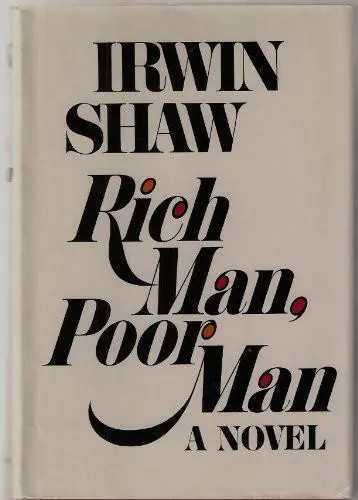
- Название:Rich Man, Poor Man
- Автор:
- Издательство:Delacorte Press, NY
- Жанр:
- Год:1970
- ISBN:9780385288583
- Рейтинг книги:5 / 5. Голосов: 1
-
Избранное:Добавить в избранное
- Отзывы:
-
Ваша оценка:
Rich Man, Poor Man: краткое содержание, описание и аннотация
Предлагаем к чтению аннотацию, описание, краткое содержание или предисловие (зависит от того, что написал сам автор книги «Rich Man, Poor Man»). Если вы не нашли необходимую информацию о книге — напишите в комментариях, мы постараемся отыскать её.
Rich Man, Poor Man — читать онлайн бесплатно полную книгу (весь текст) целиком
Ниже представлен текст книги, разбитый по страницам. Система сохранения места последней прочитанной страницы, позволяет с удобством читать онлайн бесплатно книгу «Rich Man, Poor Man», без необходимости каждый раз заново искать на чём Вы остановились. Поставьте закладку, и сможете в любой момент перейти на страницу, на которой закончили чтение.
Интервал:
Закладка:
‘I’m sorry,’ Gretchen said. ‘My brother’s coming to pick me up. I’m going up to his place for the weekend.’
Evans looked forlorn. He was capable of sixty moods a minute. ‘I’m free as a bird this weekend. I’d hoped we could … ‘ He looked over at Ida, as though he Wished she were out of the room. Ida continued working stolidly on her sheets.
‘I’ll be back Sunday night in time for dinner,’ Gretchen said.
‘Okay,’ Evans said. ‘I suppose I’ll have to settle for that. Give my regards to your brother. And congratulate him for me.’
‘For what?’
‘Didn’t you see his picture in Look! He’s famous all over America. This week.’
‘Oh, that,’ Gretchen said. The magazine had run a piece under the title ‘The Ten Political Hopefuls Under Forty’, and there had been two photographs of Rudolph, one with Jean in the living room of their house, one at his desk in the town hall. Rising fast in Republican councils, the article had said about the handsome young mayor-with the beautiful, rich young wife. Moderate liberal thinker, energetic administrator. Was not just another theoretical politician; Had met a payroll all his life. Had streamlined town government, integrated housing, cracked down on industrial pollution, jailed former police chief and three patrolmen for accepting bribes, raised a bond issue for new schools; as influential trustee of Whitby University had been instrumental in making it a coeducational institution; far-seeing town-planner, had experimented with closing off centre of town to traffic on Saturday afternoons and evenings so that people could stroll about in a neighbourly fashion while they did their shopping; had used the Whitby Sentinel,
of which he was the publisher, as a platform for hard-hitting articles on honest government, both local and national, and had won awards for newspapers in cities of under fifty thousand population; had made a forceful speech at a convention of mayors in Atlantic City and had been enthusiastically applauded; had been invited to the White House for thirty minutes with a select committee of other mayors.
‘Reading that piece,’ Gretchen said, ‘you’d think he’s done everything but raise the dead in Whitby. It must have been written by a lady journalist who’s wildly in love with him. He knows how to turn on the charm, my brother.’
Evans laughed. ‘You don’t let emotional attachments cloud your opinions of your near and dear ones, do you?*
‘I just hope my near and dear ones don’t believe all the gush people write about them.’
“The barb has found its mark, sweetie,’ Evans said. ‘I now am going home to burn all my scrapbooks.’ He kissed Ida goodbye first, then Gretchen, and said, ‘I’ll pick you up at your hotel at seven Sunday night.’
‘I’ll be there,’ Gretchen said.
‘Out into the lonely night,’ Evans said, as he left, pulling the belt of his white raincoat tight around his slim waist, young double agent playing his dangerous game in a low-budget movie.
Gretchen had an idea of just how lonely the night and the weekend were likely to be. He had two other mistresses in New York. That she knew of.
‘I can never make up my mind,’ Ida said, ‘whether he’s a jerk or a genius.’
‘Neither,’ Gretchen said and began putting the sequence that displeased her on the moviola again, to see if there was anything she could do with it.
Rudolph came into the cutting room at six-thirty, looking politically hopeful in a dark-blue raincoat and a beige cotton rain hat. Next door a train was going over a trestle on the sound track and farther down the hall an augmented orchestra was playing the 1812 Overture. Gretchen was rewinding the sequence she was working on and the dialogue was coming out in whistling, loud, incomprehensible gibberish.
‘Holy man,’ Rudolph said. ‘How can you stand it?’
The sounds of honest labour,’ Gretchen said. She finished rewinding and gave the spool to Ida. ‘Go home immediately,’ she said to her. If you didn’t watch her, and if she didn’t have
a meeting to go to, Ida would stay every night until ten or eleven o’clock, working. She dreaded leisure, Ida.
Rudolph didn’t say Happy Birthday when they went down in the elevator and out on to Broadway. Gretchen didn’t remind him. Rudolph carried the small valise Gretchen had packed in the morning for the weekend. It was still raining and there wasn’t a cab to be had, so they started walking in the direction of Park Avenue. It hadn’t been raining when she had come to work and she didn’t have an umbrella. She was soaked by the time they reached Sixth Avenue.
“This town,’ Rudolph said, ‘needs ten thousand more taxis. It’s insane, what people will put up with to live in a city.’
‘Energetic administrator,’ Gretchen said. ‘Moderate liberal thinker, far-seeing town-planner.’
Rudolph laughed. ‘Oh, you read that article. What crap.’ But she thought he sounded pleased.
They were on Fifty-second Street and the rain was coming down harder than ever. In front of Twenty-One he stopped her and said, ‘let’s duck in here and have a drink. The doorman’ll get us a taxi later.’
Gretchen’s hair was lank with rain and the backs of her stockings were splattered and she didn’t relish the idea of going into a place like Twenty-One looking bedraggled and wearing a Ban the Bomb button on her coat, but Rudolph was already pulling her to the door.
Inside, four or five different door guarders, hatcheck girls, managers, and head waiters said, ‘Good evening, Mr Jordache,’ and there was considerable handshaking. There was nothing much that Gretchen could do to repair the ruin of her hair and stockings, so she didn’t bother to go to the ladies’ room, but went into the bar with Rudolph. Because they weren’t having dinner, they didn’t ask for a table, but went to the far corner of the bar, which was empty. Near the entrance there were people grouped three deep, men with booming advertising and oil voices who almost certainly did not want to ban the bomb, and women who had obviously just come from Elizabeth Arden and who always found taxis. The lighting was low and artful and was designed to make it worthwhile for women to spend the afternoon getting their hair done and their faces massaged at Elizabeth Arden.
This’ll destroy your reputation in this place,’ Gretchen said. ‘Coming in with someone who looks the way I look tonight.’
They’ve seen worse,’ Rudolph said. ‘Much worse.’
Thanks, brother.’
‘I didn’t mean it the way it sounded,’ Rudolph said. ‘Actually, you’re beautiful.’
She didn’t feel beautiful. She felt wet and shabby and old and tired and lonely and wounded. “This is my night for self-pity,’ she said. ‘Pay no heed.’
‘How’s Jean?’ Gretchen asked. Jean had had a miscarriage with her second child and had taken it hard and the times Gretchen had seen her she had seemed remote and subdued, dropping suddenly out of conversations or getting up in the middle of a sentence and walking off into another room. She had quit her photography and when Gretchen had asked her once when she was going back to it she had merely shaken her head. ‘Jean?’ Rudolph said shortly, ‘She’s improving.’
A barman came up and Rudolph ordered a Scotch and Gretchen a martini.
Rudolph lifted his glass to her. ‘Happy birthday,’ he said.
He had remembered. ‘Don’t be nice to me,’ she said, ‘or I’ll cry.’
He took an oblong jeweller’s box from his pocket and put it on the bar in front of her. Try it on for size,’ he said.
She opened the box, which had Cartier inscribed on it. Inside was a beautiful gold watch. She took off the heavy steel watch she was wearing and clipped on the slim gold band. Time, jewelled and fleeing, exquisitely. The day’s one gift. She kissed Rudolph’s cheek, managed not to cry. I must make myself think better of him, she thought. She ordered another martini.
Читать дальшеИнтервал:
Закладка:
Похожие книги на «Rich Man, Poor Man»
Представляем Вашему вниманию похожие книги на «Rich Man, Poor Man» списком для выбора. Мы отобрали схожую по названию и смыслу литературу в надежде предоставить читателям больше вариантов отыскать новые, интересные, ещё непрочитанные произведения.





Обсуждение, отзывы о книге «Rich Man, Poor Man» и просто собственные мнения читателей. Оставьте ваши комментарии, напишите, что Вы думаете о произведении, его смысле или главных героях. Укажите что конкретно понравилось, а что нет, и почему Вы так считаете.