Irwin Shaw - Rich Man, Poor Man
Здесь есть возможность читать онлайн «Irwin Shaw - Rich Man, Poor Man» весь текст электронной книги совершенно бесплатно (целиком полную версию без сокращений). В некоторых случаях можно слушать аудио, скачать через торрент в формате fb2 и присутствует краткое содержание. Год выпуска: 1970, ISBN: 1970, Издательство: Delacorte Press, NY, Жанр: Классическая проза, на английском языке. Описание произведения, (предисловие) а так же отзывы посетителей доступны на портале библиотеки ЛибКат.
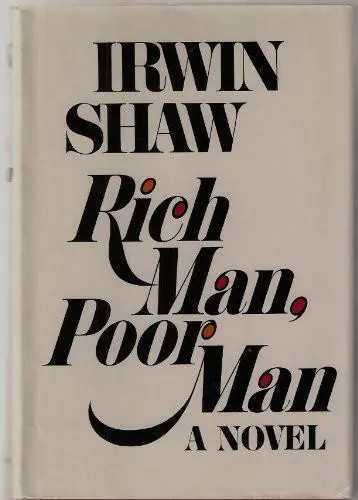
- Название:Rich Man, Poor Man
- Автор:
- Издательство:Delacorte Press, NY
- Жанр:
- Год:1970
- ISBN:9780385288583
- Рейтинг книги:5 / 5. Голосов: 1
-
Избранное:Добавить в избранное
- Отзывы:
-
Ваша оценка:
Rich Man, Poor Man: краткое содержание, описание и аннотация
Предлагаем к чтению аннотацию, описание, краткое содержание или предисловие (зависит от того, что написал сам автор книги «Rich Man, Poor Man»). Если вы не нашли необходимую информацию о книге — напишите в комментариях, мы постараемся отыскать её.
Rich Man, Poor Man — читать онлайн бесплатно полную книгу (весь текст) целиком
Ниже представлен текст книги, разбитый по страницам. Система сохранения места последней прочитанной страницы, позволяет с удобством читать онлайн бесплатно книгу «Rich Man, Poor Man», без необходимости каждый раз заново искать на чём Вы остановились. Поставьте закладку, и сможете в любой момент перейти на страницу, на которой закончили чтение.
Интервал:
Закладка:
‘What about his education?’ Rudolph persisted.
‘There’re schools in Antibes. Better than a crappy military academy.’
‘But he’s an American.’
‘Why?’ Thomas asked.
‘Well, he’s not a Frenchman.’
‘He won’t be a Frenchman either,’ Thomas said. ‘He’ll be Wesley Jordache.’
‘He won’t know where he belongs.’
‘Where do you think I belong? Here?’ Thomas laughed. ‘My son’ll belong on a boat in the Mediterranean, sailing from one country where they make wine and olive oil to another country where they make wine and olive oil.’
Rudolph quit then. They drove the rest of the way in silence to the building on Park Avenue where Rudolph had an apartment. The doorman double-parked the car for him when he said he’d only be a few minutes. The doorman gave a queer look at Thomas, with his collar open and his tie loose and his blue, wide-trousered suit and green fedora hat with the brown band that he had bought in Genoa.
‘Your doorman doesn’t approve of my clothes,’ Thomas said as they went up in the elevator. ‘Tell him I buy my clothes in Marseilles and everybody knows Marseilles is the greatest centre of haute couture for men in Europe.’
‘Don’t worry about the doorman,’ Rudolph said as he led Thomas into the apartment.
‘Not a bad little place you have here,’ Thomas said, standing in the middle of the large livingroom, with its fireplace and long, straw-coloured corduroy couch, with two winged easy chairs on each side of it. There were fresh flowers in vases on the tables, a pale-beige wall-to-wall carpet, and non-objective paintings on the dark green walls. The room faced west and the afternoon sun streamed in through the curtained windows. The air-conditioning was on, humming softly, and the room was comfortably cool.
‘We don’t get down to the city as much as we’d like,’ Rudolph said. ‘Jean’s pregnant again and she’s having a bad couple of months just now.’ He opened a cupboard. ‘Here’s the bar,’ he said. ‘There’s ice in the refrigerator. If you want to eat here,
just tell the maid when she gets in in the morning. She’s a pretty good cook.’ He led Thomas into the spare room, which Jean had made over to look exactly like the guest room in the farmhouse in Whitby, countrified and delicate. Rudolph couldn’t help but notice how out of place his brother looked in the neat, feminine room, with its four-poster twin beds and patchwork quilts.
Thomas threw his battered valise and his jacket and hat on one of the beds and Rudolph tried not to wince. On his boat, Johnny Heath had written, Tom was a stickler for neatness. Obviously, he did not carry his seagoing habits with him when he went ashore.
Back in the livingroom Rudolph poured a whiskey and soda for Thomas and himself and, while they drank, got out the papers he had collected from the Police Department and the report from the private detective and gave them to Thomas. He called the lawyer’s office and made an appointment for Thomas for the next morning at ten.
‘Now,’ he said, as they finished their drinks, ‘is there anything else you need? Do you want me to go with you when you go up to the school?’
‘I’ll handle the school on my own,’ Thomas said. ‘Don’t worry.’ ‘How are you fixed for money?’ T’m rolling,’ Thomas said. ‘Thanks.’ Tf anything comes up,’ Rudolph said, ‘call me.’ ‘Okay, mayor,’ Thomas said.
They shook hands and Rudolph left his brother standing next to the table on which lay the reports from the Police Department and the detective. Thomas was picking them up to read as Rudolph went out the front door.
Teresa Jordache, Thomas read from the police file, alias Theresa Laval. Thomas grinned. He was tempted to call her up and ask her to come over. He’d disguise his voice. ‘Apartment 14B, Miss Laval. It’s on Park Avenue between Fifty-seventh and Fifty-eighth Street.’ Even the most suspicious whore wouldn’t think there’d be any trouble at an address like that. He would love to see her face when she rang the bell and he opened the door. He nearly went to the phone to dial the last number the detective had ferreted out, then stopped. It would be almost impossible not to give her the beating she deserved and that wasn’t what he had come to America for.
He shaved and showered, using the perfumed soap in the bathroom, and had another drink and put on a clean shirt and the blue Marseilles suit, then went down in the elevator and walked over to Fifth Avenue in the dusk. On a side street he saw a steak place and went in and had a steak with half a bottle of wine and apple pie a la mode, to salute his native country. Then he strolled over to Broadway. Broadway was worse than ever, with noise coming out of music shops and bigger and uglier signs than he remembered and the people pushing and sick looking, but he enjoyed it. He could walk anywhere, go to any bar, any movie. Everybody was dead or in jail. Music.
The Hilltop Military Academy was on top of a hill and it was military. A high, grey stone wall enclosed it, like a prison, and when Thomas drove through the front gate in the car he had rented, he could see boys in blue-grey uniforms doing close-order drill on a dusty field. The weather had turned cooler and some of the trees on the ground had began to change colour. The driveway passed close to the parade grounds and Thomas stopped the car and watched. There were four separate groups wheeling and marching on different parts of the field. The group of boys nearest to him, perhaps thirty of them, were between twelve and fourteen, just about Wesley’s age. Thomas stared at them as they passed him, but if Wesley was among them he didn’t recognise him.
He started the car again and went up the driveway to a stone building that looked like a small castle. The grounds were well kept, with flower beds and closely mown lawns, and the other buildings were large and solidly built, of the same stone as the little castle.
Teresa must get a fancy price for her services, Thomas thought, to afford a place like this for the kid.
He got out of the car and went into the building. The granite hallway was dark and chilly It was lined with flags, sabres, crossed rifles, and marble lists of the names of graduates who had been killed in the Spanish-American War, the Mexican Expedition, the First World War, the Second World War, and the war in Korea. It was like the head office of a company, with a display advertising their product. A boy with close-cropped hair and a lot of fancy chevrons on his arm was coming down the steps, and Thomas asked him, ‘Son, where’s the main office here?’
The boy came to attention, as though Thomas were General MacArthur, and said, ‘This way, sir.’ They obviously taught respect for the older generation at Hilltop Military Academy.
Maybe that was why Teresa had sent the kid here. She could use all the respect going.
The boy opened the door to a big office. Two women were working at desks behind a small fence. ‘Here you are, sir,’ the boy said, and clicked his heels before turning smartly back into the hallway. Thomas went over towards the nearest desk behind the fence. The woman there looked up from the papers she was making checks on and said, ‘May I help you, sir?’ She was not in uniform and she didn’t click her heels.
‘I have a son in the school,’ Thomas said. ‘My name is Jordache. I’d like to speak to whoever is in charge here.’
The woman gave him a peculiar look, as though the name meant something not particularly pleasant to her. She stood up and said, ‘I’ll tell Colonel Bainbridge you’re here, sir. Won’t you please take a seat.’ She indicated a bench along the wall and waddled off to a door on the other side of the office. She was fat and about fifty and her stockings were crooked. They were not tempting the young soldiers with too much sex at the Hilltop Military Academy.
Читать дальшеИнтервал:
Закладка:
Похожие книги на «Rich Man, Poor Man»
Представляем Вашему вниманию похожие книги на «Rich Man, Poor Man» списком для выбора. Мы отобрали схожую по названию и смыслу литературу в надежде предоставить читателям больше вариантов отыскать новые, интересные, ещё непрочитанные произведения.









Обсуждение, отзывы о книге «Rich Man, Poor Man» и просто собственные мнения читателей. Оставьте ваши комментарии, напишите, что Вы думаете о произведении, его смысле или главных героях. Укажите что конкретно понравилось, а что нет, и почему Вы так считаете.