Irwin Shaw - Rich Man, Poor Man
Здесь есть возможность читать онлайн «Irwin Shaw - Rich Man, Poor Man» весь текст электронной книги совершенно бесплатно (целиком полную версию без сокращений). В некоторых случаях можно слушать аудио, скачать через торрент в формате fb2 и присутствует краткое содержание. Год выпуска: 1970, ISBN: 1970, Издательство: Delacorte Press, NY, Жанр: Классическая проза, на английском языке. Описание произведения, (предисловие) а так же отзывы посетителей доступны на портале библиотеки ЛибКат.
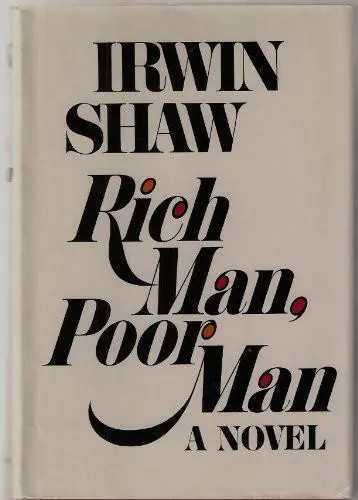
- Название:Rich Man, Poor Man
- Автор:
- Издательство:Delacorte Press, NY
- Жанр:
- Год:1970
- ISBN:9780385288583
- Рейтинг книги:5 / 5. Голосов: 1
-
Избранное:Добавить в избранное
- Отзывы:
-
Ваша оценка:
Rich Man, Poor Man: краткое содержание, описание и аннотация
Предлагаем к чтению аннотацию, описание, краткое содержание или предисловие (зависит от того, что написал сам автор книги «Rich Man, Poor Man»). Если вы не нашли необходимую информацию о книге — напишите в комментариях, мы постараемся отыскать её.
Rich Man, Poor Man — читать онлайн бесплатно полную книгу (весь текст) целиком
Ниже представлен текст книги, разбитый по страницам. Система сохранения места последней прочитанной страницы, позволяет с удобством читать онлайн бесплатно книгу «Rich Man, Poor Man», без необходимости каждый раз заново искать на чём Вы остановились. Поставьте закладку, и сможете в любой момент перейти на страницу, на которой закончили чтение.
Интервал:
Закладка:
ambition to become a director herself that would arouse jealousy, she was in great demand and could pick and choose among the jobs offered her.
The picture she was working on now was being shot in New York and she found the city’s impersonal variety exhilarating after the inbred, ambiguously jovial, big-family atmosphere of Hollywood, where everybody lived in everyone else’s pocket In her free hours she tried to continue with the political activities that had taken up a great deal of her time in Los Angeles since Colin’s death. With her assistant, Ida Cohen, she went to meetings where people made speeches about the war in Viet Nam and school bussing. She signed dozens of petitions and tried to get the important people in the movie business to sign them, too. All this helped her assuage her sense of guilt about having given up her studies in California. Also, Billy was now of a draftable age, and the thought of her one son being killed in Viet Nam was intolerable to her. Ida had no sons but was even more intense about the meetings, demonstrations, and petitions than Gretchen. They both wore Ban the Bomb buttons on their blouses and on their coats.
When she wasn’t going to meetings in the evenings, Gretchen went as often as she could to the theatre, with a renewed appetite for it, after the years of being away. Sometimes she went with Ida, a small dowdy, shrewd woman of about her own age, with whom she had developed a steady friendship, sometimes she went with Evans Kinsella, the director of the picture, with whom she was’ having an affair, sometimes with Rudolph and Jean, when they were in town, or with one or another of the actors she met when she visited the locations on which they were shooting.
The images passed before her on the glass screen and she grimaced. The way Kinsella had done the shooting made it difficult to get the tone that she felt the sequence needed. If she couldn’t somehow correct it by more ingenious cutting, or if Kinsella himself couldn’t come up with some ideas on it, she knew that eventually the whole scene would have to be reshot.
She stopped for a cigarette. The film tins she and Ida used for ash trays were always brimming with butts. Here and there stood empty coffee containers, lipstick stained.
Forty years old, she thought, inhaling.
Nobody today had as yet congratulated her. With good reason. Although she had looked for a telegram, at least, in her box at the hotel, from Billy. There had been no telegram. She hadn’t told Ida, now rewinding long strips of film on spools out
of a big canvas basket. Ida was past forty herself, why drive in another spike? And she certainly hadn’t told Evans. He was thirty-two. A forty-year-old woman did not remind a thirty-two-year-old lover of her birthday.
She thought of her dead mother, forty years ago today. First born, a girl, to a girl scarcely more than twenty herself. If Mary Pease Jordache had known that day what words were going to pass between herself and the new infant in her arms, what tears would she have shed? And Billy… ?
The door opened and Evans Kinsella came in. He was wearing a white, belted raincoat over his corduroy slacks and red polo shirt and cashmere sweater. He made no sartorial concessions to New York. His raincoat was wet. She hadn’t looked out of the window for hours and didn’t know it was raining.
‘Hi, girls,’ Evans said. He was a tall thin man with tousled black hair and a blue-black beard that made him look as if he needed a shave at all times. His enemies said he looked like a wolf. Gretchen varied between thinking he was alertly handsome and Jewishly ugly, although he was not a Jew. Kinsella was his real name. He had been in analysis for three years. He had already made six pictures, three of which had been very successful. He was a lounger. As soon as he entered a room he leaned against something or sat on a desk, or if there were a couch handy lay down and put his feet up. He was wearing suede desert boots.
He kissed Ida on the cheek, then Gretchen. He had made one picture in Paris and had learned to kiss everybody there. The picture had been disastrous. ‘A foul day,’ he said. He swung himself up on one of the high, metal cutting-benches. He made a point of seeming at home wherever he was. ‘We got in two set-ups this morning and then the rains came. Just as well. Hazen was drunk by noon.’ Richard Hazen was the male star of the picture. He was always drunk by noon. ‘How’s it going here?’ Evans asked. ‘We ready to run?’
‘Just about,’ Gretchen said. She was sorry she hadn’t realised how late it was. She would have done something about her hair and put on fresh make-up to be ready for Evans. ‘Ida,’ she said, ‘will you take the last sequence with you and tell Freddy to run it after the rushes?’
They went down the hall to the small projection room at the end of the corridor. Evans pinched her arm secretly. ‘Gretchen,’ he said, ‘beautiful tailor in the vineyards.’
They sat in the darkened projection room and watched the rushes of the day before, the same scene, from different angles,
done over and over again, that would one day, they hoped, be arranged into one harmonious flowing entity and be shown on huge screens in theatres throughout the world. As she watched, Gretchen thought again how Evans’ talent, kinky and oblique, showed in every foot of film he shot. She made mental notes of how she would make the first cut of the material. Richard Hazen had been drunk before noon yesterday, too, she saw. In two years nobody would give him a job.
‘What do you think?’ Evans asked, when the lights went up.
‘You might as well quit every morning by one,’ Gretchen said, ‘if Hazen’s working.’
‘It shows, eh?’ Evans was sitting slouched low in his chair, his legs over the back of the chair in front of him.
‘It shows,’ Gretchen said.
‘I’ll talk to his agent.’
‘Try talking to his bartender,’ Gretchen said.
‘Drink,’ Evans said, ‘Kinsella’s curse. When drunk by others.’
The room went dark again and they watched the sequence Gretchen had been working on all day, Projected that way, it seemed even worse to Gretchen than it had been on the moviola. But when it was over and the lights went up again, Evans said, ‘Fine, I like it.’
Gretchen had known Evans for two years and had already done a picture with him before this one and she had come to recognise that he was too easily pleased with his own work. Somewhere in his analysis he had come to the conclusion that arrogance was good for his ego and it was dangerous to criticise him openly. ‘I’m not so sure,’ Gretchen said. ‘I’d like to fiddle with it some more.’
‘A waste of time,’ Evans said. ‘I tell you it’s okay.’
Unlike most directors he was impatient in the cutting room and careless about details.
‘I don’t know,’ Gretchen said. ‘It seems to me to drag.’
‘That’s just what I want right there,’ Evans said. ‘I want it to drag.’ He argued like a stubborn child.
‘All those people going in and out of doors,’ Gretchen persisted, ‘with those ominous shadows with nothing ominous happening … ‘
‘Stop trying to make me into Colin Burke.’ Evans stood up abruptly. ‘My name is Evans Kinsella, in case it slipped your mind, and Evans Kinsella it will remain. Please remember that.’
‘Oh, stop being an infant,’ Gretchen snapped at him. Sometimes the two functions she served for Evans became confused.
‘Where’s my coat? Where did I leave my goddamn coat?’ he said loudly.-
‘You left it in the cutting room.’
They went back to the cutting room together, Evans allowing her to carry the cans of film they had just run and which she picked up from the projectionist. Evans put on his coat, roughly. Ida was making out the sheet for the film they had handled that day. Evans started out of the door, then stopped and came back to Gretchen. ‘I had intended to ask you to have dinner with me and take in a movie,’ he said. ‘Can you make it?’ He smiled placatingly. He dreaded the thought of being disliked, even for a moment.
Читать дальшеИнтервал:
Закладка:
Похожие книги на «Rich Man, Poor Man»
Представляем Вашему вниманию похожие книги на «Rich Man, Poor Man» списком для выбора. Мы отобрали схожую по названию и смыслу литературу в надежде предоставить читателям больше вариантов отыскать новые, интересные, ещё непрочитанные произведения.




Обсуждение, отзывы о книге «Rich Man, Poor Man» и просто собственные мнения читателей. Оставьте ваши комментарии, напишите, что Вы думаете о произведении, его смысле или главных героях. Укажите что конкретно понравилось, а что нет, и почему Вы так считаете.