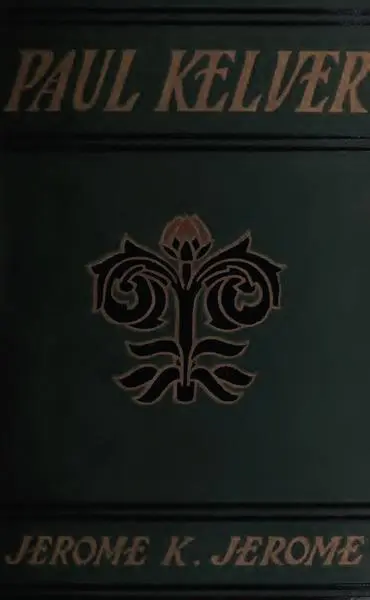
Jerome Jerome - Paul Kelver
Здесь есть возможность читать онлайн «Jerome Jerome - Paul Kelver» весь текст электронной книги совершенно бесплатно (целиком полную версию без сокращений). В некоторых случаях можно слушать аудио, скачать через торрент в формате fb2 и присутствует краткое содержание. Город: New York, Год выпуска: 1902, Издательство: Dodd, Mead & Company, Жанр: Классическая проза, на английском языке. Описание произведения, (предисловие) а так же отзывы посетителей доступны на портале библиотеки ЛибКат.
- Название:Paul Kelver
- Автор:
- Издательство:Dodd, Mead & Company
- Жанр:
- Год:1902
- Город:New York
- ISBN:нет данных
- Рейтинг книги:3 / 5. Голосов: 1
-
Избранное:Добавить в избранное
- Отзывы:
-
Ваша оценка:
Paul Kelver: краткое содержание, описание и аннотация
Предлагаем к чтению аннотацию, описание, краткое содержание или предисловие (зависит от того, что написал сам автор книги «Paul Kelver»). Если вы не нашли необходимую информацию о книге — напишите в комментариях, мы постараемся отыскать её.
Paul Kelver — читать онлайн бесплатно полную книгу (весь текст) целиком
Ниже представлен текст книги, разбитый по страницам. Система сохранения места последней прочитанной страницы, позволяет с удобством читать онлайн бесплатно книгу «Paul Kelver», без необходимости каждый раз заново искать на чём Вы остановились. Поставьте закладку, и сможете в любой момент перейти на страницу, на которой закончили чтение.
Интервал:
Закладка:
“Come up and see me. I am a prisoner in this damned hole till the weather breaks. Hal.”
I hardly recognised him at first. Only the poor ghost he seemed of the Hal I had known as a boy. His long privations endured during the Paris siege, added to the superhuman work he had there put upon himself, had commenced the ruin of even his magnificent physique—a ruin the wild, loose life he was now leading was soon to complete. It was a gloomy, vaulted room that once had been a chapel, lighted dimly by a cheap, evil-smelling lamp, heated to suffocation by one of those great green-tiled German ovens now only to be met with in rare out-of-the-way world corners. He was sitting propped up by pillows on the bed, placed close to one of the high windows, his deep eyes flaring like two gleaming caverns out of his drawn, haggard face.
“I saw you from the window,” he explained. “It is the only excitement I get, twice a day when the sledges come in. I broke down coming across the Pass a fortnight ago, on my way from Davos. We were stuck in a drift for eighteen hours; it nearly finished my last lung. And I haven't even a book to read. By God! lad, I was glad to see your frosted face ten minutes ago in the light of the lantern.”
He grasped me with his long bony hand. “Sit down, and let me hear my voice using again its mother tongue—you were always a good listener—for the last eight years I have hardly spoken it. Can you stand the room? The windows ought to be open, but what does it matter? I may as well get accustomed to the heat before I die.”
I drew my chair close to the bed, and for awhile, between his fits of coughing, we talked of things that were outside our thoughts, or, rather, Hal talked, continuously, boisterously, meeting my remonstrances with shouts of laughter, ending in wild struggles for breath, so that I deemed it better to let him work his mad mood out.
Then suddenly: “What is she doing?” he asked. “Do you ever see her?”
“She is playing in—” I mentioned the name of a comic opera then running in Paris. “No; I have not seen her for some time.”
He laid his white, wasted hand on mine. “What a pity you and I could not have rolled ourselves into one, Paul—you, the saint, and I, the satyr. Together we should have made her perfect lover.”
There came back to me the memory of those long nights when I had lain awake listening to the angry voices of my father and mother soaking through the flimsy wall. It seemed my fate to stand thus helpless between those I loved, watching them hurting one another against their will.
“Tell me,” I asked—“I loved her, knowing her: I was not blind. Whose fault was it? Yours or hers?”
He laughed. “Whose fault, Paul? God made us.”
Thinking of her fair, sweet face, I hated him for his mocking laugh. But the next moment, looking into his deep eyes, seeing the pain that dwelt there, my pity was for him. A smile came to his ugly mouth.
“You have been on the stage, Paul; you must have heard the saying often: 'Ah, well, the curtain must come down, however badly things are going.' It is only a play, Paul. We do not choose our parts. I did not even know I was the villain, till I heard the booing of the gallery. I even thought I was the hero, full of noble sentiment, sacrificing myself for the happiness of the heroine. She would have married me in the beginning had I plagued her sufficiently.”
I made to speak, but he interrupted me, continuing: “Ah, yes, it might have been better. That is easy to say, not knowing. So, too, it might have been worse—in all probability much the same. All roads lead to the end. You know I was always a fatalist, Paul. We tried both ways. She loved me well enough, but she loved the world also. I thought she loved it better, so I kissed her on her brow, mumbled a prayer for her happiness and made my exit to a choking sob. So ended the first act. Wasn't I the hero throughout that, Paul? I thought so; slapped myself upon the back, told myself what a fine fellow I had been. Then—you know what followed. She was finer clay than she had fancied. Love is woman's kingdom, not the world. Even then I thought more of her than of myself. I could have borne my share of the burden had I not seen her fainting under hers, shamed, degraded. So we dared to think for ourselves, injuring nobody but ourselves, played the man and woman, lost the world for love. Wasn't it brave, Paul? Were we not hero and heroine? They had printed the playbill wrong, Paul, that was all. I was really the hero, but the printing devil had made a slip, so instead of applauding you booed. How could you know, any of you? It was not your fault.”
“But that was not the end,” I reminded him. “If the curtain had fallen then, I could have forgiven you.”
He grinned. “That fatal last act. Even yours don't always come right, so the critics tell me.”
The grin faded from his face. “We may never see each other again, Paul,” he went on; “don't think too badly of me. I found I had made a second mistake—or thought I had. She was no happier with me after a time than she had been with him. If all our longings were one, life would be easy; but they are not. What is to be done but toss for it? And if it come down head we wish it had been tail, and if tail we think of what we have lost through its not coming down head. Love is no more the whole of a woman's life than it is of a man's. He did not apply for a divorce: that was smart of him. We were shunned, ignored. To some women it might not have mattered; but she had been used to being sought, courted, feted. She made no complaint—did worse: made desperate effort to appear cheerful, to pretend that our humdrum life was not boring her to death. I watched her growing more listless, more depressed; grew angry with her, angrier with myself. There was no bond between us except our passion; that was real enough—'grand,' I believe, is the approved literary adjective. It is good enough for what nature intended it, a summer season in a cave. It makes but a poor marriage settlement in these more complicated days. We fell to mutual recriminations, vulgar scenes. Ah, most of us look better at a little distance from one another. The sordid, contemptible side of life became important to us. I was never rich; by contrast with all that she had known, miserably poor. The mere sight of the food our twelve-pound-a-year cook put upon the table would take away her appetite. Love does not change the palate, give you a taste for cheap claret when you have been accustomed to dry champagne. We have bodies to think of as well as souls; we are apt to forget that in moments of excitement.”
“She fell ill, and it seemed to me that I had dragged her from the soil where she had grown only to watch her die. And then he came, precisely at the right moment. I cannot help admiring him. Most men take their revenge clumsily, hurting themselves; he was so neat, had been so patient. I am not even ashamed of having fallen into his trap; it was admirably baited. Maybe I had despised him for having seemed to submit meekly to the blow. What cared he for me and my opinion? It was she was all he cared for. He knew her better than I, knew that sooner or later she would tire, not of love but of the cottage; look back with longing eyes towards all that she had lost. Fool! Cuckold! What was it to him that the world would laugh at him, despise him? Love such as his made fools of men. Would I not give her back to him?”
“By God! It was fine acting; half into the night we talked, I leaving him every now and again to creep to the top of the stairs and listen to her breathing. He asked me my advice, I being the hard-headed partner of cool judgment. What would be the best way of approaching her after I was gone? Where should he take her? How should they live till the nine days' talk had died away? And I sat opposite to him—how he must have longed to laugh in my silly face—advising him! We could not quite agree as to details of a possible yachting cruise, and I remember hunting up an atlas, and we pored over it, our heads close together. By God! I envy him that night!”
Читать дальшеИнтервал:
Закладка:
Похожие книги на «Paul Kelver»
Представляем Вашему вниманию похожие книги на «Paul Kelver» списком для выбора. Мы отобрали схожую по названию и смыслу литературу в надежде предоставить читателям больше вариантов отыскать новые, интересные, ещё непрочитанные произведения.




Обсуждение, отзывы о книге «Paul Kelver» и просто собственные мнения читателей. Оставьте ваши комментарии, напишите, что Вы думаете о произведении, его смысле или главных героях. Укажите что конкретно понравилось, а что нет, и почему Вы так считаете.