Gabriel Chevallier - Fear
Здесь есть возможность читать онлайн «Gabriel Chevallier - Fear» весь текст электронной книги совершенно бесплатно (целиком полную версию без сокращений). В некоторых случаях можно слушать аудио, скачать через торрент в формате fb2 и присутствует краткое содержание. Город: New York, Год выпуска: 2014, Издательство: New York Review Books, Жанр: Классическая проза, на английском языке. Описание произведения, (предисловие) а так же отзывы посетителей доступны на портале библиотеки ЛибКат.
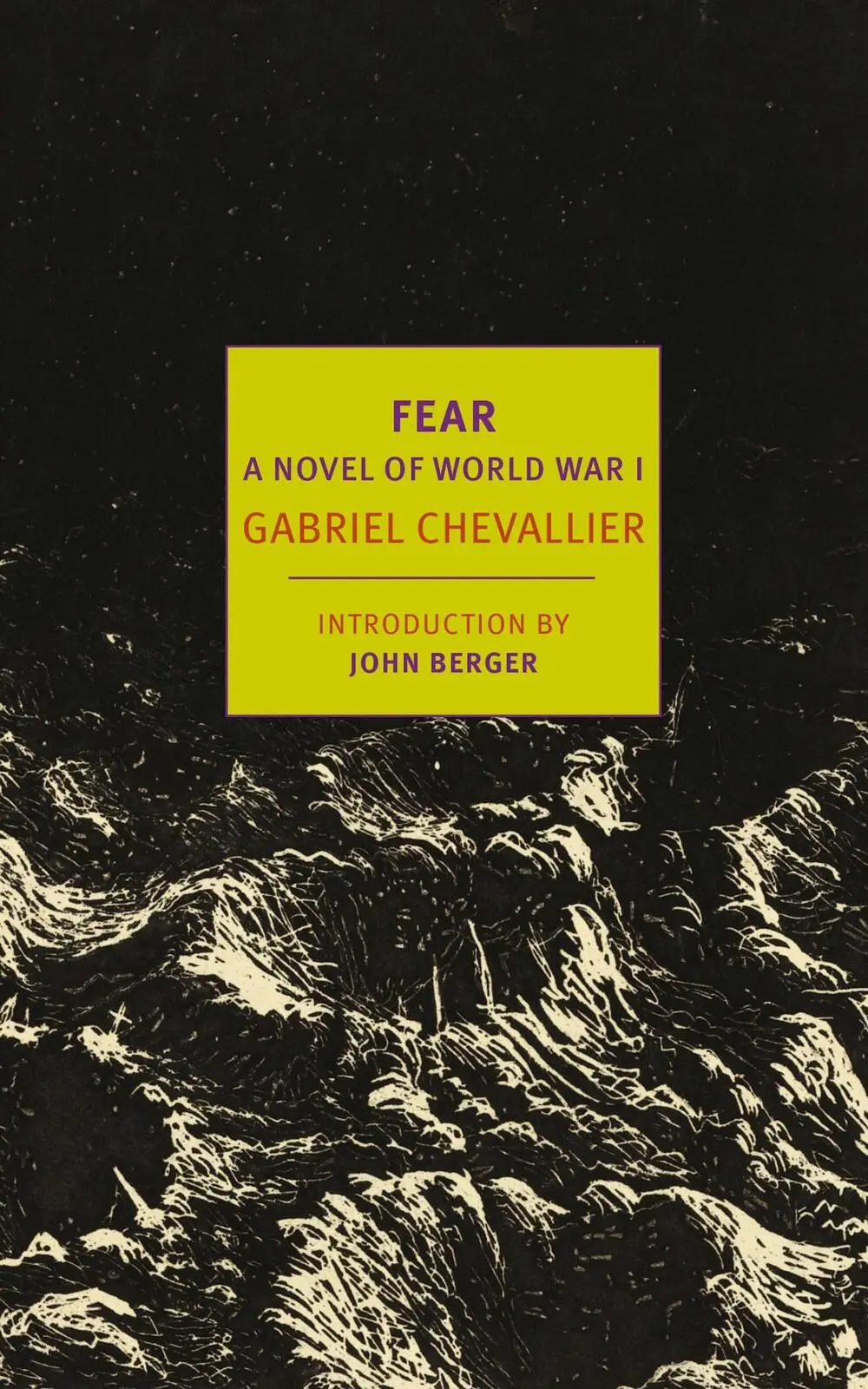
- Название:Fear
- Автор:
- Издательство:New York Review Books
- Жанр:
- Год:2014
- Город:New York
- ISBN:нет данных
- Рейтинг книги:3 / 5. Голосов: 1
-
Избранное:Добавить в избранное
- Отзывы:
-
Ваша оценка:
Fear: краткое содержание, описание и аннотация
Предлагаем к чтению аннотацию, описание, краткое содержание или предисловие (зависит от того, что написал сам автор книги «Fear»). Если вы не нашли необходимую информацию о книге — напишите в комментариях, мы постараемся отыскать её.
1915: Jean Dartemont heads off to the Great War, an eager conscript. The only thing he fears is missing the action. Soon, however, the vaunted “war to end all wars” seems like a war that will never end: whether mired in the trenches or going over the top, Jean finds himself caught in the midst of an unimaginable, unceasing slaughter. After he is wounded, he returns from the front to discover a world where no one knows or wants to know any of this. Both the public and the authorities go on talking about heroes — and sending more men to their graves. But Jean refuses to keep silent. He will speak the forbidden word. He will tell them about fear.
John Berger has called
“a book of the utmost urgency and relevance.” A literary masterpiece, it is also an essential and unforgettable reckoning with the terrible war that gave birth to a century of war.
Fear — читать онлайн бесплатно полную книгу (весь текст) целиком
Ниже представлен текст книги, разбитый по страницам. Система сохранения места последней прочитанной страницы, позволяет с удобством читать онлайн бесплатно книгу «Fear», без необходимости каждый раз заново искать на чём Вы остановились. Поставьте закладку, и сможете в любой момент перейти на страницу, на которой закончили чтение.
Интервал:
Закладка:
After coffee, the cars take us to the nearby aerodrome. A Bessonneau hangar has been transformed into a theatre. A stage has been built, benches set out, and acting roles given to young aviators, of whom the bourgeoisie of this place have provided rather a lot. Soldiers from the camp, wounded from the hospital, and local people are all there. The general, surrounded by various dignitaries, sits in the front row in an armchair. The curtain rises. As was to be expected, the revue celebrates the virtues of the race and the valour of our fighters. One after another, an infantryman, artilleryman, horseman, machine-gunner, grenadier, etc., come on to the stage and recite Cornelian couplets with very warlike vehemence. At the end of each tableau, a luminous France, draped in tricolour sheets, clasps them all to her bosom. The general’s sublime alexandrines, in which ‘trench’ rhymes with ‘French’ and ‘savagery’ with ‘Germany’ are greatly relished by the civilians, who stamp their feet with restrained enthusiasm. It is a real shame to let such energy go to waste; they should be given weapons immediately and taken to Champagne…
The general receives many congratulations, which he accepts with the modesty of genius. My obscurity luckily prohibits me from offering my own: a common soldier cannot have an opinion on something that emanates from a great leader. At last he is accompanied to his staff car. He carefully settles himself down on his cushions and makes his departure, distributing little limp waves as he goes, like a bishop giving blessings.
The lady of the house then discovers that the envelope he has given her for her hospital contains a derisory sum, the kind of tip one might give a maid. Some observe that his behaviour at dinner was not of the best, and I foresee the moment when he will be denounced as a miserable skinflint… But the appearance of Frédéric tempers any criticism: the child has not yet been placed! Until further notice it is advisable to find the general charming, refined, spiritual…
I realise how useful it is for a young man in troubled times to have a rich father and energetic mother… I tell myself, too, that generals are less fearsome when they put their names to verse rather than battle orders. At least the one who has just left only murders language.
When I return to my sector, all is in order again. People tell me what had happened.
On the evening of 13 July, a surprise attack near the village of Tahure gained us some German prisoners in assault kit. From them we learned that the German attack, postponed by our poison-gas shells, was fixed for the following morning. Orders were immediately given, runners set off in all directions. At eleven in the evening, Gouraud’s forces were put on full alert, the infantry took up combat positions and the artillerymen stood by their guns. On all sides hundreds of thousands of men were anxiously awaiting the moment when the silence would be shattered.
At midnight, a great blaze of light filled the horizon. The German artillery was starting its bombardment. But even before its first salvo had hit the ground, the sky turned crimson on the French side. Our own artillery was beginning its job, with greater fire-power. And we were striking our blows on massed troops, while the enemy’s shells were hammering down on empty positions. We were the ones causing destruction, not only of troop units and dugouts, but of the morale of men who would very soon have to go through this storm.
They attacked at dawn, as predicted. Our artillery reduced its range from our abandoned trenches to a point ahead of our line of defence. Batteries of 75s specially adapted for barrage fire went into action. Successive waves of German forces, sticking to their timetables, piled up at the same place and were flattened without being able to cross the fire zone. From its new positions, our infantry machine-gunned them at good range. The attackers’ situation became untenable, they had to fall back and more were killed by the mustard gas we had put in the trenches when we left them. During the day of 14 July the great German push (the push ‘for peace’) was broken, having failed to make any serious breaches in our positions. Over the next days our troops reoccupied their former emplacements without encountering much resistance. As the men sum it up:
‘The Boche came a cropper!’
Few traces can be seen of the hard battle that has just taken place. The trenches have already been repaired and the fresh shell-holes merge with old ones on this lifeless ground which has been pulverised so many times. Once again, the defenders have won.
In our own group there was only one victim: Frondet, who died of shock. During the bombardment, a 210 shell had pierced through the logs covering the shelter where the battalion runners were based and rolled on to the middle of the floor, without hitting anyone or exploding. But there were three terrifying seconds, in the sudden presence of this monstrosity that might go off and pulverize the petrified men. Frondet’s heart gave up.
‘He just stayed there like that…’
‘His mouth gaping, his eyes wide open, like the face of some bloke in a film calling for help.’
‘We thought he was kidding at first…’
Poor Frondet! Yes, I can well imagine the expression on his face — the expression they have all had, without ever knowing it…
‘You know, when you have a great shock…’
‘After that blow, we just stood there for a good quarter of an hour unable to say a word.’
‘We had the feeling that if we spoke we’d set the thing off.’
‘Did the battalion catch it badly?’
‘The 11th got it worst. Three platoon leaders and forty men cut down.’
‘And the 9th?’
‘Not much. They were lucky.’
We are not being relieved. Reserves must be getting rarer. We go back to our usual tasks.
One morning I am making my rounds of the sector. Down in the ravine I bump into my company commandant, Lieutenant Larcher. Proud of his own courage, of his influence over the men whose dangers he shares, he is rather scornful of the battalion’s ‘dug-ins’ — like me — and he shows it. Although I am often there and he knows it, he pretends to be surprised:
‘What are you doing here?’
‘Checking the maps, and inspecting a bit of the sector.’
‘I’ll show you round.’
He takes me with him. Fifty metres on, we find a machine-gun emplacement. The lieutenant climbs up on the fire-step and I climb up beside him. Our chests are fully exposed above the trench. We are surrounded and overlooked by enemy lines. I know this spot and I have climbed up here on my own already, but very briefly. Today it is up to the lieutenant to decide how long we will stand here. He points out a bank of yellow clay some three of four hundred metres away.
‘The Boche are there, and there, and there…’
He smugly goes through all the enemy positions, in detail… I see: this is a game of pride! Here we both are, with no witnesses, very calm, risking our lives. I ask a few questions coldly and he gives me the answers. Neither the questions nor the answers are of any interest. He is thinking: ‘So, you dabble in inspecting the lines, like an amateur. I’ll soon put you off that!’ And I am thinking: ‘I am just as capable of taking risks as some little lieutenant, however brave he’s supposed to be…’ But the Boche have a lot of patience this morning!
Rat-tat-tat-tat, ss-ss-ss-ss. Bullets whistle around us. The lieutenant has jumped down into the trench and he pulls at my sleeve.
‘You’ll get yourself killed!’
I calmly descend. I am surprised, not by the bullets — which were to be expected — but because he gave way so fast. He stares at me. We are both thinking the same thing: ‘Well, well…’ I am sure I have not gone pale. Abruptly, he shakes my hand.
Читать дальшеИнтервал:
Закладка:
Похожие книги на «Fear»
Представляем Вашему вниманию похожие книги на «Fear» списком для выбора. Мы отобрали схожую по названию и смыслу литературу в надежде предоставить читателям больше вариантов отыскать новые, интересные, ещё непрочитанные произведения.









Обсуждение, отзывы о книге «Fear» и просто собственные мнения читателей. Оставьте ваши комментарии, напишите, что Вы думаете о произведении, его смысле или главных героях. Укажите что конкретно понравилось, а что нет, и почему Вы так считаете.