Gabriel Chevallier - Fear
Здесь есть возможность читать онлайн «Gabriel Chevallier - Fear» весь текст электронной книги совершенно бесплатно (целиком полную версию без сокращений). В некоторых случаях можно слушать аудио, скачать через торрент в формате fb2 и присутствует краткое содержание. Город: New York, Год выпуска: 2014, Издательство: New York Review Books, Жанр: Классическая проза, на английском языке. Описание произведения, (предисловие) а так же отзывы посетителей доступны на портале библиотеки ЛибКат.
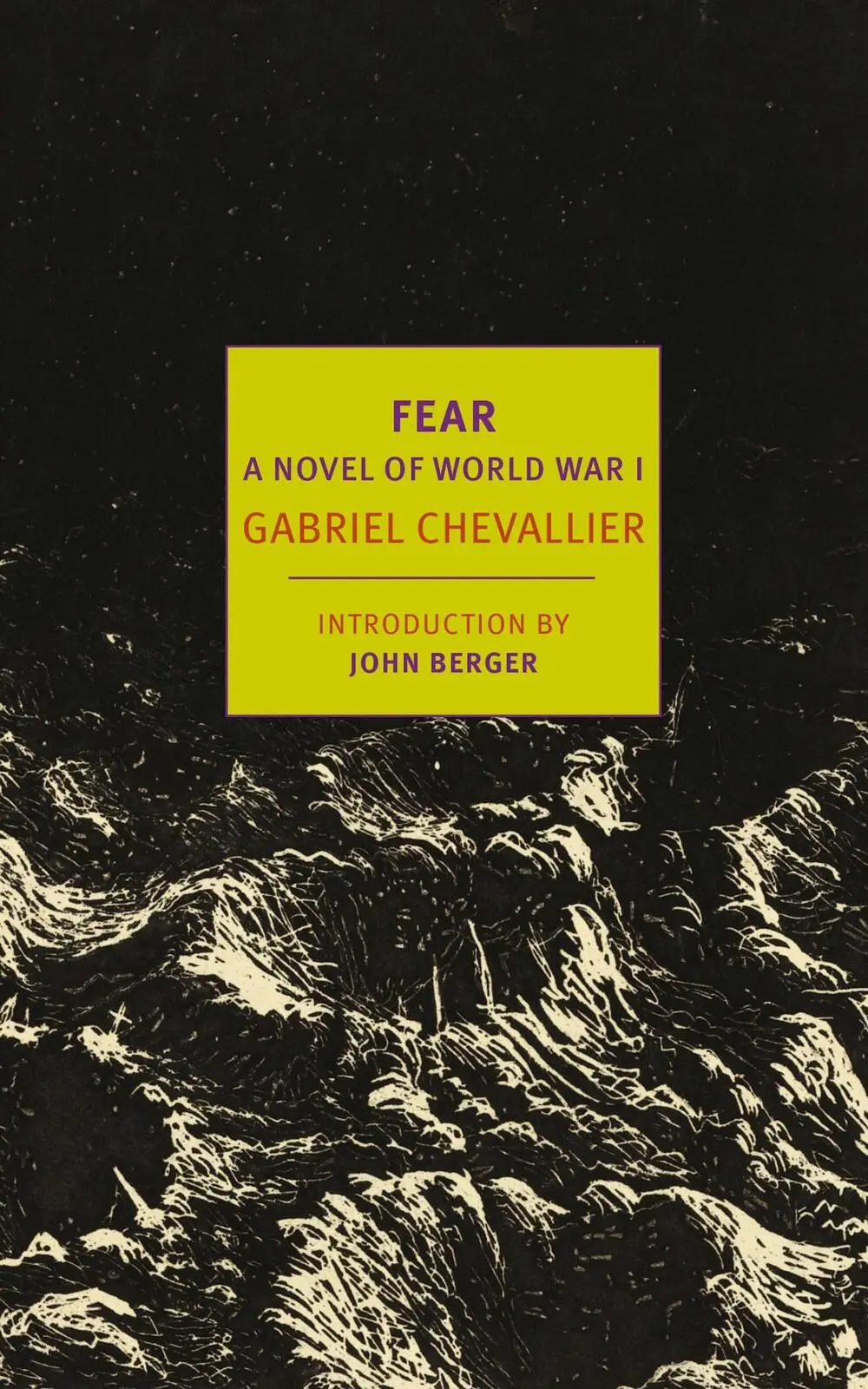
- Название:Fear
- Автор:
- Издательство:New York Review Books
- Жанр:
- Год:2014
- Город:New York
- ISBN:нет данных
- Рейтинг книги:3 / 5. Голосов: 1
-
Избранное:Добавить в избранное
- Отзывы:
-
Ваша оценка:
Fear: краткое содержание, описание и аннотация
Предлагаем к чтению аннотацию, описание, краткое содержание или предисловие (зависит от того, что написал сам автор книги «Fear»). Если вы не нашли необходимую информацию о книге — напишите в комментариях, мы постараемся отыскать её.
1915: Jean Dartemont heads off to the Great War, an eager conscript. The only thing he fears is missing the action. Soon, however, the vaunted “war to end all wars” seems like a war that will never end: whether mired in the trenches or going over the top, Jean finds himself caught in the midst of an unimaginable, unceasing slaughter. After he is wounded, he returns from the front to discover a world where no one knows or wants to know any of this. Both the public and the authorities go on talking about heroes — and sending more men to their graves. But Jean refuses to keep silent. He will speak the forbidden word. He will tell them about fear.
John Berger has called
“a book of the utmost urgency and relevance.” A literary masterpiece, it is also an essential and unforgettable reckoning with the terrible war that gave birth to a century of war.
Fear — читать онлайн бесплатно полную книгу (весь текст) целиком
Ниже представлен текст книги, разбитый по страницам. Система сохранения места последней прочитанной страницы, позволяет с удобством читать онлайн бесплатно книгу «Fear», без необходимости каждый раз заново искать на чём Вы остановились. Поставьте закладку, и сможете в любой момент перейти на страницу, на которой закончили чтение.
Интервал:
Закладка:
I tell myself that there is a certain grandeur to this spectacle. It is quite moving to watch these pathetically small, fragile groups of men, little blue caterpillars, so far apart, marching to meet the thunder, disappearing into the gullies and ditches and re-emerging on the slopes of this valley of hell. It is moving to watch these pygmies controlling the advance of the cataclysm, commanding the elements, wrapping themselves in a sky of fire that clears and ploughs all that is ahead of them.
All grandeur and beauty suddenly vanishes. We are passing scattered, broken corpses, men in blue lying flat in the nothingness on a litter of blood and entrails. One of the wounded is writhing, grimacing and screaming, his arm torn off, torso ripped open. We all know him. He was the batman for the intelligence officer, a giant of a man who was even more ‘dug-in’ than us… We turn our eyes away so as not to see the reproach in his, we hurry on so as not to hear his imploring cries.
This is where we really enter the battle — our flesh on full alert…
It’s nine o’clock. The sun is shining.
After many pauses, we have reached the rim of a valley whose floor is still hidden by a light mist. Above this mist on the other side emerge the slopes held by the enemy, with their menacing trenches. We have advanced for two or three kilometres over abandoned positions. The enemy had pulled back, covering its retreat with just a few sacrificed troops who surrendered without putting up any fight. We passed a detachment of prisoners dazed by the night’s hammering.
Soon the black American regiment appeared; they were following us. They formed a line along the ridge, their mass silhouetted against the sky. Thousands of bayonets glistened at the ends of their rifles. They were laughing. Many of them had already swopped their weapons and gas masks for German equipment.
‘It’s stupid to stay up there in full view!’ some observe wisely.
But no one is listening to them. We are a bit intoxicated by our victory. Our losses were very low. We fraternise with the Americans.
We waste a good hour like this. Flights of enemy aeroplanes appear overhead. Fighters circle gracefully, gathering information on our positions, which does not bother us.
At last the Americans march off along a communication trench which leads down into the valley. We wave to them cheerfully as they disappear, full of confidence.
We have another long wait. The mist has cleared, our bombardment ceased. For the first time today we hear machine guns…
Now it is our turn. The battalion goes off along the wide communication trench, which is open to enfilade fire from the ridges opposite along its entire length. One man in front of me separates me from the commandant, himself preceded by the captain adjutant-major.
The enemy can see us. 77s and 88s start to strike the parapets with terrible precision and regularity. Machine guns support them. A swarm of bullets is buzzing round our ears, tormenting us… Then there is some kind of bottleneck ahead. The front of the column stops moving. We stay there, crouched down and panting, offering ourselves as targets all the way down this slope. The shells are getting ever closer. Our situation is hopeless if we continue to go down the trench. We will leave hundreds of dead men behind us.
There is a terrible explosion right next to us. People are shouting:
‘Get in the shelter, quick!’
Our commandant, his face ashen, turns back, pushes past us and throws himself down the steps of a German deep shelter a few metres way. I can understand his panic. The shell went straight into the captain adjutant-major, blew up in his chest and scattered him in pieces, but, miraculously, did not claim any other victims. By terrifying the commandant, this death saved all of us.
We crowd through the shelter’s two entrances. Just as I am going in I recognise Sergeant Brelan, a teacher, with whom I have had some friendly chats in the past. I draw back:
‘After you, sergeant!’
This gesture takes two seconds, time enough for a few shells or ten bullets to find me… Refinement, a wish to impress? I do not think so. It was more a matter of concern for my morale, a way of warding off panic. More than anything I am afraid of fear itself overwhelming me. One must use any bit of folly to control it.
For the next two hours, heavy shells hunt us in our underground shelter, where we spend the rest of the day.
We take advantage of the clear night to continue our journey down the valley, whose floor is covered with a bog about two hundred metres long. We cross this by a narrow footbridge which the Germans had left intact to give themselves a way of escape. A few big time-shells go off just above us.
Our successive waves of troops from this morning now form a single line at the foot of a four-metre bank, the limit of our advance. Above the bank there is another stretch of flat ground, swept by German machine-gun fire since nightfall. The Americans were stopped here with heavy losses. Corpses rolled down the slope where in the darkness they got mixed in with the sleeping bodies of the living. We attack at first light.
Our preparation starts a little before dawn. Our shells are coming down just in front of us. But they fail to demolish the bunkers from which the machine guns are firing with fury.
Then a battery of 75s fires short. We can clearly hear the four bangs when the shells depart and they are above us with terrifying speed, exploding only a few metres ahead. The bog prevents any retreat. It feels as if death will strike us from behind, and we have a quarter-hour of total panic under these fratricidal blows. We fire off all our red warning rockets to tell them to increase the range. The fire then stops but by then we are too demoralised to attack. And in any case the machine guns are still sweeping the open ground.
Day has dawned. Heavy shells are seeking out the footbridge to cut off our communications. They throw up showers of mud.
In the afternoon the machine guns go silent. We move forward without any opposition. At the entrance to a sap lies a German corpse, a hole in his temple: one of those who held us up.
We advance very slowly for some days, with lengthy delays caused by invisible machine guns. The land we conquer is covered with our corpses. The Americans, who do not understand how to use cover or shelters, have been badly hit. We have seen them changing positions following the whistle, as artillery fire is striking the middle of their sections, throwing men into the air. They launched a bayonet attack on the village of Sochaux across open ground. And left behind hundreds of dead.
Overall, the artillery fire is not doing us a lot of damage and the Germans only have a few guns to use against us. But it is true that they use them well, holding their fire till they have spotted troops massing. Mostly, though, they are covering their retreat with machine-gunners who must have orders to hold us down for a certain time. Over broken, bare ground, well concealed machine guns have an extraordinary effectiveness that tests us cruelly. Some resolute platoons stop whole battalions. We do not see any of the enemy. Some surrender at the last minute, others escape into the night, their mission accomplished. All this confirms once again that the attacker, obliged to use dense troop formations, has the more dangerous role. If we had chosen a defensive strategy in 1914, we would have avoided Charleroi and done considerable damage to the German forces.
After several trying days in the rain and cold, we have now assembled on the highest summit of the Champagne mountains, looking down over the vast plain where the Ardennes begin.
It is afternoon, and the sun is shining. Two or three German batteries are harassing us, but fortunately their shells are landing behind a little trench that shields us from the shrapnel.
Читать дальшеИнтервал:
Закладка:
Похожие книги на «Fear»
Представляем Вашему вниманию похожие книги на «Fear» списком для выбора. Мы отобрали схожую по названию и смыслу литературу в надежде предоставить читателям больше вариантов отыскать новые, интересные, ещё непрочитанные произведения.







Обсуждение, отзывы о книге «Fear» и просто собственные мнения читателей. Оставьте ваши комментарии, напишите, что Вы думаете о произведении, его смысле или главных героях. Укажите что конкретно понравилось, а что нет, и почему Вы так считаете.