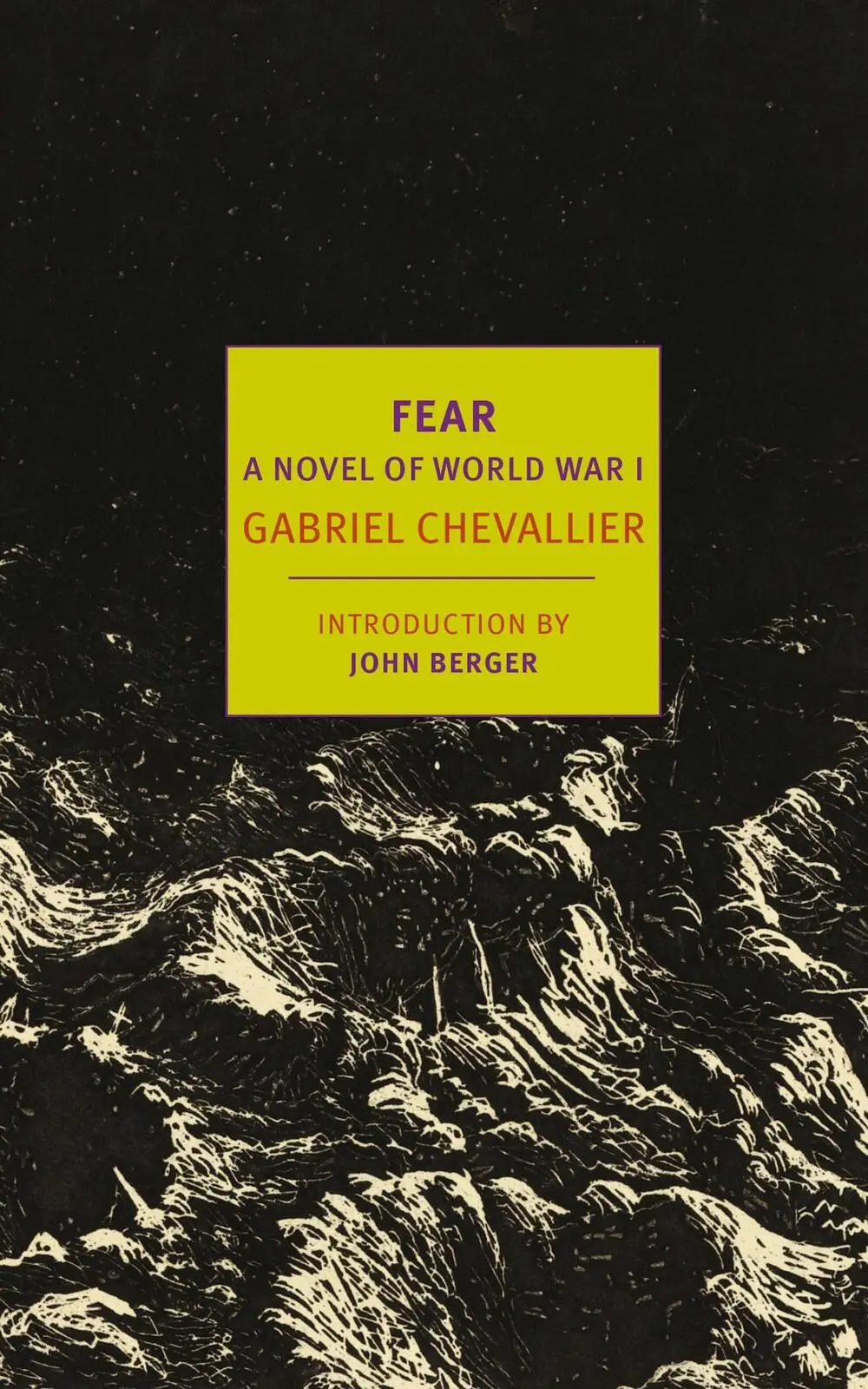
Gabriel Chevallier - Fear
Здесь есть возможность читать онлайн «Gabriel Chevallier - Fear» весь текст электронной книги совершенно бесплатно (целиком полную версию без сокращений). В некоторых случаях можно слушать аудио, скачать через торрент в формате fb2 и присутствует краткое содержание. Город: New York, Год выпуска: 2014, Издательство: New York Review Books, Жанр: Классическая проза, на английском языке. Описание произведения, (предисловие) а так же отзывы посетителей доступны на портале библиотеки ЛибКат.
- Название:Fear
- Автор:
- Издательство:New York Review Books
- Жанр:
- Год:2014
- Город:New York
- ISBN:нет данных
- Рейтинг книги:3 / 5. Голосов: 1
-
Избранное:Добавить в избранное
- Отзывы:
-
Ваша оценка:
Fear: краткое содержание, описание и аннотация
Предлагаем к чтению аннотацию, описание, краткое содержание или предисловие (зависит от того, что написал сам автор книги «Fear»). Если вы не нашли необходимую информацию о книге — напишите в комментариях, мы постараемся отыскать её.
1915: Jean Dartemont heads off to the Great War, an eager conscript. The only thing he fears is missing the action. Soon, however, the vaunted “war to end all wars” seems like a war that will never end: whether mired in the trenches or going over the top, Jean finds himself caught in the midst of an unimaginable, unceasing slaughter. After he is wounded, he returns from the front to discover a world where no one knows or wants to know any of this. Both the public and the authorities go on talking about heroes — and sending more men to their graves. But Jean refuses to keep silent. He will speak the forbidden word. He will tell them about fear.
John Berger has called
“a book of the utmost urgency and relevance.” A literary masterpiece, it is also an essential and unforgettable reckoning with the terrible war that gave birth to a century of war.
Fear — читать онлайн бесплатно полную книгу (весь текст) целиком
Ниже представлен текст книги, разбитый по страницам. Система сохранения места последней прочитанной страницы, позволяет с удобством читать онлайн бесплатно книгу «Fear», без необходимости каждый раз заново искать на чём Вы остановились. Поставьте закладку, и сможете в любой момент перейти на страницу, на которой закончили чтение.
Интервал:
Закладка:
4 The buildings of Les Invalides in Paris include a retirement home for war veterans.
5 François Achille Bazaine was commander-in-chief of the French army during the Franco-Prussian War. He surrendered the city of Metz and a force of 180,000 men to the Prussians in October 1870.
6 Pseudonym of Emmanuel Poiré, a popular political cartoonist.
7 Charles Martel, ‘Charles the Hammer’ (688–741 AD), Charlemagne’s grandfather, most famous for leading the victory of Christian Frankish and Burgundian armies against the Muslim forces of the Umayyad Caliphate at the battle of Poitiers (or Tours) in 732.
8 Louis IX.
9 In fact he is supposed to have said ‘Paris is well worth a Mass’.
10 Differences between French and British army ranks can be confusing. Here, it is worth noting that an adjutant ( adjudant ) is a sub-officer, immediately above a sergeant, and has some of the same duties as a lieutenant (same spelling and similar role to the British one). A commandant is an officer one rank above captain, thus almost but not quite the equivalent of a British major. A French major , however, is a staff warrant officer, above an adjutant and below a lieutenant. And to make matters more complicated still, at least for luckless translators, a major was also the term used for an army doctor, at least until the late 1920s.
11 In fact Cicero wrote ‘Quousque tandem abutere, Catilina, patientia nostra?’, ‘How long will you abuse our patience, Catiline?’
12 He is referring to an infamous quote from General Joffre, who, when asked in October 1918 by leading politicians what his strategy was, replied ‘I’ll just keep nibbling at them for the time being.’
13 The German offensive that began the war had initially been very successful and by September Paris was in danger. During the Battle of the Marne between 5 and 12 September, a French counter-offensive drove the Germans back to lines where the armies remained for much of the rest of the war. On 7 September the French 6th Army was helped by the dispatch to the front of 10,000 reserves from Paris, of whom some 6,000 came in Paris taxi cabs sent by General Gallieri, the city’s military governor. The taxis — whose drivers apparently received 27 % of the actual fare for the journey — became a symbol of national unity, though in fact their military role was relatively insignificant.
14 Bat d’Af was the usual name for the Bataillons d’infanterie légère d’Afrique, also known as ‘Joyeux’, who mainly served in the French colonies of north Africa. Many of the men in the Bat d’Af had previously served relatively short prison terms, usually for crimes of violence or immorality. Discipline in the Bat d’Af was especially tough.
15 Author’s note: This is the effect of foreshortening. A pilot flying over the battlefield would obviously not have seen a blue plain but a plain dotted with blue. In the same way, the earlier expression ‘kingdom of the dead’ may seem excessive to those who judge coldly at a distance. What must be understood is the state of mind of a young man who, after a night of danger and exhaustion, suddenly finds himself facing hundreds of corpses — thousands, even, if you take account of those too far away for him to see. This young man is there as a participant… A man who watches a bombardment from a distance might find the sight curious, even amusing. But take him a kilometre closer, where he can look down on what is happening, and his judgement will be strangely different. One should thus not be surprised if emotions bring a few distortions, but remind oneself that no exaggeration, no invention, could ever surpass the horror of the reality.
16 This is a precise description (author’s note).
17 These were used as revetments to retain the soil at the sides of trenches.
18 The 75mm field gun was the main artillery piece used by the French, effective in open country but not much good against trenches.
19 A devout Catholic organisation for young women.
20 The battle of Charleroi in August 1914 ended with the first major German victory of the war and the flight of thousands of civilians. The French Fifth Army, commanded by General Lanrezac, was eventually forced to retreat. Though Lanrezac took much blame for this (Joffre claimed he lacked ‘offensive spirit’), the retreat probably saved the French Army from complete destruction.
21 Rosalie was French army slang for the bayonet. The name comes from a popular (at least among patriotic civilians) song by the Breton poet and singer Théodore Botrel. ‘Rosalie is so pretty that she had two or three million admirers… Rosalie loves to dance to the sound of the cannon… she is white when the dance begins but crimson when it ends…’ etc. Having been turned down for military service because of his age, this Catholic and Royalist became the official ‘Bard of the Armies’ and toured the front entertaining the troops.
22 Poculotte is using part of a well-known declaration by General (and Comte de) Rochambeau, which he made in 1781 when he brought French troops to aid Washington in the American War of Independence.
23 Blessed are the poor in spirit.
24 A spur in the Vosges mountains, also known as Hartmannswillerkopf, the scene of very fierce and bloody fighting at several times in 1915.
25 The French term is embusqué , literally ‘under cover’. An ambush is une embusquade , a sniper un tireur embusqué . Although the WWI French word is sometimes translated perfectly well as ‘shirker’ or ‘skiver’, there are British equivalents from the same period. Thus a ‘dugout’, as well as being a shelter in a trench, often referred to men, mainly officers, recalled to active service from leave or retirement or a comfortable job. And a ‘dug-in’ was the name given to anyone with a relatively safe job at or near the front, a term usually used with a mixture of scorn and envy.
26 Pauvres Cons du Front. Poor sods of the front line.
27 Huts made from wood and metal, similar to Nissen huts.
28 Author’s note: This quote is from Leurs figures . So this is of course Barrès at a late stage of his development, a Lorrainer and nationalist. [ Leurs figures (1902) was the third novel of Barrès’s trilogy, Roman de l’énergie nationale .]
29 Gabions were large wicker tubes, open at both ends, rather like a roll of carpet, used mainly in breastwork defences around gun emplacements and, as here, around look-out positions.
30 The artillery NCO is describing the beginning of the Second Battle of the Aisne, a catastrophic attack on well-entrenched and defended German positions on the Chemin des Dames, a road running along a high ridge for some 30 kilometres between the valleys of the Aisne and Ailette rivers. It began on 16 April 1917. There were approximately 40,000 French casualties on the first day alone. The ‘Mangin’ to whom he refers was General Charles Mangin, known as ‘the butcher’. It was Mangin who bought thousands of troops from French colonies in West Africa, especially Senegal and Niger, to join the slaughter. On 21 February 1917 Mangin wrote to the Ministry of War asking for ‘as many black units as possible, so as to save French blood’.
31 A battalion usually consisted of about 1,000 men.
32 One of a number of cave networks in this area, given its name because of the role played by Moroccan troops in the fight to capture it from the Germans.
33 After the disaster of the Second Battle of the Aisne, a wave of mutinies spread through the regiments who had suffered most. Sixty-eight divisions were affected, about 40,000 men involved. Actions ranged from simply refusing to move to attacking officers, waving the red flag and singing the Internationale.
Читать дальшеИнтервал:
Закладка:
Похожие книги на «Fear»
Представляем Вашему вниманию похожие книги на «Fear» списком для выбора. Мы отобрали схожую по названию и смыслу литературу в надежде предоставить читателям больше вариантов отыскать новые, интересные, ещё непрочитанные произведения.









Обсуждение, отзывы о книге «Fear» и просто собственные мнения читателей. Оставьте ваши комментарии, напишите, что Вы думаете о произведении, его смысле или главных героях. Укажите что конкретно понравилось, а что нет, и почему Вы так считаете.