Pearl Buck - Kinfolk
Здесь есть возможность читать онлайн «Pearl Buck - Kinfolk» весь текст электронной книги совершенно бесплатно (целиком полную версию без сокращений). В некоторых случаях можно слушать аудио, скачать через торрент в формате fb2 и присутствует краткое содержание. Год выпуска: 2012, Издательство: Open Road Media, Жанр: Классическая проза, на английском языке. Описание произведения, (предисловие) а так же отзывы посетителей доступны на портале библиотеки ЛибКат.
- Название:Kinfolk
- Автор:
- Издательство:Open Road Media
- Жанр:
- Год:2012
- ISBN:нет данных
- Рейтинг книги:4 / 5. Голосов: 1
-
Избранное:Добавить в избранное
- Отзывы:
-
Ваша оценка:
Kinfolk: краткое содержание, описание и аннотация
Предлагаем к чтению аннотацию, описание, краткое содержание или предисловие (зависит от того, что написал сам автор книги «Kinfolk»). Если вы не нашли необходимую информацию о книге — напишите в комментариях, мы постараемся отыскать её.
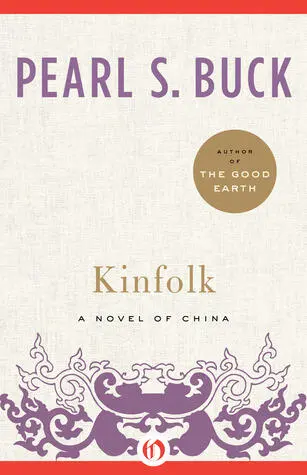
, a sharp dissection of the expatriate experience, Pearl S. Buck unfurls the story of a Chinese family living in New York. Dr. Liang is a comfortably well-off professor of Confucian philosophy, who spreads the notion of a pure and unchanging homeland. Under his influence, his four grown children decide to move to China, despite having spent their whole lives in America. As the siblings try in various ways to adjust to a new place and culture, they learn that the definition of home is far different from what they expected.
Kinfolk — читать онлайн бесплатно полную книгу (весь текст) целиком
Ниже представлен текст книги, разбитый по страницам. Система сохранения места последней прочитанной страницы, позволяет с удобством читать онлайн бесплатно книгу «Kinfolk», без необходимости каждый раз заново искать на чём Вы остановились. Поставьте закладку, и сможете в любой момент перейти на страницу, на которой закончили чтение.
Интервал:
Закладка:
“Now that she is come, I am frightened.”
“Silly,” she said softly. “She likes you already.”
“Then you have said too much about me.”
Mary gave him a little push. “Go on.”
“All by myself?”
“All by yourself,” she decreed.
She waved her hand and went on, and he turned aside into his own room to take a last look at his hair and he stared at his face in a small old metal mirror that hung on the wall above his table. An ugly fellow, he told himself!
He shrugged his shoulders then and went to find Mrs. Liang. In a large side room, she was surrounded by relatives, men and women, who sat down to give her company while she ate, for the family had already eaten. James was with her and he rose when he saw Chen.
“Ah, here he is,” he called. “Ma, this is Chen.”
Mrs. Liang rose, her hands hanging at her side, and she looked at Chen. The first look was doubtful, her eyes grew warm, and next she smiled.
“So this is you,” she said kindly. Then as though she were a foreigner she put out her hands and took his hand between both of them while the relatives stared. It was a good and warm clasp and Chen liked her then and there. If this was the woman that Mary would one day be, he was pleased.
“Eh, eh—” he said in Chinese. “You must sit down and eat your food while it is hot. I will sit down here.”
Properly and modestly he sat down at some distance away and she sat down again and the relatives began their chatter. In the midst of the hubbub she stole glances at him sitting there and half the time their eyes met, with increased content.
James saw his mother take her place in this Liang household as though she had never been away. Despite the years she had been gone her roots were not disturbed. She was correct in all her relationships, and never once did her tongue slip into the wrong title for sisters-in-law, elder and younger, and for their husbands and their children. They liked her. What had been sharp in her as a young girl was gone. What had been sharp even in her life in her own home, James saw was gone. She had become mellow and mild.
“Ma likes it here,” Mary said.
“It is her true home,” Chen replied.
Yet Mrs. Liang did not sink back into old ways. She approved Mary’s little school and she went about the village urging mothers to send their children to learn. In America, she told them, all people are compelled to go to school.
The villagers were aghast to hear of such tyranny. “Who then does the work?” they inquired. When she told them that learning to read did not spoil working men by turning them into scholars they could not believe her. They were used to their scholars who when they learned were too good for work.
One night she said a word of wisdom to Mary. “Now these ancestral people do not understand that a person can read and at the same time work. It is necessary that you continually show them it is possible.”
She herself washed her own garments and helped in the kitchens and in all ways surprised the Liang women who expected her to act as a learned and idle woman. The fame of this went out over the Liang lands, and women began to come and see Mrs. Liang and then to tell her of their troubles and even, because she too was a woman, of how Uncle Tao oppressed their families. But Mrs. Liang was shrewd. She knew that oppression was like a sword in the hands of two who struggle for its possession.
“Right is not always with the poor,” she answered James when he told her one day how much it troubled him that Uncle Tao had no thought for the people. “First you must ask why are people poor? Is it because they will not work or because they are thieves or because misfortune has overtaken them? Only when you know this can you know how they must be helped. With some the surest help is work or starvation.”
“Uncle Tao is too hard,” he said.
“He is hard,” she agreed, “but do not you be soft.”
To Mary she said, “Your brother James needs a good plain wife.”
“He does,” Mary agreed, “but where shall he find her?”
“I hope he is not looking at that little Rose nurse,” Mrs. Liang said. She did not approve of any woman working at a man’s side and she looked sidewise very often at Rose as she worked with James every day.
“James does not look at any woman since Lili married Charlie Ting,” Mary said.
“James is stupid,” Mrs. Liang exclaimed.
“Why not Rose, Ma?” Mary inquired.
Her mother raised her eyebrows, shrugged her plump shoulders, scratched her head with her gold hairpin, and cleaned her ears, all without answering. Then she said, “A bowl ought not to be too small for the hand that holds it,” and would say no more.
Meanwhile the wedding day drew near. For the sake of decency before the relatives Chen and Mary kept apart, and did not meet at all until the day itself came. It was natural that Mrs. Liang should put her whole mind on this wedding, but James felt his mother’s eyes often upon him. He knew her well. As soon as her mind was free she would have a plan concerning him.
On the night before the wedding he said to Mary, “As soon as you are married, Ma will be after me for something. I can feel it.”
“She wants you to marry,” Mary said.
He pretended to be terrified at this and begged Mary to prevent their mother. But in his heart he was amused, curious, and cautious.
The wedding day was a good one. The sun came up round and yellow, and there was neither cloud nor snow. Uncle Tao had been astonished when he heard that none of Chen’s family was to come, but when he knew their circumstances, how they were held in Communist country, he could only pity them, and for once he did well. He ordered a good feast to last the whole of one day and all the village was invited to it, and such tenants as cared to walk the distance from the land. The wedding was an old-fashioned one.
“It is easier to have it so than to explain why I do not have it so,” Mary had said.
So the marriage took place before the relatives, and Chen chose as proxy for his family a distant Liang cousin, and the papers were written, the wine drunk, the millet bowls exchanged, and so the ceremony was done. It was a bitter cold day, but the sun continued to shine and when men, women, and children were full of hot food it was good enough. There was no such thing as a honeymoon, for that was too foreign. Mary moved her boxes into Chen’s room, and James gave up his room for their sitting room and he went into another room near his eldest cousin. The next day Mary went as usual to her school and Chen to the clinic and neither gave a sign of inner happiness. Yet James knew it was there. His very flesh was sensitive to their secret joy. He would not have lessened their joy by an iota, and yet suddenly it increased his own loneliness.
This he bore quietly and when Chen had given greeting that morning after the wedding night, James began to speak of the enlargement of the clinic into the hospital. This he had planned for early spring. At the same time he planned to set up classes for itinerant first-aid centers. There were two bright boys in the village who wanted to learn medicine from him, one a cousin of Young Wang’s wife, for whom Young Wang had come to intercede, and the other the son of the village night watchman. When he perceived that Chen was answering “yes-yes” to all he proposed, and that his thoughts were not here, he stopped his talk, and it was at this moment that James felt his loneliness grow monstrous.
All through the day James and Chen worked side by side and Rose worked near them, tending the long line of the sick who now came from many parts of that region, some walking hundreds of miles, and the dying brought in litters or clinging to the back of some near relative. The old sorrow was that too often they came too late, having tried witchcraft and sorcerers first.
Читать дальшеИнтервал:
Закладка:
Похожие книги на «Kinfolk»
Представляем Вашему вниманию похожие книги на «Kinfolk» списком для выбора. Мы отобрали схожую по названию и смыслу литературу в надежде предоставить читателям больше вариантов отыскать новые, интересные, ещё непрочитанные произведения.



Обсуждение, отзывы о книге «Kinfolk» и просто собственные мнения читателей. Оставьте ваши комментарии, напишите, что Вы думаете о произведении, его смысле или главных героях. Укажите что конкретно понравилось, а что нет, и почему Вы так считаете.