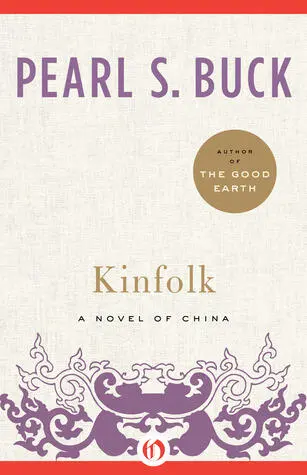
Pearl Buck - Kinfolk
Здесь есть возможность читать онлайн «Pearl Buck - Kinfolk» весь текст электронной книги совершенно бесплатно (целиком полную версию без сокращений). В некоторых случаях можно слушать аудио, скачать через торрент в формате fb2 и присутствует краткое содержание. Год выпуска: 2012, Издательство: Open Road Media, Жанр: Классическая проза, на английском языке. Описание произведения, (предисловие) а так же отзывы посетителей доступны на портале библиотеки ЛибКат.
- Название:Kinfolk
- Автор:
- Издательство:Open Road Media
- Жанр:
- Год:2012
- ISBN:нет данных
- Рейтинг книги:4 / 5. Голосов: 1
-
Избранное:Добавить в избранное
- Отзывы:
-
Ваша оценка:
Kinfolk: краткое содержание, описание и аннотация
Предлагаем к чтению аннотацию, описание, краткое содержание или предисловие (зависит от того, что написал сам автор книги «Kinfolk»). Если вы не нашли необходимую информацию о книге — напишите в комментариях, мы постараемся отыскать её.
, a sharp dissection of the expatriate experience, Pearl S. Buck unfurls the story of a Chinese family living in New York. Dr. Liang is a comfortably well-off professor of Confucian philosophy, who spreads the notion of a pure and unchanging homeland. Under his influence, his four grown children decide to move to China, despite having spent their whole lives in America. As the siblings try in various ways to adjust to a new place and culture, they learn that the definition of home is far different from what they expected.
Kinfolk — читать онлайн бесплатно полную книгу (весь текст) целиком
Ниже представлен текст книги, разбитый по страницам. Система сохранения места последней прочитанной страницы, позволяет с удобством читать онлайн бесплатно книгу «Kinfolk», без необходимости каждый раз заново искать на чём Вы остановились. Поставьте закладку, и сможете в любой момент перейти на страницу, на которой закончили чтение.
Интервал:
Закладка:
Moreover, James was impatient because he had not yet had a chance to perform an operation. The people were frightened when he spoke of anything more than lancing a boil, and even a wen he could not remove, and Uncle Tao’s stubbornness encouraged their fear. James had to restrain himself one day when a soldier came in with a gun wound in the arm, but when the man died with gangrene he could not but speak. “He would have lived, even though without an arm,” he told the man’s wailing mother. “Yet you would not let me save his life.” The mother did not like him better for such truth and when she went home she told her neighbors how she had saved her son at least to live a little longer because she would not let the new doctor cut off his arm.
James was angry with the fearfulness of the people and their ignorance, but he would not let himself hate them for these things. He would not let himself even talk about them, and he kept inside himself his discontents and his impatience. But he felt more and more that he would make no true headway unless he found some sort of bridge which would carry him into that place, whatever and wherever it was, in which the people lived. His feet were upon the physical soil of his ancestors, but his mind was not, nor could it be, and his soul was not their soul, and they knew it.
Nor could he go back. He began to understand better now Su and Peng and their kind. They too had reached this place of knowing their difference. There they had stopped. They had accepted their isolation and this he was not willing to do. There must be some way of reaching his people. He was no longer content with the little clinic, enlarged by two rooms for patients who could not go home the same day. He would not be content even with a hospital. As the months went on he saw that nothing short of deep reforms would mend ignorance and ill health and bad government.
Yes, bad government! What had not been apparent to him when he first came was that Uncle Tao was in some way connected with the country police, who were in turn connected with the local magistrate and this connection put the people in the village at the mercy of the magistrate and of Uncle Tao. The magistrate came from elsewhere and having no blood ties in the village he oppressed the people very much. No one could get justice at his court and bribes must be given at the very gate, if one were to be heard at all. No matter what evil befell a villager, he considered it a greater one to go to court to get it righted. Taxes were high, except for Uncle Tao, and those who were poorest paid the most.
There were hours in the night when James, lying restless upon his bed, hated his very name. Because he was a Liang, he told himself, the people would never trust him. Yet how could he help what he was born? He promised himself fiercely that he would find a way, though he were a Liang, to break through to his own folk. Then sometimes even his determination failed and he remembered the beautiful clean hospital in New York where he might have become a great surgeon, and he thought of his father’s fine home, and he thought of what might have been his own fortune had he stayed there and married Lili and what it would have been to have escaped the dust and filth and cold and heat of this village, and all the stupidities of his people. And yet he knew he could never have escaped. In spite of anything his heart was here. Somehow he would find a bridge to cross that short span, that fathomless abyss, between his eyes and the eyes of the man who would look at him in his clinic tomorrow morning.
In such mood James received from his father the cable saying that his mother was coming to China by air. The cable reached the city promptly enough but from there it had to be taken on foot by messenger to the village. This left James and Mary only the shortest possible time to meet their mother at the airport. As usual, Uncle Tao had first to be informed of the news.
The first difficulty, however, was that no one had yet told Uncle Tao even of the betrothal. As soon as it was known it would be impossible for Mary and Chen to meet face to face again without offending the proprieties in this ancestral village, and both Chen and Mary had been slow to give up the joy of seeing one another. Now all agreed the time had come. The mother was arriving for the wedding, which must take place soon, and James must therefore tell Uncle Tao everything immediately. He went to the elder one evening after the day’s work was done.
Now James knew more surely with every passing day that at some time or other he must come face to face with Uncle Tao on very grievous matters having to do with the life of the people. It was no use, for example, to save from death a man who when he returned to his home would fall ill again from lack of proper food. Nor could James urge him to eat more and better food when taxes were so high that there was no money left with which to buy food. The people hid eggs as they might hide gold, for in these days of worthless money eggs were good tender even to the tax gatherer. Wheat was precious, too, and the tax gatherer or the local military lord took all except the seed wheat. The magistrate kept silent before these for he also must have his share. In the midst of soldier, magistrate, and idle scholar, none of whom produced food or clothing or shelter or tools for themselves, the man on the land who raised food and the artisan who made clothes and shelter and tools were slowly being squeezed out of life. Soldier, magistrate, and scholar clung together against peasant and artisan while they fought among themselves for the petty booty. James began to see that merely to heal the body was doubtful good. Often the man on the land came to him exhausted before he was old, with too little will to live. Something was wrong here in the ancestral village and James had determined one day soon to grapple with Uncle Tao, who allowed all to continue as it was.
But today was not the time, he knew, not only because he must think first of Mary and Chen and of his mother, but above all he had not found his own place here. He was not yet indispensable to his people. If he made trouble Uncle Tao would cast him out and the people would be silent. Before he tried to set up even one of the reforms of which he dreamed, he must have such strength in the ancestral village that Uncle Tao would not dare to cast him out. Ruthless as Uncle Tao seemed to be, yet even he in his secret heart feared the people in anger. For these people on the land and in small shops and crafts could be patient for a generation or two and then one day for some small cause their patience broke and they took up hoes and rakes and knives and mallets and went out to kill their oppressors. Men and women and children they killed. There were times when James felt the hour of the people’s anger was near at hand again, especially as the bitter winter drew on and as the bandits began once more to come out of their nests in the distant hills to the northeast.
Yet today was still not the day to speak of such things. James went to find Uncle Tao, and he found him in his bed, where he always went as soon as he had eaten his last meal for the day. Three times each day Uncle Tao ate heartily, although in the winter when the work on the land ceased he allowed to others no more than two meals. He excused himself by saying that those like himself who must take care of others are valuable and should be kept alive.
When James came into the room the youngest son of Uncle Tao was hearing his last commands and all but going away for the night. The older grandsons took turns each night sleeping on a pallet bed in Uncle Tao’s room, but tonight Uncle Tao bade the lad wait outside until he was called. Then he told James to shut the door and draw up a stool near the bed.
This unusual kindness from Uncle Tao made James wonder what was wrong here. In a moment he knew. When they were alone Uncle Tao put off the bedclothes, pulled up his night jacket, and pointed to his belly. “Feel my knot,” he told James.
Читать дальшеИнтервал:
Закладка:
Похожие книги на «Kinfolk»
Представляем Вашему вниманию похожие книги на «Kinfolk» списком для выбора. Мы отобрали схожую по названию и смыслу литературу в надежде предоставить читателям больше вариантов отыскать новые, интересные, ещё непрочитанные произведения.



Обсуждение, отзывы о книге «Kinfolk» и просто собственные мнения читателей. Оставьте ваши комментарии, напишите, что Вы думаете о произведении, его смысле или главных героях. Укажите что конкретно понравилось, а что нет, и почему Вы так считаете.